

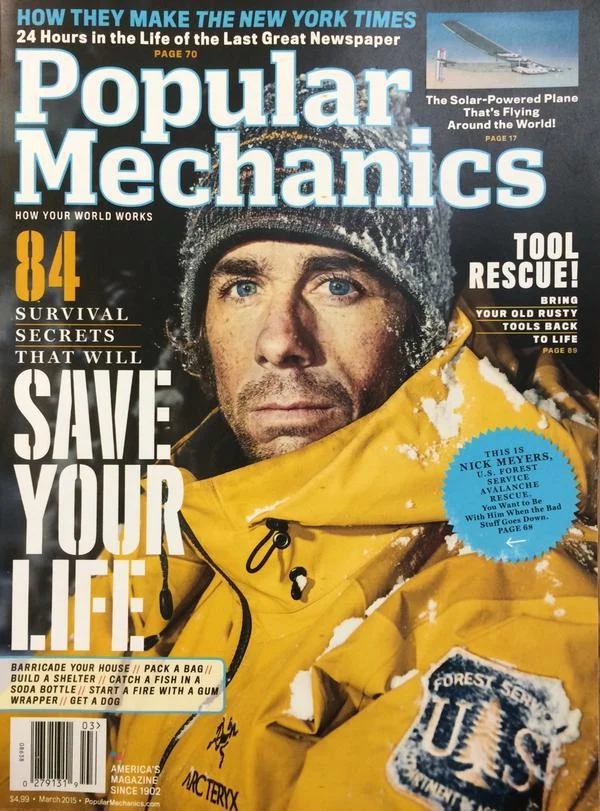
In a significant recognition of professional expertise and mountain safety leadership, Nick Meyers, the Director of the Mount Shasta Avalanche Center (MSAC) and the Lead Climbing Ranger for the Shasta-Trinity National Forest, has been featured on the cover of Popular Mechanics magazine. The feature highlights Meyers’ extensive experience in high-altitude rescue operations and his role as a primary authority on avalanche safety in one of the most prominent alpine environments in the United States. This national exposure brings critical attention to the specialized skills required for mountain management and the essential gear necessary for survival in extreme backcountry conditions.
The feature article, titled "10 Survival Essentials an Avalanche Rescue Expert Always Carries," serves as a comprehensive guide for both amateur enthusiasts and professional mountaineers. By highlighting Meyers, a veteran of the United States Forest Service (USFS), the publication bridges the gap between technical engineering and the practical application of survival technology. Meyers’ inclusion on the cover underscores the growing national interest in backcountry safety as outdoor recreation in high-consequence environments continues to see a surge in participation across North America.
The Professional Profile of Nick Meyers and the Mount Shasta Avalanche Center
Nick Meyers has served as a cornerstone of the Mount Shasta community and the broader mountaineering world for over a decade. As the Lead Climbing Ranger, his responsibilities encompass a wide range of duties, including search and rescue (SAR) coordination, public education, and resource protection on the 14,179-foot stratovolcano. His dual role as the Director of the Mount Shasta Avalanche Center involves the daily synthesis of meteorological data, snowpack analysis, and the issuance of avalanche forecasts that are vital for the safety of thousands of climbers and skiers who visit the mountain annually.
The Mount Shasta Avalanche Center operates as a partnership between the Shasta-Trinity National Forest and the Friends of the Mount Shasta Avalanche Center (FMSAC), a 501(c)(3) non-profit organization. This public-private partnership is essential for funding the staff and equipment necessary to provide high-quality safety information. Meyers’ leadership has been instrumental in modernizing the center’s outreach, ensuring that real-time data is accessible to the public through digital platforms and community workshops.
Geographic and Climatic Context of Mount Shasta
Mount Shasta, located at the southern end of the Cascade Range in Northern California, presents unique challenges for avalanche forecasting and mountain rescue. Unlike many other peaks in the Cascades, Shasta stands as a solitary mass, rising nearly 10,000 feet above the surrounding terrain. This isolation subjects the mountain to high winds and rapid weather shifts, which significantly impact snow stability.
The mountain features several distinct climbing routes, with Avalanche Gulch being the most popular. Despite its name, the route is a primary corridor for climbers, making accurate avalanche forecasting a matter of life and death. The terrain includes massive glaciers, such as the Whitney and Hotlum glaciers, and steep volcanic chutes that are prone to both winter powder avalanches and spring wet-slide events. Meyers’ work requires an intimate understanding of these geological and climatic nuances to predict when "high-consequence" events are likely to occur.
Chronology of Avalanche Safety and Professionalization
The professionalization of avalanche forecasting in the United States has evolved significantly over the last several decades, and Meyers’ career reflects this trajectory.
- Early Development (Pre-1990s): Avalanche safety on Mount Shasta was largely informal, handled by generalist rangers and local enthusiasts.
- Establishment of the MSAC (1998): The Mount Shasta Avalanche Center was officially founded to address the increasing number of winter recreationalists.
- Meyers’ Integration (Mid-2000s): Nick Meyers joined the USFS as a climbing ranger, eventually rising to lead the program. His tenure saw the transition from paper-based reporting to digital forecasting.
- National Recognition (2015): The feature in Popular Mechanics represents a milestone in the mainstreaming of avalanche safety culture, positioning Forest Service rangers as technical experts on a par with aerospace engineers and industrial designers.
- Modern Era: Today, the MSAC utilizes remote weather stations, satellite data, and community-sourced observations to provide a granular look at mountain conditions.
Supporting Data on Mountain Safety and Avalanche Risk
The significance of Meyers’ work is underscored by national statistics regarding backcountry accidents. According to data from the Colorado Avalanche Information Center (CAIC), which tracks national fatalities, the United States averages approximately 27 avalanche-related deaths per year. While Mount Shasta has a strong safety record compared to other high-traffic areas like the Wasatch or the Tetons, the potential for catastrophic events remains high due to the sheer volume of visitors.
In peak season, Mount Shasta can see upwards of several hundred climbers attempting the summit in a single weekend. The "human factor"—the psychological tendency for groups to ignore safety warnings in favor of reaching a goal—is a primary focus of Meyers’ educational efforts. Data suggests that over 90% of avalanche victims are caught in slides triggered by themselves or someone in their party. This statistic reinforces the importance of the survival gear and expert knowledge promoted in the Popular Mechanics cover story.
Technical Analysis of the Survival Essentials
The Popular Mechanics feature focuses heavily on the "Ten Essentials" adapted for avalanche terrain. Meyers emphasizes that technology is a supplement to, not a replacement for, expert judgment. The core components of his kit include:
Avalanche Transceivers (Beacons)
Modern transceivers utilize three-antenna technology to provide a directional signal during a search. Meyers advocates for regular practice with these devices, as their effectiveness is entirely dependent on the user’s speed and accuracy under stress.
Probes and Shovels
While the beacon locates the victim, the probe and shovel are the tools of recovery. Technical data from rescue simulations shows that shoveling takes up the vast majority of rescue time. Meyers highlights the need for professional-grade, collapsible aluminum shovels that can move large volumes of dense, "concrete-like" avalanche debris.
Communication and Navigation
In the remote alpine environment of Mount Shasta, cellular service is non-existent on much of the mountain. Meyers utilizes high-output VHF radios and satellite messaging devices (such as the Garmin inReach) to maintain contact with dispatch and other rescue personnel.
Personal Protective Equipment (PPE)
The use of avalanche airbags has become a standard recommendation in the industry. These systems use a large balloon to increase the victim’s volume, helping them stay toward the surface of a moving slide through the process of granular convection.
Official Responses and Institutional Impact
While the US Forest Service typically maintains a low-profile, "quiet professional" stance, the recognition of one of their own in a major national publication has been met with internal praise. Representatives from the Shasta-Trinity National Forest have noted that Meyers’ appearance in Popular Mechanics serves as an excellent recruitment and public relations tool for the agency. It highlights the USFS’s role not just as land managers, but as elite first responders and technical experts.
The Friends of the Mount Shasta Avalanche Center also released statements emphasizing that such national coverage helps in their fundraising efforts. As a non-profit that covers a significant portion of the center’s operating budget, the visibility provided by the magazine helps demonstrate the value of the MSAC to donors and the local community.
Broader Implications for Backcountry Recreation
The feature of Nick Meyers is indicative of a broader shift in how the public views outdoor "experts." In an era of social media influencers, Meyers represents a "subject matter expert" whose authority is derived from thousands of hours on the mountain and dozens of successful rescue operations. This transition back toward valuing institutional knowledge and professional experience is vital for the safety of the growing backcountry community.
Furthermore, the focus on "gear" in Popular Mechanics appeals to a demographic that may not traditionally seek out avalanche safety courses. By framing survival as a matter of technical proficiency and proper equipment, the article reaches a wider audience, potentially saving lives by encouraging the adoption of safety standards among casual hikers and tech-oriented hobbyists.
Conclusion
The selection of Nick Meyers for the cover of Popular Mechanics is a testament to his dedication to the field of mountain safety and the high regard in which the Mount Shasta Avalanche Center is held. As the Lead Climbing Ranger on one of America’s most iconic peaks, Meyers continues to set the standard for avalanche forecasting and rescue operations. His work ensures that the thousands of individuals who seek the challenge of Mount Shasta can do so with the benefit of world-class expertise and data-driven safety information. This national recognition not only honors Meyers’ individual career but also elevates the critical importance of the United States Forest Service’s mission in the modern era of outdoor recreation.
