

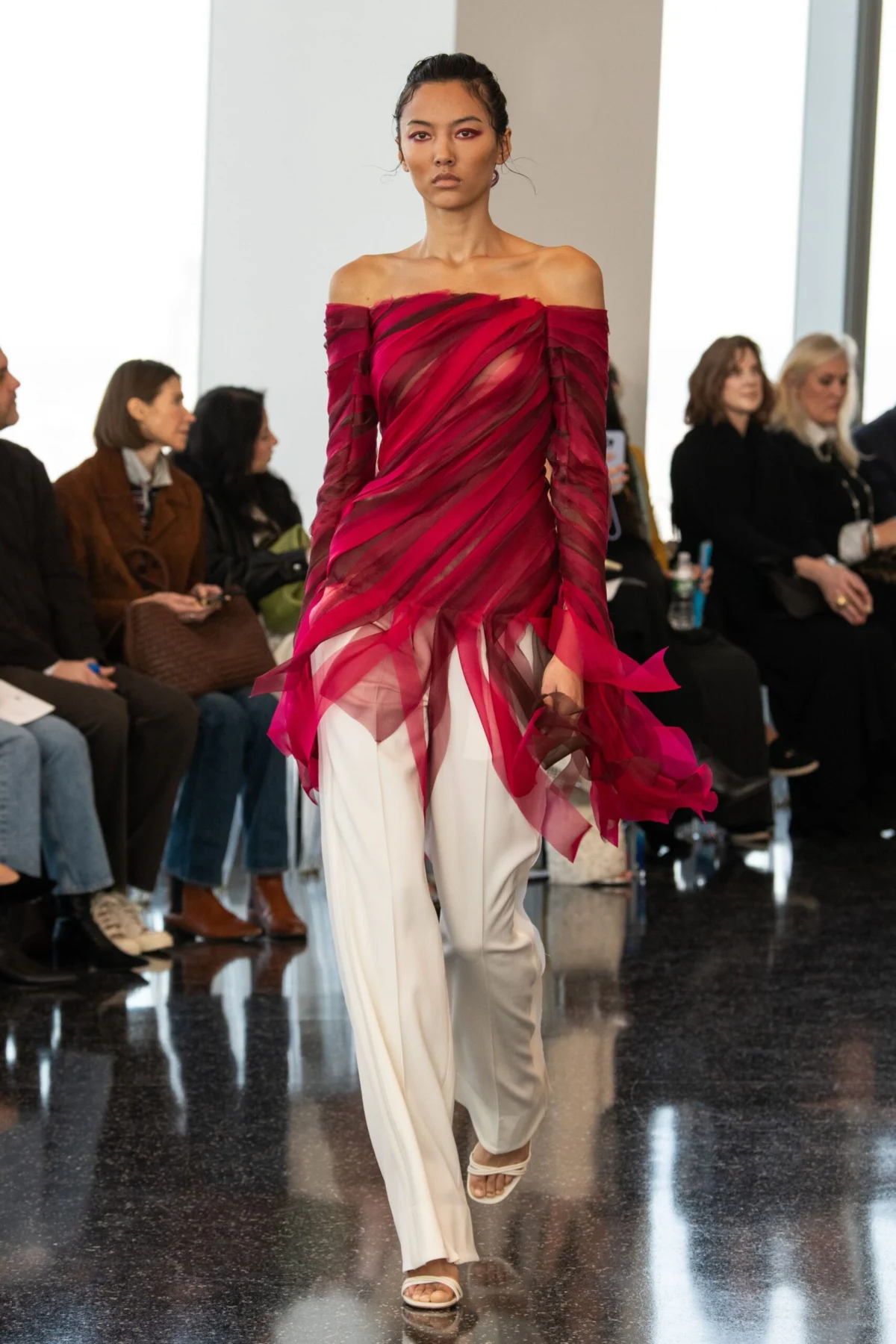
The sky-high panorama of New York City served as a breathtaking backdrop for J. Mendel’s latest collection, presented yesterday on the 102nd floor of One World Trade Center. This marked the first review of the brand by Vogue Runway since 2022 and, more significantly, the debut collection from resident creative director Jonathan Cohen. The opulent setting, while undeniably grand, cast a long shadow, raising questions about the brand’s ability to transcend its established, almost time-honored, identity. The sheer magnitude of the venue presented a formidable challenge for any designer to match, and in this instance, it served to highlight the somewhat confined scope of a brand that appears to be navigating a delicate balance between its storied past and the demands of contemporary fashion.
A Legacy Forged in Fur, Evolving with the Times
The history of J. Mendel is a testament to adaptation and enduring craftsmanship. Founded in 1870 in St. Petersburg, the house initially established its reputation as a purveyor of fine furs. This legacy continued in Paris until 1981, when Gilles Mendel inaugurated a New York City branch. It is important to note that Gilles Mendel has not been formally associated with the brand since 2018, a detail that underscores the brand’s evolution under new creative leadership. As societal attitudes and market demands shifted, leading to a decline in the popularity of fur, J. Mendel demonstrated a remarkable capacity for reinvention. This pivot culminated in the official introduction of its ready-to-wear line in 2002.
This era, characterized by the prominence of socialites such as Tinsley, Byrdie, and Muffie, and events like the Frick Young Fellows Ball, saw J. Mendel’s creations become synonymous with a particular brand of sophisticated romance. Feathered and embroidered dresses, often paired with elegant tippets, were the hallmarks of this period, adorning the wardrobes of a discerning clientele who sought to express a refined glamour. The brand’s enduring appeal was further cemented when Natalie Portman graced the January 2011 cover of Vogue in a delicate, palest pink, hand-pleated silk chiffon gown from the label. Recalling this iconic piece, Cohen himself commented, "I just always remember that dress being so beautiful and I loved how easy it looked." This sentiment, a nod to effortless elegance, appears to have influenced Cohen’s own aesthetic, as evidenced by look 15, a daringly short and skin-baring pink ensemble, which he playfully attributed to an inspiration drawn from Britney Spears.
Jonathan Cohen’s Vision: Bridging Evening Elegance and Daywear Practicality
Cohen’s mandate at J. Mendel is to ingeniously transpose the brand’s inherent evening wear expertise into more accessible daywear. The opening look of the collection exemplified this objective: sleek trousers paired with a flowing top crafted from bias-cut chiffon strips in a spectrum of red hues. This design, inspired by the intricate couture-level finishing found within the atelier, offered a versatile silhouette suitable for sophisticated luncheons or chic cocktail gatherings.
The collection also featured separates with fur paneling, which, while referencing the brand’s heritage, unfortunately felt somewhat heavy and perhaps less aligned with the modern desire for lightness. In contrast, the more successful pieces were those that embraced fluidity and print, particularly in pleated chiffon. One item that particularly excited Cohen was a leather jacket, distinguished by its charmingly puckered pockets. This piece represented an innovative application of furrier’s techniques, manufactured using a fur machine. This specialized process allowed for fused seams, thereby eliminating seam allowances and resulting in an exceptionally lightweight garment.
Navigating the Tightrope: Heritage, Artisanship, and Modern Relevance
This application of the furrier’s meticulous craftsmanship to alternative materials presents an intriguing and forward-thinking avenue for J. Mendel. However, the collection, as a whole, grappled with certain challenges. The overly fitted silhouettes in some of the looks, while perhaps intended to be figure-hugging, detracted from the overall fluidity and ease that the brand has historically strived for. More broadly, the collection seemed weighed down by a palpable sense of the past, struggling to fully break free from its established iconography.
Cohen’s access to a highly skilled atelier is an undeniable asset, offering a unique platform for exquisite craftsmanship. To imbue J. Mendel with greater contemporary relevance, and to ground the brand’s more aspirational "champagne wishes and caviar dreams" identity in tangible, everyday wearability, a strategic recalibration might be in order. This could involve directing that artisanal expertise towards capturing the raw, concrete energy that defines New York City. Imagine the brand’s luxurious fabrics and impeccable construction applied to designs that reflect the dynamism, the grit, and the unapologetic spirit of urban life. This approach could allow J. Mendel to evolve from a label associated with a specific era of glamour to one that embodies a more inclusive and relevant modern sophistication.
The Broader Context of Fashion Week and Brand Evolution
The presentation of J. Mendel’s collection occurs within the bustling ecosystem of New York Fashion Week, a bi-annual event that draws global attention from media, buyers, and fashion enthusiasts. This season, like many before it, is a crucible for designers to showcase their vision and for brands to define their future trajectory. For heritage houses, the challenge is often to honor their legacy without becoming beholden to it. The industry, driven by rapid trends and a constant demand for novelty, requires brands to be both timeless and timely.
J. Mendel’s journey from its fur origins to its current iteration reflects broader shifts in the fashion landscape. The decline in fur, the rise of ethical consumerism, and the increasing demand for sustainable and versatile clothing have all shaped how brands must operate. The emphasis on ready-to-wear, and now the push towards daywear from evening wear, signifies a strategic effort to broaden the brand’s appeal and market share.
Data Points and Industry Trends
The global luxury goods market, which includes high-end apparel, continues to demonstrate resilience and growth, albeit with evolving consumer preferences. According to reports from consulting firms like Bain & Company, while personal luxury goods sales saw a significant rebound post-pandemic, there is a growing emphasis on experiences, sustainability, and brands that can authentically connect with consumers on a deeper level. For a brand like J. Mendel, this translates to a need to not only produce exquisite garments but also to articulate a compelling narrative that resonates with today’s discerning shopper.
The data suggests that consumers are increasingly seeking brands that align with their values. This includes transparency in sourcing, ethical production practices, and a commitment to environmental sustainability. While J. Mendel’s heritage in craftsmanship is a strong foundation, integrating these modern considerations into its brand identity could be crucial for long-term success.
Potential Industry Reactions and Implications
The fashion industry is a closely watched arena, and the debut of a new creative director at a storied house like J. Mendel inevitably sparks discussion and analysis. Industry insiders and critics will be evaluating Cohen’s ability to inject new life into the brand while respecting its historical significance. The success of his vision will likely be measured not only by critical reception but also by commercial performance, including sales figures and market penetration.
The implications of this collection extend beyond J. Mendel itself. It serves as a case study for other heritage brands facing similar challenges of modernization. The question of how to balance tradition with innovation is a perennial one in fashion. Cohen’s approach, particularly his innovative use of furrier techniques on non-fur materials, offers a glimpse into potential pathways for other brands seeking to leverage their artisanal heritage in novel ways.
Furthermore, the choice of venue at One World Trade Center is not merely symbolic; it represents a deliberate positioning of the brand within a narrative of resilience and rebirth. The building itself is a powerful emblem of New York City’s indomitable spirit, and by choosing it as a backdrop, J. Mendel signals an intention to be part of that ongoing narrative of progress and reinvention.
The coming seasons will reveal the true impact of Jonathan Cohen’s direction at J. Mendel. Whether the brand can successfully bridge its opulent past with a dynamic and relevant future remains to be seen, but the initial steps taken at this elevated New York landmark have certainly set the stage for a compelling evolution. The ultimate test will be in how the brand’s exquisite craftsmanship and refined aesthetic can be translated into designs that capture the imagination and meet the demands of the contemporary fashion landscape.
