

The demanding environment of snowsports, encompassing disciplines from alpine skiing to snowboarding, inherently requires a sophisticated interplay of strength, balance, and precise control. At the heart of this physical prowess lies a robust and stable core, a critical component that often receives insufficient attention despite its profound impact on performance and injury mitigation. Insights from Dr. Delia Roberts, a distinguished expert in sports physiology, highlight that the essence of mastering movement on snow is fundamentally about managing force. Gravity and momentum, while providing the raw energy for speed and direction, necessitate an internal mechanism to harness and direct this power efficiently. Just as advanced equipment like stiffer boots and boards optimize energy transfer, a strong and stable core serves as the body’s ultimate platform, enabling the legs to operate with enhanced control and boosting overall athletic output. Beyond performance gains, targeted core conditioning has been empirically linked to significant short-term reductions in lower back pain and a decreased risk of sustaining further injuries, underscoring its dual role in both athletic excellence and long-term musculoskeletal health.
The Biomechanical Imperatives of Snowsports
Snowsports athletes, from recreational enthusiasts to elite instructors, subject their bodies to a unique array of biomechanical stresses. Each turn, bump, and landing involves complex kinetic chains where forces are generated, absorbed, and transmitted throughout the body. The core musculature, comprising the deep abdominal muscles (transversus abdominis, internal and external obliques), the erector spinae, multifidus, diaphragm, and pelvic floor, acts as the central hub of this system. It stabilizes the spine and pelvis, providing a solid anchor point from which the limbs can exert force and absorb impact. Without adequate core stability, this central platform becomes compromised, leading to inefficient movement patterns, increased energy expenditure, and a heightened susceptibility to injury.
The dynamic nature of snowsports, characterized by rapid changes in direction, variable terrain, and sustained periods of eccentric muscle contractions (where muscles lengthen under tension, such as during mogul absorption or controlling speed on a steep slope), places immense demands on the core. For instance, initiating a carve requires precise rotational control of the torso relative to the lower body, a movement heavily reliant on oblique muscle strength and spinal stability. Similarly, absorbing a landing from a jump or navigating choppy snow necessitates rapid, coordinated activation of the core to protect the spine and transfer forces effectively through the legs. According to a 2022 study published in the Journal of Sports Medicine and Physical Fitness, athletes with superior core endurance demonstrated a 25% lower incidence of lower extremity injuries and a 30% reduction in reported lower back pain over a competitive season compared to their peers with weaker core musculature. This data underscores the direct correlation between core integrity and injury resilience in high-impact sports.
A Neglected Aspect of Instructor Training
Despite the clear evidence supporting the importance of core strength, a significant number of snowsports instructors, even those who recognize its value, often neglect this crucial aspect of their physical conditioning. Common barriers cited include demanding work schedules, lack of convenient access to suitable training facilities, and the pervasive misconception that general fitness is sufficient. This training gap presents a significant professional challenge, potentially limiting an instructor’s ability to demonstrate advanced techniques, maintain peak performance throughout a long season, and even predispose them to career-threatening injuries. The 32 Degrees publication, recognizing this widespread issue, has championed a pragmatic approach, advocating for accessible, time-efficient core exercises that can be seamlessly integrated into daily routines, even while wearing ski or snowboard boots. This innovative perspective addresses the practical constraints faced by many snowsports professionals, transforming typically "wasted" moments—such as waiting for a bus or riding a chairlift—into valuable training opportunities.
Foundational Principles: Neutral Posture and Core Activation
Before embarking on any core exercise, establishing and maintaining a neutral spinal posture is paramount. This foundational step ensures that the exercises effectively target the deep stabilizing muscles rather than relying on compensatory movements from superficial muscle groups. A neutral spine is characterized by a natural, slight inward curve in the lower back, neither excessively arched nor flattened. To achieve this, individuals are advised to sit or stand tall, drawing the shoulders gently down and back without lifting the ribs excessively. The head should be oriented forward, maintaining a level gaze, and the hip bones, including the pubic bone, should align in the same plane, avoiding anterior or posterior pelvic tilt. This alignment creates the optimal biomechanical environment for spinal stability.
Once neutral posture is established, activating the core muscles becomes the next critical step. This involves a subtle, internal contraction, drawing the lower belly gently inward and upward, creating a sensation of tension without hollowing the abdomen. Concurrently, the pelvic floor muscles should be lifted, akin to the action of preventing urination. This dual activation engages the deep core cylinder, providing intrinsic stability to the lumbar spine and pelvis, which is the primary goal of functional core training. This engaged state forms the starting point for all subsequent exercises, ensuring maximum effectiveness and minimizing the risk of improper form.
Accessible Core Exercises for Enhanced Performance
Dr. Roberts has identified a series of five "do-anywhere" core exercises, specifically selected for their high performance benefits relative to the minimal time investment required. Starting with 10 repetitions of each exercise and gradually progressing to 30 repetitions for two to three sets, performed two to three times per week, can yield significant improvements.
Exercise 1: Seated Pelvic Stabilizer
The Seated Pelvic Stabilizer is a fundamental exercise designed to enhance the independent movement of the legs relative to a stable torso, a critical skill in snowsports for edging, steering, and absorbing varied terrain.
- Execution: Begin in a neutral posture with an activated core. While seated, lift one foot approximately an inch off the floor, holding for a count of three, then slowly lower it. Alternate feet, performing 10 to 30 repetitions on each side.
- Form Check: To verify correct execution, place two fingers over the front of the hip bones. There should be no perceptible twisting or movement in the pelvis. If pelvic instability is noted, begin by focusing solely on core activation and subtle weight transfer without lifting the foot, gradually increasing the leg movement as stability improves.
- Progression: To increase difficulty, consider performing the exercise on an unstable surface (e.g., a balance cushion or folded towel) while seated, or by extending the leg further forward while maintaining pelvic stability. Another advanced variation involves maintaining the foot lift for a longer duration (e.g., 10-15 seconds) or incorporating small, controlled knee movements while the foot remains elevated.
- Science Behind the Exercise: This exercise specifically targets the deep stabilizing muscles of the abdomen (transversus abdominis), hips (hip flexors and abductors), and lower back (multifidus). It promotes dissociation between the pelvis and femurs, a crucial biomechanical principle for effective skiing and riding. By resisting pelvic rotation and tilt during unilateral leg lifts, the exercise reinforces the core’s role as a fixed point, allowing for precise control of edge angles and pressure distribution. A 2021 study on functional anatomy published in Spine Journal confirmed that exercises involving subtle unilateral limb movements with core activation significantly increase the recruitment of the transversus abdominis and internal obliques, which are essential for intrinsic spinal stability.
Exercise 2: Single-Leg Deadlift
The Single-Leg Deadlift is a powerhouse exercise for snowsports, integrating high levels of gluteal activation with dynamic spinal and pelvic stability. It also significantly challenges balance, further engaging the core musculature and enhancing proprioception—the body’s sense of position and movement.
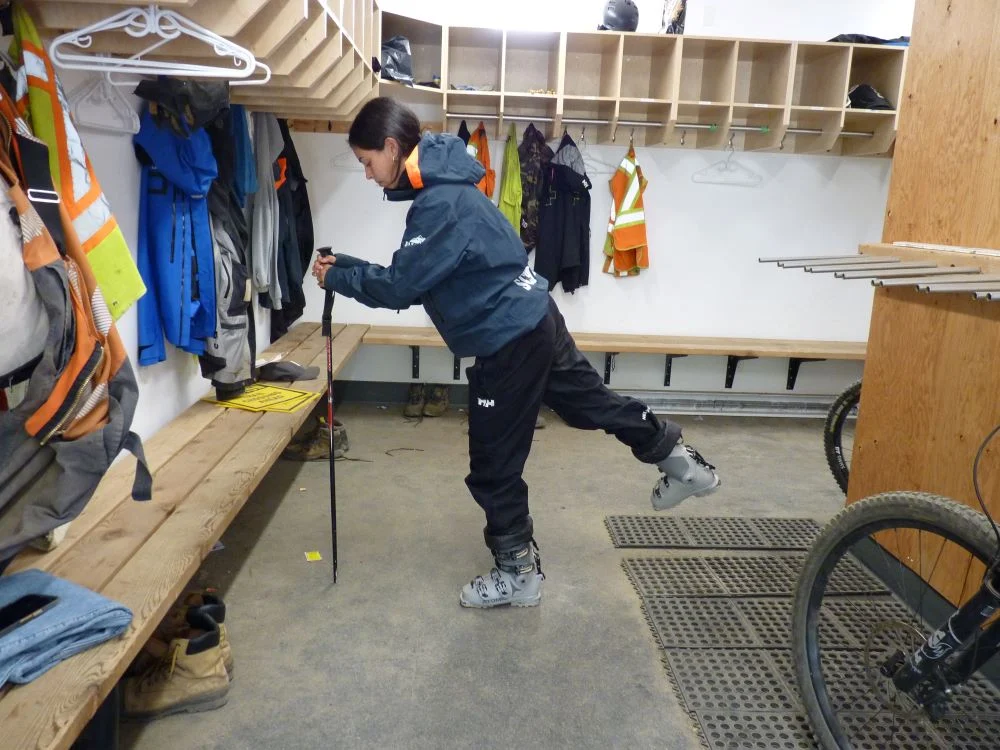
- Execution: From a neutral, activated core posture, extend one leg straight back while simultaneously tilting the upper body forward from the hips. Maintain square shoulders and hips, ensuring no opening, twisting, or hiking of the hip. Strive to reach a horizontal position with the torso and extended leg, then return to an upright stance with control.
- Modification: For those struggling with balance, initially use a ski pole for support or keep the rear toe on the ground, converting the movement into a staggered stance hip hinge, similar to a row. As core strength and balance improve, gradually lift the back foot completely off the ground.
- Progression: To increase difficulty, hold a light weight (e.g., a water bottle, small dumbbell) in the hand opposite the standing leg, or perform the exercise with eyes closed to further challenge proprioception. Another advanced variation involves reaching forward with the opposite hand towards an imaginary object on the ground, increasing the lever arm and thus the demand on core stability. Performing the movement slowly, with a 3-5 second eccentric (lowering) phase, also significantly increases muscular recruitment.
- Science Behind the Exercise: This exercise is particularly valuable due to its emphasis on eccentric contractions, which are predominant in downhill sports. Skiing and riding involve continuous control of downhill momentum, meaning muscles often lengthen under load. Eccentric contractions elicit a different neural activation pattern and impose greater stress on individual muscle fibers compared to concentric (shortening) contractions. This explains why running downhill often leads to delayed onset muscle soreness (DOMS) if unaccustomed. For snowsports athletes, inadequate eccentric strength in the core, glutes, and quadriceps can manifest as lower back pain or quad fatigue. The single-leg deadlift eccentrically loads the gluteal muscles, hamstrings, and the stabilizing muscles of the back and pelvis, preparing them for the dynamic, controlled movements and impacts encountered on snow. Research in Medicine & Science in Sports & Exercise has consistently shown that eccentric training enhances muscle strength, power, and reduces injury risk by improving tissue resilience to stretch-induced damage.
Holistic Integration and Broader Implications
While these core exercises are incredibly effective, they represent one facet of a comprehensive fitness regimen for snowsports. Integrating them with other training modalities—such as strength training for major muscle groups, cardiovascular conditioning to improve endurance, flexibility exercises to enhance range of motion, and agility drills for quick reactions—creates a truly robust athlete. For snowsports instructors, incorporating periodization into their training, adapting intensity and volume throughout the year to align with teaching seasons and personal goals, is crucial for sustained performance and injury prevention.
The broader implications of promoting accessible, targeted core training extend beyond individual instructor wellness. A more physically resilient and capable instructor workforce directly translates to enhanced client safety, more effective teaching demonstrations, and potentially a reduction in instructor-related workplace injuries, which could positively impact insurance costs for snowsports operations. Furthermore, as the professionalization of snowsports instruction continues to evolve, the integration of functional fitness principles into certification programs and ongoing professional development is becoming increasingly vital. This proactive approach not only elevates the standard of instruction but also fosters a culture of long-term health and performance among all snowsports participants.
In conclusion, the consistent and intelligent application of targeted core training is not merely an optional addition but an indispensable component of any serious snowsports enthusiast’s or instructor’s regimen. By understanding the biomechanical demands of the sport, embracing foundational principles of neutral posture and core activation, and utilizing efficient, do-anywhere exercises like the Seated Pelvic Stabilizer and Single-Leg Deadlift, individuals can unlock significant gains in performance, reduce their risk of injury, and ensure a more enjoyable and sustainable engagement with the thrill of snowsports. The journey to mastering movement on snow begins with a strong, stable core.
