

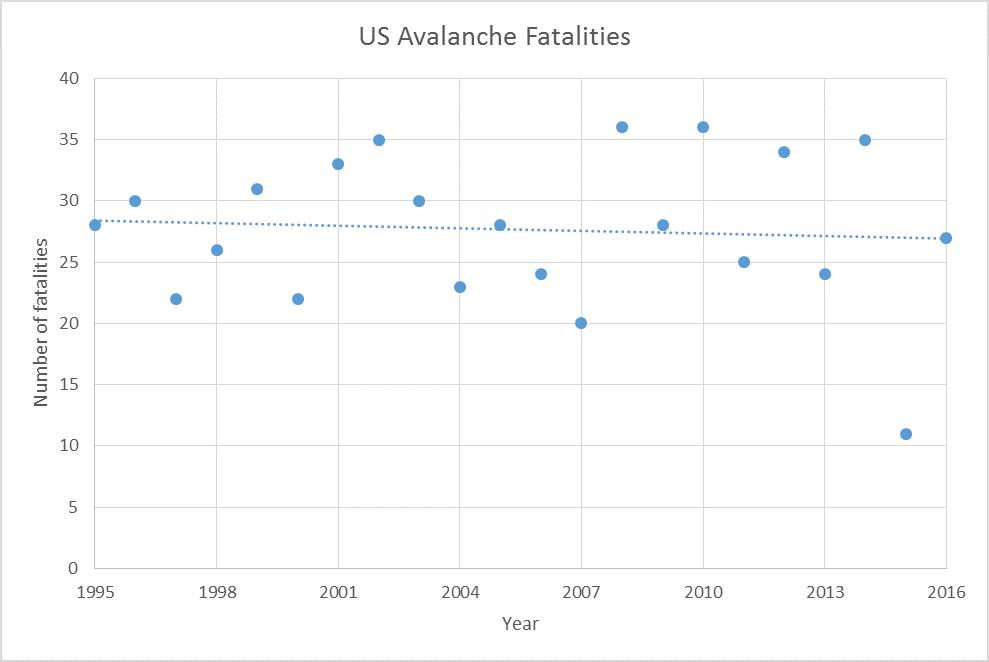
The landscape of American winter recreation has undergone a seismic shift over the last three decades, transitioning from a niche pursuit for a dedicated few into a mainstream industry involving millions of participants. Despite this exponential increase in the number of people venturing into the backcountry, a comprehensive analysis of historical data reveals a surprising and counter-intuitive trend: annual avalanche fatalities in the United States have remained statistically flat for more than twenty years. This plateau in mortality rates, occurring alongside a literal explosion in backcountry usage, suggests a significant and successful evolution in public safety, education, and technological intervention.
To understand the magnitude of this achievement, one must look back to the winter of 1994/95, a pivotal era in the history of North American avalanche safety. During that season, the infrastructure for avalanche forecasting was in its infancy. Organizations such as the Colorado Avalanche Information Center (CAIC) in Denver, the Utah Avalanche Center (UAC) in Salt Lake City, and the Northwest Avalanche Center (NWAC) in Seattle were the primary pillars of the community. Other now-essential hubs, such as those in the Chugach Mountains of Alaska, the Sierra Nevada at Lake Tahoe, or Mt. Shasta in California, were either nonexistent or in their nascent stages. The tools of the trade were similarly primitive; most backcountry skiers relied on telemark equipment, often paired with leather boots that offered minimal support by modern standards. Snowmobiles of the mid-90s lacked the horsepower, flotation, and maneuverability that allow today’s riders to access steep, high-elevation terrain. Perhaps most importantly, the digital age had not yet arrived; the first avalanche advisories were only just beginning to appear on the nascent World Wide Web as the 1994/95 season drew to a close.
Statistical Trends: The Paradox of the Flat Line
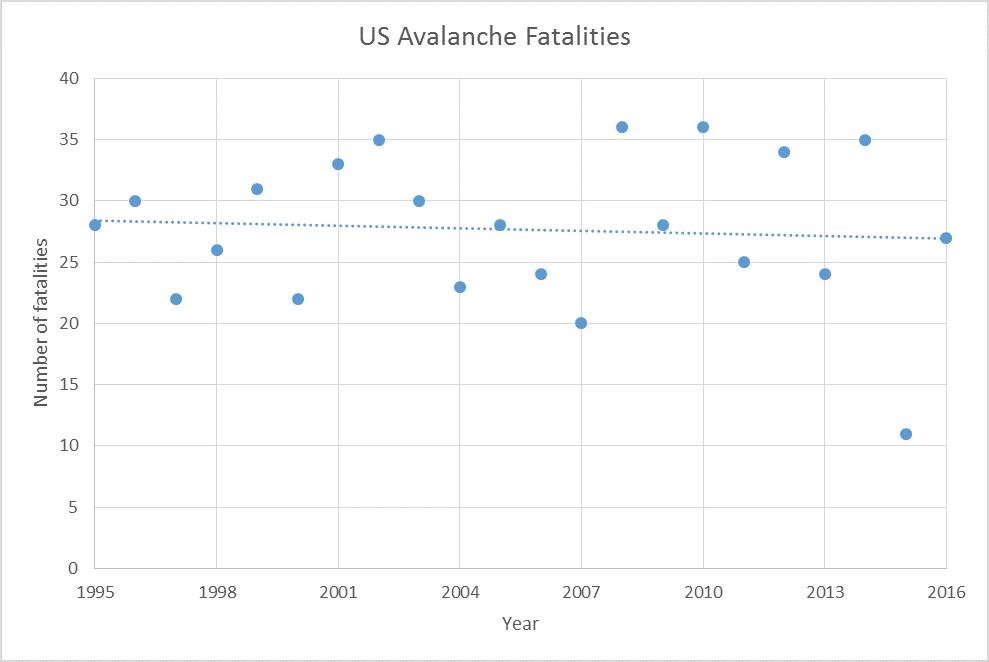
Data compiled by the Colorado Avalanche Information Center and analyzed by experts such as Karl Birkeland of the National Avalanche Center paints a remarkable picture of the period between 1994 and 2016. According to the long-term fatality records, the annual number of deaths caused by avalanches has shown no statistically significant increase. Using a least-squares trend line analysis, researchers found a p-value of 0.7 for overall fatalities, a figure that indicates no statistical evidence of a change in the frequency of deaths over twenty-two seasons.
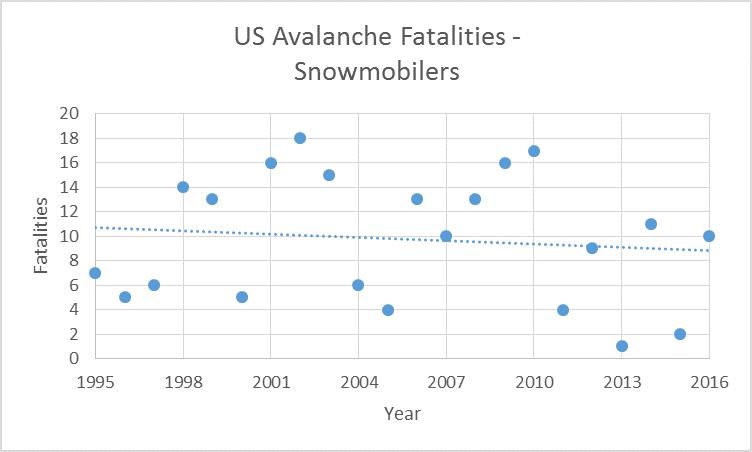
When the data is disaggregated by user group, the stability remains largely consistent. For snowmobilers, a group that saw a surge in popularity and technological capability during the late 1990s and early 2000s, the fatality trend is also flat, with a p-value of 0.6. There is a slight, marginal indication of an upward trend among backcountry skiers and snowboarders (p = 0.07), but even this remains remarkably low when contrasted with the estimated growth of these sports.
The significance of this "flat line" cannot be overstated. In almost every other high-risk recreational activity, a massive influx of new, inexperienced participants typically correlates with a corresponding spike in accidents and fatalities. In the context of avalanche safety, however, the community has managed to decouple participation rates from mortality rates.
Measuring the Backcountry Boom: The Multiplier Effect
Quantifying exactly how many people enter the backcountry each winter is a notoriously difficult task, as there are no turnstiles at trailheads and no centralized registration system for dispersed winter recreation. However, safety experts utilize "proxy data" to estimate the growth in usage. One of the most reliable metrics is the frequency with which the public accesses avalanche advisories.
The growth in information consumption over the twenty-two-year period ending in 2016 is staggering:
- The Utah Avalanche Center reported a 12-fold increase in advisory usage.
- The Colorado Avalanche Information Center saw usage grow by a factor of 17.
- The Gallatin National Forest Avalanche Center in Montana recorded a 36-fold increase.
- The Northwest Avalanche Center experienced a massive 60-fold increase in the number of people seeking safety information.
While some of this growth can be attributed to the ease of accessing information via smartphones and social media, it serves as a powerful indicator of a massive surge in the number of people recreating in avalanche-prone terrain. Even using a conservative estimate—assuming that actual backcountry usage has increased by a factor of eight since 1994—the implications are profound. If the fatality rate (the number of deaths per backcountry user day) had remained constant while usage grew eight-fold, the United States would be witnessing upwards of 200 avalanche fatalities every winter. Instead, the number has remained steady, typically hovering between 25 and 30 deaths per year. This suggests that the individual risk for a person entering the backcountry today is at least eight times lower than it was in the mid-1990s.
The Pillars of Success: Education, Technology, and Information
The dramatic reduction in the fatality rate is the result of a multi-faceted approach involving public-private partnerships, technological innovation, and a cultural shift toward safety awareness.
1. The Regional Avalanche Center Network
The expansion of the regional avalanche center network has been a cornerstone of this success. These centers provide the "boots on the ground" intelligence necessary for daily forecasting. By professionalizing the collection of snowpack data and weather observations, these centers have moved from general seasonal summaries to high-resolution, daily advisories that allow users to make informed decisions about where and when to travel. The transition from recorded telephone "hotlines" to sophisticated mobile apps and interactive websites has ensured that critical safety information is available at the exact moment a user is planning their trip.
2. The Evolution of Safety Equipment
The period between 1994 and 2016 saw a revolution in life-saving technology. The transition from analog to digital avalanche beacons made transceiver searches faster and more intuitive for novices. The introduction of the "Avaluance" and, more significantly, the widespread adoption of avalanche airbag packs provided users with tools to increase their chances of survival during an actual slide. Furthermore, the development of lightweight, high-performance Alpine Touring (AT) gear and more powerful, reliable snowmobiles has been accompanied by a trend toward better protective gear, including helmets and integrated communication systems.
3. Comprehensive Education and "Know Before You Go"
The "Know Before You Go" (KBYG) program is often cited as a benchmark for successful public safety campaigning. By targeting younger demographics and entry-level users with a simple, actionable message—Get the Gear, Get the Training, Get the Forecast, Get the Picture, Get Out of Harm’s Way—the program has instilled a baseline level of awareness in a broad cross-section of the public. Simultaneously, professional organizations like the American Institute for Avalanche Research and Education (AIARE) have standardized curriculum for multi-day courses, ensuring that a consistent and rigorous safety message is delivered across the country.
Chronology of a Changing Landscape
The timeline of these improvements shows a steady progression of safety milestones:
- 1994-1995: The baseline season. Avalanche centers are limited; the internet is not yet a factor in daily safety.
- Late 1990s: Digital transceivers begin to replace analog models, significantly reducing search times.
- Early 2000s: The "sidecountry" phenomenon emerges as ski resorts open boundaries, necessitating new types of signage and education for lift-access backcountry users.
- 2004-2010: Social media and smartphones begin to revolutionize how avalanche centers communicate. Real-time observations from the public (crowdsourcing) become a vital part of the forecasting ecosystem.
- 2010-2016: Airbag technology becomes mainstream. Professional education programs see record enrollment, and the "Know Before You Go" program expands internationally.
Broader Impact and Future Implications
The success of the avalanche safety community serves as a case study for other high-risk outdoor industries. It demonstrates that targeted education and robust information systems can mitigate the inherent risks of dangerous environments even when participation numbers rise.
However, experts remain cautious. While the flat fatality line is a "win," the community’s ultimate goal remains a reduction toward zero. The slight evidence of an increase in skier and snowboarder fatalities suggests that as equipment allows people to go deeper into the wilderness and stay out longer, the margin for error may be narrowing in certain sectors. The challenge for the next twenty years will be to maintain this downward trend in fatality rates as climate change introduces new levels of unpredictability into mountain snowpacks.
Ultimately, the data from the past two decades is a testament to the hard work of educators, forecasters, and equipment manufacturers. It confirms that the current strategies—focusing on high-quality daily information and accessible education—are working. For the thousands of professionals and volunteers who comprise the U.S. avalanche safety network, the flat fatality line is not just a statistic; it is a validation of a life-saving mission that continues to evolve alongside the mountains themselves.