

In the realm of high-risk winter sports, a statistical anomaly has emerged that challenges traditional expectations regarding public safety and recreational growth. For more than two decades, as the number of enthusiasts venturing into the backcountry has surged to unprecedented levels, the annual number of avalanche fatalities in the United States has remained remarkably stable. This phenomenon suggests a profound shift in the efficacy of avalanche education, technological intervention, and the dissemination of critical safety information. Data compiled from the 1994/1995 winter season through the 2015/2016 period reveals that while the "sidecountry" and "backcountry" have become mainstream destinations, the anticipated spike in mountain tragedies has failed to materialize, pointing toward a significant drop in the individual fatality rate.
A Retrospective on the Backcountry Landscape of the Mid-1990s
To understand the current state of mountain safety, one must examine the starkly different landscape of the winter of 1994/1995. During this era, the infrastructure for avalanche awareness was in its infancy. Leading the charge were a handful of experts: Knox Williams in Denver, Bruce Tremper in Utah, and Mark Moore in Seattle. Other critical nodes in the safety network included Jim Kanzler in Jackson Hole and Brad Ray at Mount Washington. At the time, regional avalanche centers were far from the ubiquitous resources they are today; centers in high-traffic areas such as the Chugach Range in Alaska, Lake Tahoe, and Mount Shasta had yet to be established.
The equipment used by recreationalists during this period further illustrates the gap between the past and the present. Backcountry skiing was dominated by telemark gear, often paired with leather boots that offered minimal support compared to modern standards. Snowmobiles, while present, lacked the high-performance engines, advanced suspension, and lightweight frames that allow contemporary riders to navigate steep, complex terrain. Furthermore, the concept of "sidecountry"—accessible via ski resort lifts but located outside managed boundaries—was largely non-existent. Most ski areas maintained closed boundaries, and the culture of "ducking the rope" was strictly discouraged and less frequent than the integrated access seen today.
Perhaps the most significant difference lay in communication. In 1994, the internet was a nascent tool. The first avalanche advisories were only just beginning to appear on the World Wide Web at the conclusion of that season. For most users, obtaining a forecast required calling a dedicated phone hotline or visiting a physical bulletin board at a trailhead.
The Statistical Paradox: Stable Fatalities Amidst Surging Use
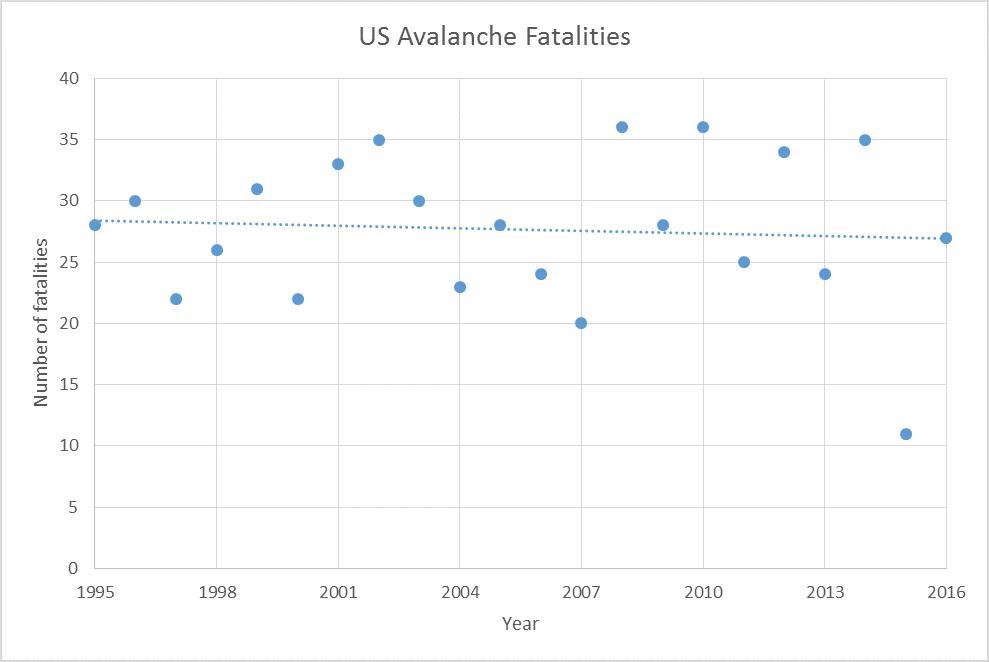
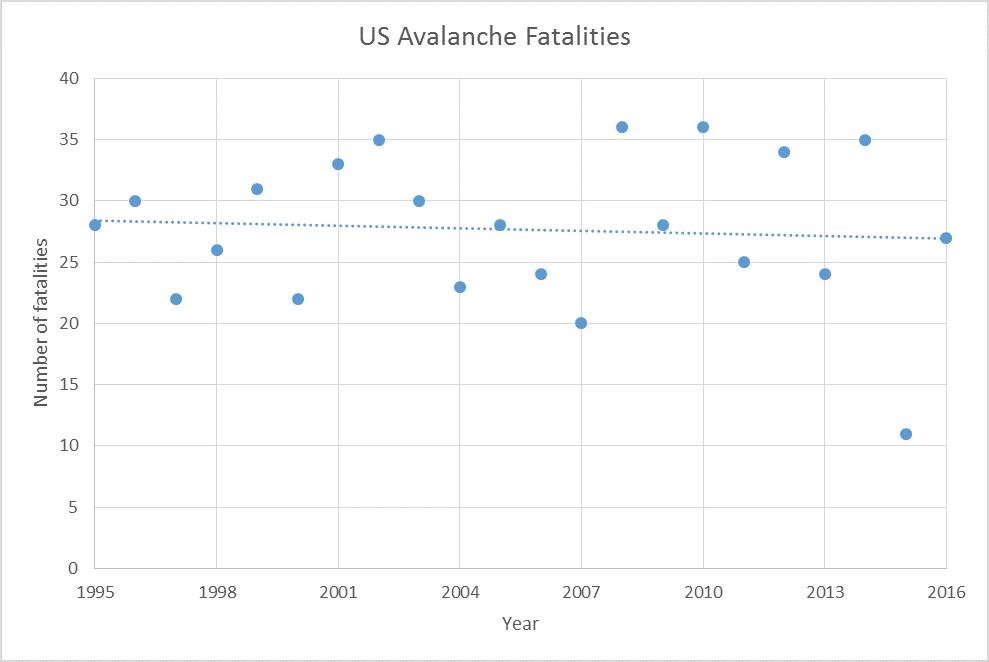
The most striking takeaway from the 22-season period ending in 2016 is the lack of a statistically significant increase in U.S. avalanche fatalities. According to data provided by the Colorado Avalanche Information Center (CAIC), the trend line for total annual fatalities has remained essentially flat. While there is a slight downward slope in the least-squares trend line, researchers note a p-value of 0.7, indicating that there is no statistical evidence of a change in the raw number of deaths per year.
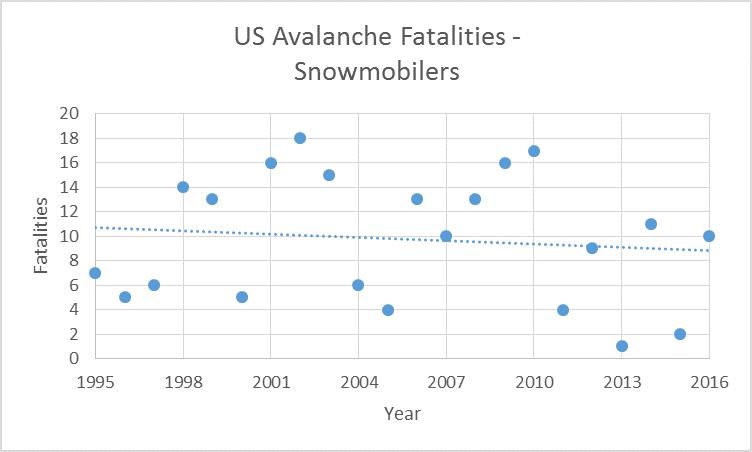
When the data is disaggregated by user group, similar patterns emerge. For snowmobile-related avalanche fatalities, the trend remains flat with a p-value of 0.6. Among backcountry skiers and snowboarders, there is some statistical evidence (p = 0.07) of a very slight increase, yet this minor rise is dwarfed by the massive increase in the number of individuals participating in these activities.
The true significance of these flat lines is revealed when compared against usage metrics. Because tracking every individual who enters the backcountry is logistically impossible, experts use "avalanche advisory usage" as a proxy for participation. The growth in these numbers is staggering:
- Utah Avalanche Center: 12-fold increase in advisory usage.
- Colorado Avalanche Information Center: 17-fold increase.
- Gallatin National Forest Avalanche Center: 36-fold increase.
- Northwest Avalanche Center: 60-fold increase.
While some of this growth can be attributed to the transition from phone hotlines to digital platforms and mobile apps, the sheer scale of the increase confirms that many more people are recreating in avalanche-prone terrain than were doing so 20 years ago.
Calculating the Decline in Relative Risk
If one assumes a conservative estimate that backcountry use has increased eight-fold over the past 22 years, the implications for safety are profound. With the total number of fatalities remaining steady, the fatality rate—defined as avalanche deaths per backcountry user day—has dropped by at least a factor of eight.
This mathematical reality suggests that if safety measures, education, and technology had remained static while participation grew, the United States could have reasonably expected to see over 200 avalanche fatalities per winter. Instead, the annual toll has hovered near the historical average, usually ranging between 20 and 30 deaths. This "win" for the outdoor community represents thousands of lives potentially saved through proactive intervention and cultural shifts in risk management.
The Pillars of Modern Avalanche Safety
The dramatic reduction in the fatality rate can be attributed to a multi-faceted approach involving education, technology, and professional services.
1. Evolution of Education and Awareness
The mid-90s saw the beginning of a standardized approach to avalanche education. Programs like "Know Before You Go" (KBYG) revolutionized how safety information was delivered to the public, focusing on simple, actionable steps: get the gear, get the training, get the forecast, get the picture, and get out of harm’s way. Professional-level courses became more accessible, and the curriculum shifted from purely scientific snow-pit analysis to a greater focus on human factors and decision-making psychology.
2. Technological Advancements
The transition to digital avalanche beacons marked a turning point in search-and-rescue efficiency. Modern three-antenna beacons are significantly more intuitive and faster than the analog models of the 1990s. Furthermore, the introduction of supplemental safety gear has provided a secondary layer of protection. Airbag packs, which help keep a victim near the surface of a moving slide, and the Avalung, which allows a buried victim to breathe for an extended period, have directly contributed to survival rates in the event of an accident. Additionally, the integration of GPS and satellite communication devices into the standard backcountry kit has allowed for faster emergency response times.
3. The Role of Regional Avalanche Centers
The expansion of the regional avalanche center network has been instrumental. These centers provide daily, high-quality advisories that translate complex meteorological and snowpack data into easy-to-understand danger ratings. By providing this information for free and making it easily accessible via smartphones, avalanche centers have ensured that "getting the forecast" is a standard part of the morning routine for modern backcountry users.
4. Professional Guiding and Ski Area Operations
The professionalization of the industry has also played a role. Guided backcountry skiing and snowmobiling have become more popular, placing more users under the supervision of trained professionals. Simultaneously, ski areas have refined their "sidecountry" or "off-piste" management, providing better signage and education at the points where skiers exit the managed boundaries.
Broader Implications and Future Challenges
The fact that the U.S. has maintained a flat fatality trend during a period of explosive growth is a testament to the collective efforts of the winter recreation community. It validates the investment in public safety infrastructure and suggests that the "culture of safety" is successfully being passed down to new generations of mountain enthusiasts.
However, challenges remain. As climate change leads to more volatile weather patterns and more frequent "extreme" snow events, the predictability of the snowpack may decrease. Furthermore, as technology continues to empower users to travel deeper into the wilderness and onto steeper slopes, the margin for error remains slim. The slight upward trend in skier and snowboarder fatalities, though not yet statistically dominant, serves as a reminder that the community cannot afford complacency.
The success of the past 22 years provides a roadmap for the future. By continuing to refine educational tools, supporting the regional avalanche center network, and fostering technological innovation, the goal of pushing fatalities toward zero remains a tangible, if difficult, objective.
Acknowledgments and Data Integrity
The analysis of these trends relies heavily on the diligent record-keeping of the Colorado Avalanche Information Center (CAIC). For decades, CAIC personnel and their partners across the country have meticulously documented avalanche accidents, providing the data necessary to identify these long-term trends. This commitment to data transparency allows researchers and educators to learn from every incident, ultimately shaping the strategies that keep the public safe. Contributions and reviews from experts such as Simon Trautman, Doug Chabot, and Spencer Logan continue to ensure that the analysis of avalanche trends remains grounded in rigorous scientific and statistical standards.