

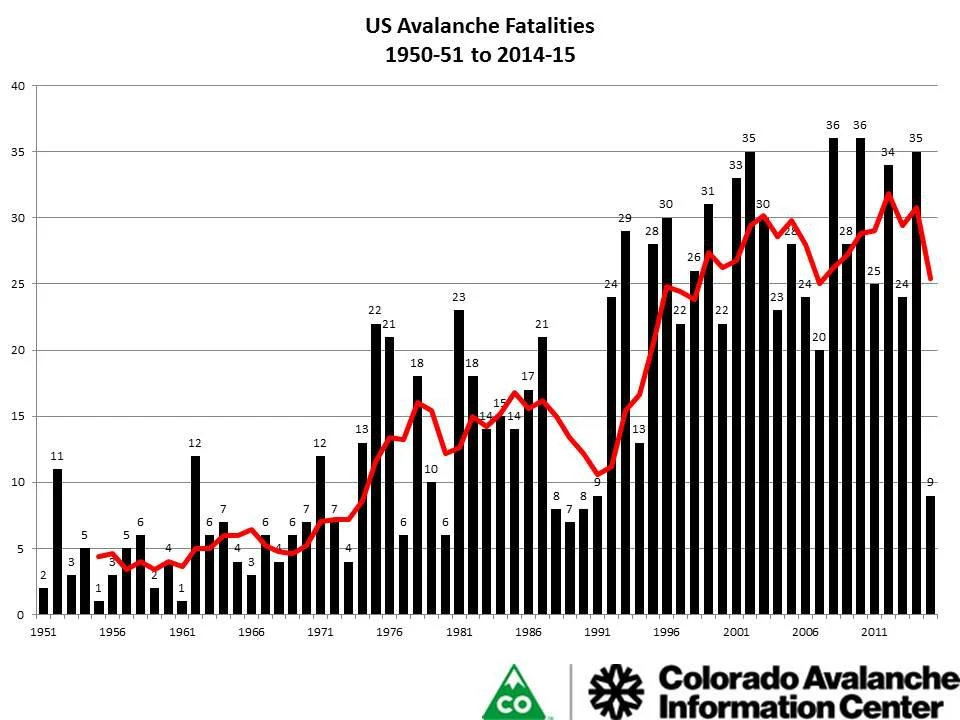
As the 2014-2015 winter season draws to a close on April 30, data compiled by national monitoring agencies reveals a significant and encouraging decline in avalanche-related deaths across the United States. With only nine recorded fatalities this season, the country has reached its lowest death toll since 1991, marking a pivotal moment in backcountry safety and snow science. While experts at the Colorado Avalanche Information Center (CAIC) and the United States Forest Service (USFS) emphasize that even a single loss of life is a tragedy, the single-digit figure represents a stark contrast to the high-fatality years of the previous decade. This decline is attributed to a complex interplay of meteorological anomalies, a historic lack of snow in critical regions, and the increasingly effective reach of public safety campaigns.
The 2014-2015 season challenged traditional expectations of winter recreation. For much of the year, the "avalanche season" appeared subdued, yet the data suggests that the low fatality count was not merely a matter of luck. Instead, it was the result of a unique atmospheric environment coupled with a more informed public. Despite a massive surge in the number of skiers, snowboarders, and snowmobilers venturing into the backcountry over the last 15 years, the stability of the five-year moving average for fatalities—which currently sits between 25 and 30 deaths per year—suggests that safety initiatives are successfully decoupling participation rates from mortality rates.
Meteorological Factors: The Role of a "Poor Snow Year"
The primary driver behind the reduced number of accidents this season was the unconventional weather patterns that dominated the Western United States. Avalanche activity requires two fundamental components: a steep slope and a sufficient volume of unstable snow. During the 2014-2015 cycle, several key mountain ranges lacked the latter.
Along the West Coast, particularly in the Sierra Nevada of California and the Cascades of Washington and Oregon, the winter was characterized by historic droughts and record-high freezing levels. In California, the April 1 snowpack measurement—traditionally the peak of the season—was a mere five percent of the historical average. Many high-altitude slopes that typically hold several meters of snow remained bare or were covered only by a thin, patchy layer. This lack of "fuel" for avalanches naturally reduced the number of slides, as there was simply not enough mass to create the large-scale catastrophic events often seen in high-snowfall years.
Further inland, across the Intermountain West and the Rocky Mountains, the situation was different but equally conducive to lower fatality rates. While these regions saw more precipitation than the coast, they were plagued—or perhaps blessed, from a safety perspective—by unusually warm temperatures. In states like Colorado, Utah, and Montana, frequent warm spells helped "heal" the snowpack. Warmth facilitates the rounding of snow crystals, a process that creates stronger bonds between layers. This is in sharp contrast to cold, dry winters where "depth hoar" or faceted snow develops at the base of the pack, creating a fragile foundation that can collapse under the weight of a single skier. The 2014-2015 season saw fewer of these persistent weak layers, leading to a more predictable and generally safer snowpack for much of the winter.
Historical Context and Chronology of the Season
To understand the significance of nine fatalities, one must look at the broader historical trajectory of avalanche accidents in the United States. In the early 1990s, backcountry travel was a niche activity reserved for elite mountaineers and a small community of enthusiasts. By 1991, the last time fatalities were this low, the equipment was rudimentary, and digital beacons were in their infancy.
The intervening decades saw a revolution in outdoor gear. The advent of "fat" skis, splitboards, and high-performance mountain snowmobiles allowed tens of thousands of people to access terrain that was previously unreachable. By the early 2000s, fatalities began to climb, often exceeding 30 per year, peaking during seasons with volatile snowpacks and high weekend traffic.
The 2014-2015 season timeline followed an unusual path:
- Early Season (October – December): Sparse snowfall across the West led to a "thin" snowpack, which is often the most dangerous. However, the lack of significant subsequent storms meant that these weak layers were rarely "loaded" with enough weight to cause widespread natural or human-triggered slides.
- Mid-Season (January – February): While this is typically the deadliest period of the winter, 2015 saw record-breaking warmth. Many regions experienced rain-on-snow events at high elevations. While rain can initially trigger slides, the subsequent freezing of that moisture creates a "rain crust," which acts as a structural reinforcement for the snowpack.
- Late Season (March – April): Spring conditions arrived early. While wet-slab avalanches became a concern, the predictability of "corn snow" and diurnal freeze-thaw cycles allowed recreationists to time their activities to avoid the most dangerous windows of the day.
The Impact of Education and Institutional Outreach
While the weather played a major role, safety experts argue that the efforts of the Forest Service avalanche centers and the CAIC cannot be overlooked. Over the past decade, there has been a paradigm shift in how avalanche information is disseminated.
The CAIC, which maintains the national database of avalanche accidents in collaboration with experts like Spencer Logan, has modernized its approach to communication. This season saw an increased reliance on mobile apps, social media updates, and simplified "danger scales" that translate complex snow science into actionable advice for the general public. The "Know Before You Go" program, a collaborative effort between various agencies and private industry, has successfully targeted younger and less experienced demographics, emphasizing the "Five Red Flags" of avalanche danger: recent avalanches, cracking/whumpfing, heavy snowfall, wind-blown snow, and rapid warming.
Furthermore, the professionalization of avalanche education has reached a new peak. Organizations like the American Institute for Avalanche Research and Education (AIARE) have standardized curriculum across the country. More backcountry users than ever before are heading into the mountains equipped not just with beacons, probes, and shovels, but with the formal training required to use them. The 2014-2015 season serves as a testament to the idea that an informed public can navigate even a dangerous environment with a lower margin of error.
Analysis of Long-Range Trends and Backcountry Use
One of the most striking observations in the 2014-2015 data is the stability of the five-year moving average. Statistical analysis shows that while the number of people entering the backcountry has "skyrocketed"—with some estimates suggesting a 300% to 500% increase in gear sales and trailhead counts over the last 15 years—the death rate has not followed a linear upward trend.
This stabilization, running between 25 and 30 deaths annually, suggests a significant improvement in "per capita" safety. If the fatality rate had tracked perfectly with the increase in usage, the U.S. might be seeing 100 or more deaths per year. The fact that the numbers have stayed flat, and in the case of this season, plummeted, indicates that the culture of safety is taking root. Backcountry users are increasingly treating avalanche gear as mandatory rather than optional, and "checking the forecast" has become a ritual as common as checking the weather.
Regional Variations and Official Responses
Official responses to the 2014-2015 figures have been cautiously optimistic. Spencer Logan of the Colorado Avalanche Information Center, who has been instrumental in maintaining the U.S. avalanche accident database, noted that the data provided in the seasonal graphic reflects a rare alignment of factors. While the CAIC expressed relief at the low numbers, they also issued a reminder that "low snow" does not mean "no danger."
In Colorado, which historically accounts for the highest number of avalanche deaths in the U.S. due to its continental climate and weak snow layers, the season was still marked by several "close calls" that did not result in fatalities. In the Pacific Northwest, local centers noted that while the avalanche danger was low for much of the year, the "danger of the void"—falling into tree wells or over cliffs that would normally be covered by deep snow—became a more prominent concern.
The Forest Service avalanche centers highlighted that the reduction in fatalities also reduces the burden on Search and Rescue (SAR) teams, many of which are comprised of volunteers. A season with nine fatalities means fewer high-risk recovery missions in unstable terrain, preserving resources and protecting the lives of first responders.
Broader Implications and Future Outlook
The 2014-2015 season offers a window into the future of mountain recreation in a changing climate. As winters become more volatile, with the potential for more "low snow" years on the West Coast and "warm snow" years in the Rockies, the nature of avalanche danger will evolve.
However, the primary takeaway for the scientific and outdoor communities is the validation of the "Education + Information" model. The data suggests that when high-quality, real-time snowpack information is paired with a public that understands how to interpret it, the risks of the backcountry can be managed effectively.
As the industry looks toward the 2015-2016 season, the focus will remain on maintaining this downward trend. Experts warn against complacency; a single heavy-snow year with a return to cold, "facet-producing" temperatures could easily see numbers return to the 30s if the public ignores the lessons of the past. The goal for organizations like the CAIC and the USFS remains the same: to ensure that the "avalanche season" is defined not by the number of tragedies, but by the number of people who return home safely from the mountains.
In summary, the 2014-2015 season stands as a historical outlier—a year where a combination of a "poor" snowpack and "rich" educational resources created a perfect storm for safety. The nine lives lost remain a somber reminder of the inherent risks of the wilderness, but the broader statistics offer a glimmer of hope that the path toward a safer backcountry is being successfully forged through science, data, and public awareness.
