

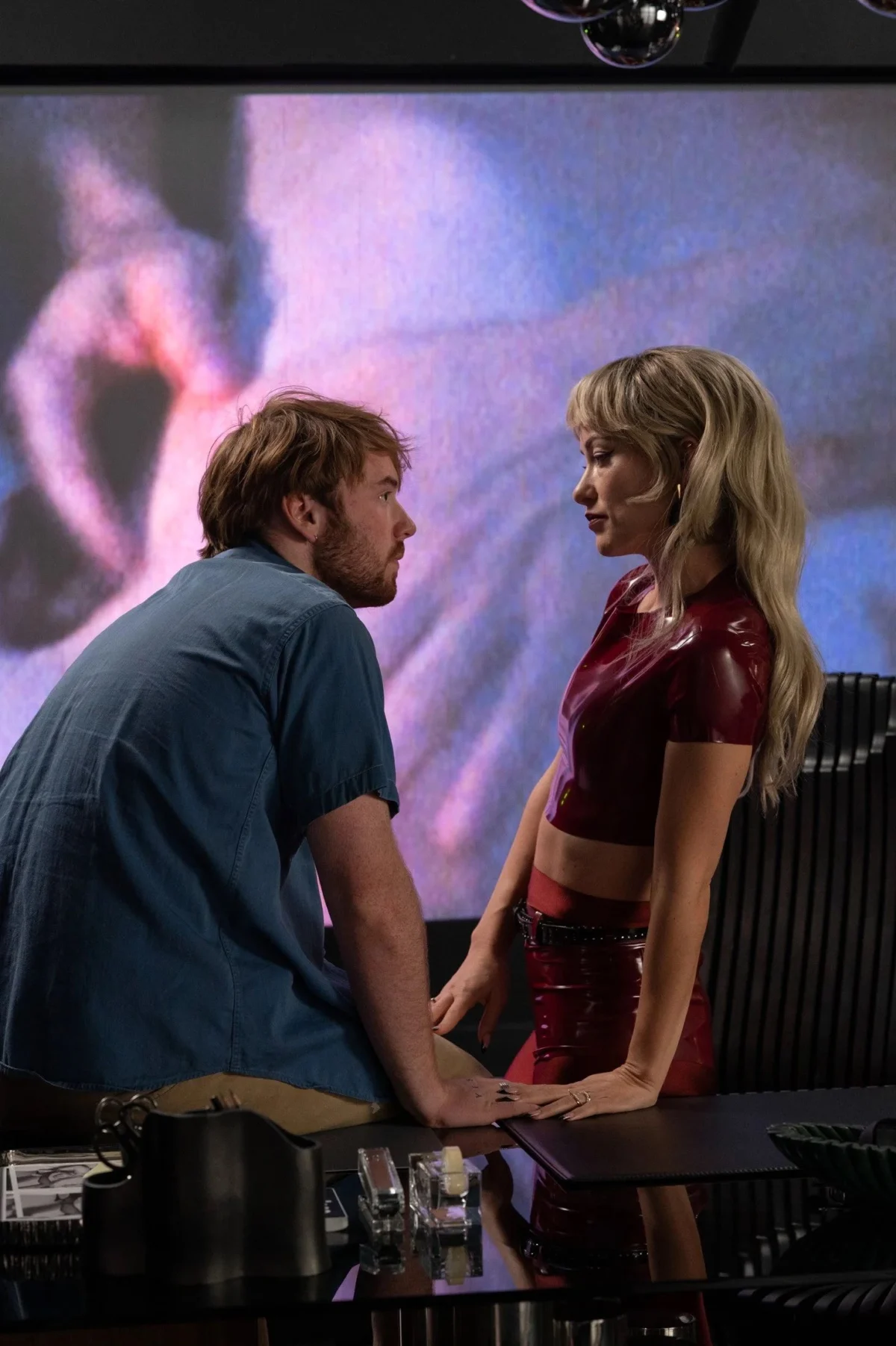
The cinematic landscape is experiencing a notable shift, with the upcoming release of "I Want Your Sex," a film co-written by Karley Sciortino and directed by Gregg Araki. This provocative new feature delves into the complexities of a Dom/sub relationship, playfully dubbed a "dom-com," where a seasoned artist, portrayed by Olivia Wilde, enlists her significantly younger, fresh-faced assistant, played by Cooper Hoffman, as her artistic and sexual muse. The narrative explores the assistant’s burgeoning infatuation and his gradual, perhaps disorienting, immersion into a dynamic he may not fully comprehend.
The genesis of "I Want Your Sex" stems from Sciortino’s personal experiences. At the age of 25, she found herself in a BDSM-influenced relationship with her then-editor, a British man two decades her senior. Sciortino describes this as a transformative, albeit life-altering, sexual encounter that ultimately became a significant part of her personal narrative. The journey from this deeply personal experience to a cinematic adaptation, particularly one intended for a mainstream audience, has been a lengthy and evolving process.
The Evolution of a Screenplay: From Personal to Problematic to Progressive
The initial stages of script development for "I Want Your Sex" began approximately thirteen years ago. Sciortino’s early drafts reflected her lived experience, centering on a narrative of a younger woman involved with a considerably older man. This initial concept faced considerable hurdles in Hollywood’s notoriously lengthy production timelines. Years were spent navigating an array of meetings with industry professionals who expressed enthusiasm for the story’s premise but hesitated to commit the necessary financial backing. This period of development ultimately led to the script being shelved.
However, a few years ago, director Gregg Araki proposed revisiting the project. Upon re-reading the screenplay, Sciortino observed a significant cultural shift that had occurred in the interim, largely influenced by the #MeToo movement. The original narrative, which depicted a middle-aged man in a dominant role with his much younger female assistant, suddenly appeared problematic and, consequently, difficult to finance.
This realization prompted a crucial pivot in the creative direction. Araki suggested a gender-swap, reorienting the narrative to feature a woman in the dominant, "pervy boss" role and a man as her eager, albeit perhaps naive, subordinate. Initially conceived as a practical solution to overcome financing obstacles and address evolving societal sensitivities, this alteration proved to be more than a mere adjustment. The re-imagined dynamic, Sciortino observed, imbued the story with a more compelling and sensual dimension, revealing a potentially richer vein of dramatic and thematic exploration.
The Rise of the "Boy-Toy" Cinema: A Cultural Phenomenon
The apparent success of this gender-flipped narrative aligns with a broader trend observed in contemporary cinema and popular culture. Over the past two years, audiences have witnessed a surge in films and series exploring the dynamic of older woman/younger man relationships. Notable examples include "Babygirl," "The Idea of You," "Bridget Jones: Mad About the Boy," "Vladimir," and "Marty Supreme." This trend suggests a growing appetite for narratives that challenge traditional power structures and sexual archetypes.
This shift is not merely a fleeting trend but reflects a deeper cultural reckoning with established norms. The portrayal of a woman in her 40s or 50s engaging in a relationship with a younger man is increasingly being normalized and even celebrated. In contrast, depictions of younger women in similarly dominant or exploitative roles with older men often elicit a more critical or uncomfortable response. This disparity, Sciortino suggests, points to a double standard in how female and male desire, particularly across age divides, is perceived and accepted.
The perceived "sexiness" of the older woman/younger man dynamic, Sciortino posits, may stem from its novelty. For decades, female desire has been subject to societal shame and suppression. When it finally emerges in a bold, uninhibited, and even unconventional manner, it can be perceived as a form of liberation and a powerful statement against patriarchal constraints. Simultaneously, these narratives often provide a rare opportunity to see men in roles where they are the object of desire, the "pretty, naive, wanted one." In "I Want Your Sex," for instance, Olivia Wilde’s character not only engages in a power-laden relationship with her subordinate but also draws upon him as her artistic muse, a role historically associated with femininity. The experience of seeing a man being objectified and scrutinized can be a novel and, for many viewers, a deeply satisfying inversion of typical cinematic portrayals.
Reclaiming Agency: Older Women and Their Sexual Narratives
Beyond the specific dynamics of age-gap relationships, "I Want Your Sex" also contributes to a larger cultural movement of celebrating female sexuality in midlife and beyond. For generations, particularly for women, societal narratives have dictated a distinct "expiration date" for sexual desirability, often placed in the late 30s or early 40s. This was juxtaposed with the enduring image of older men, like George Clooney at 45, being lauded as the epitome of eligible bachelors. This disparity in how age and desirability are perceived for men and women has been a pervasive theme in storytelling and societal expectations.
However, a palpable shift is underway, driven by Gen X and elder millennial women who are actively rejecting the notion of invisibility as they enter midlife. The age of 40 is no longer synonymous with a diminishment of vitality or allure. As articulated by Emma Rosenblum in The Wall Street Journal, a 45-year-old Diane Keaton in 1991 was cast as the mother of the bride, while a 43-year-old Lupita Nyong’o in "The Odyssey" plays Helen of Troy, the epitome of desirability. This evolution in casting and character representation signifies a growing recognition that sexiness is not solely tethered to youth. Both on screen and in broader societal discourse, women are increasingly challenging the idea that their appeal is transient and tied to a limited age bracket.
The Broader Implications: Art as a Blueprint for Life
The adage that art imitates life holds true for "I Want Your Sex," but Sciortino also suggests a reciprocal influence. By depicting women breaking established societal and sexual norms, and doing so successfully within the narrative, the film offers viewers a new framework or "script" for understanding and enacting their own desires and boundaries.
Beneath the layers of discourse surrounding age gaps, the commodification of younger men as "boy toys," and the re-emergence of the female gaze, "I Want Your Sex" ultimately offers a profoundly human story. At its core, it is a narrative about a young individual undergoing a deeply impactful and eye-opening sexual awakening. It is about the complex, often irrational, decision to invest in a relationship with someone who may be demonstrably unsuitable, yet profoundly influential. This fundamental human experience, Sciortino emphasizes, transcends gender and speaks to the universal complexities of desire, self-discovery, and the often-unpredictable trajectory of personal growth.
"I Want Your Sex" is scheduled for release in theaters nationwide on July 31. Karley Sciortino’s Substack newsletter, "Hotline," provides further insights into her work and perspectives.
