

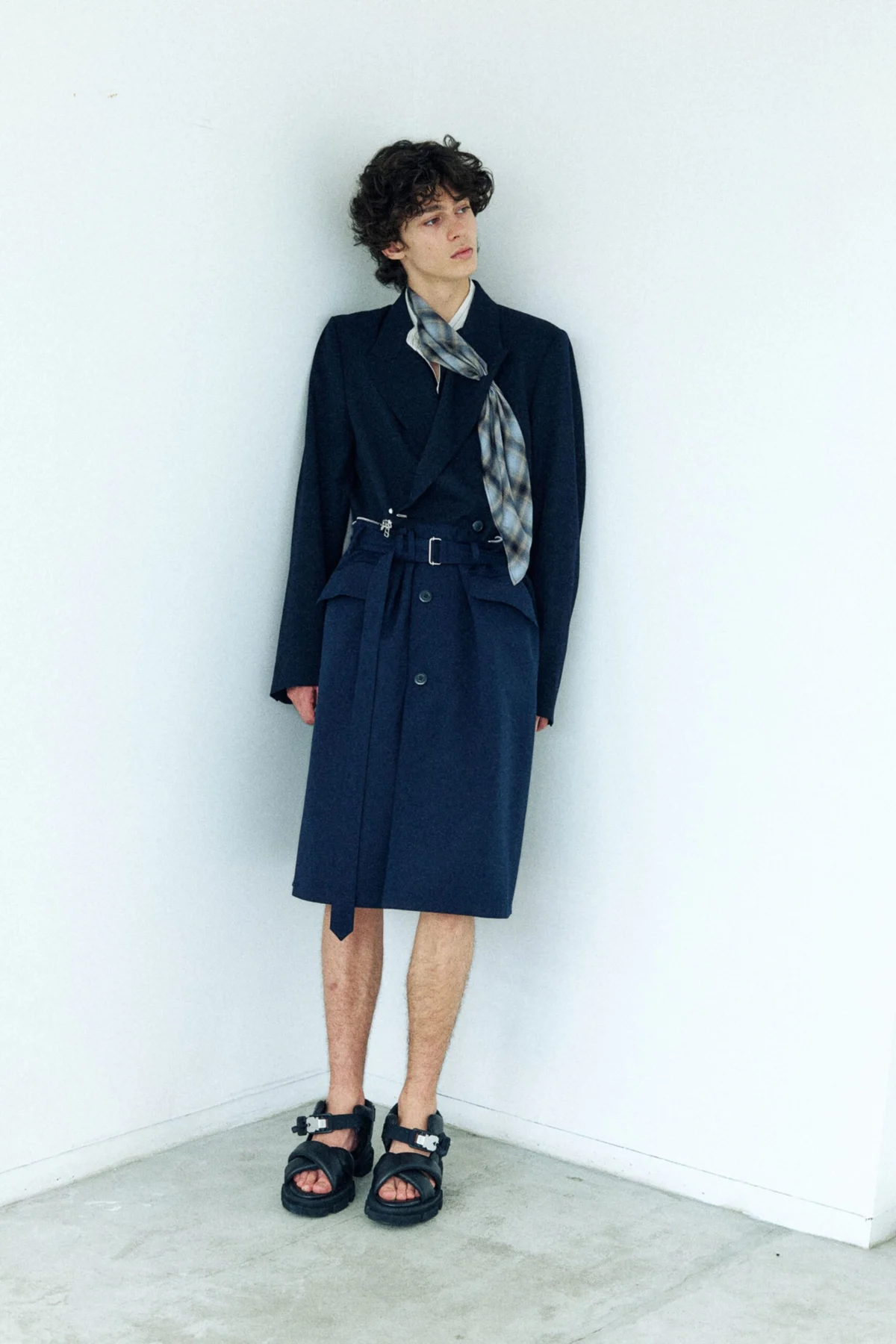
The fashion industry, particularly within its avant-garde circles, often embraces terminology that transcends immediate English translation, offering a more precise lens through which to understand creative processes. One such term, deeply embedded in Japanese fashion vernacular, is "docking." It describes the intricate art of merging elements from two distinct garments to forge a singular, cohesive piece. This can manifest as the unexpected union of a rugged nylon jacket with the refined texture of a cotton shirt, or the audacious amalgamation of a sneaker’s athletic profile with the classic silhouette of a loafer. It is precisely this sophisticated technique of "docking" that defines the creative output of Tatsuya Tamada, the visionary behind the Tamme label, as vividly showcased in his recent Spring/Summer 2025 collection.
Tamada’s artistic journey for this season has been profoundly influenced by a deeply personal source: the image of his police officer father. This paternal inspiration has become a recurring motif, evolving from season to season. Previously, Tamada explored the inherent hallmarks of authority he observed on his father’s uniform, translating these into more casual, streetwise garments. His approach masterfully blurred the lines between the polished and the gritty, the impeccably buttoned-up and the nonchalantly blasé. For the Spring/Summer 2025 collection, Tamada has delved even deeper into this paternal wellspring, adopting a notably softer, more nuanced approach to his signature "docking" technique. This deliberate evolution is not without precedent; Tamada’s formative years in the industry included a significant tenure working under Chitose Abe of Sacai, a designer widely recognized as a doyenne of this very garment-merging art form. Abe’s influence, characterized by her deconstructive yet harmonizing approach to fashion, has undoubtedly informed Tamada’s own sophisticated reinterpretation of the concept.
"I wanted to take familiar structures, like the three-panel construction of a jacket, or the standard pairing of a suit jacket and trousers with a dress shirt, and soften their inherent rigidity," Tamada explained in a post-show discussion. His objective was to deconstruct these archetypal silhouettes and reassemble them with a gentler, more fluid aesthetic. This was achieved through subtle yet impactful alterations to the garments’ silhouettes. Shoulders were rounded, imparting a less severe, more approachable feel. Lengths were adjusted, creating a more ambiguous and less definitive line. These deliberate modifications served to blur what Tamada described as "the rigid outlines typical of uniform-style garments," thereby questioning the very essence of structured attire.
The collection presented a series of compelling sartorial transformations. A pair of ostensibly simple grayish-blue button-up shirts were ingeniously layered and fused into a single, complex garment, challenging the notion of individual pieces. A classic khaki sport coat underwent a metamorphosis, evolving into a more utilitarian field jacket, merging formal tailoring with functional design. Blazers, traditionally symbols of sartorial formality, were re-imagined as contemporary hoodies, a bold juxtaposition of structure and leisurewear. The often-unruly nature of sweatpants was tamed, re-engineered with the elegant drape and subtle flare that is more commonly associated with meticulously tailored trousers. Even seemingly straightforward pieces like polo shirts and zip-up tops bore intricate crest-shaped cutouts on the chest. These deliberate apertures offered a glimpse into underlying layers of striped shirting, evoking the potent imagery of badges of authority being artfully peeled away, revealing the more complex narratives beneath.
The cumulative effect of these design choices was the creation of a sartorial palimpsest. This term, borrowed from manuscript traditions where older text is scraped away to make room for new writing, aptly describes Tamada’s collection. It presented a wardrobe that was simultaneously and gently grungy, yet still retained discernible echoes of authority. The garments occupied a liminal space, hovering between the conservatism inherent in uniform design and the spirit of individual rebellion. "It’s about peeling back existing layers," Tamada articulated, emphasizing the conceptual underpinnings of his work. "What I’m aiming for is one look, where different intentions and layers overlap to form a single, cohesive whole." This philosophy underscores a desire to create garments that are not merely worn, but experienced as complex, multi-layered narratives.
Background and Context: The Evolving Landscape of Fashion
The Spring/Summer 2025 season has seen a broader industry trend towards deconstruction and reconstruction, a continuation of a dialogue that has been central to fashion for decades. Designers are increasingly challenging traditional garment construction, seeking to imbue their creations with personal narratives and societal commentary. Tamada’s approach, while deeply personal, resonates with this larger movement. The concept of "docking," though perhaps less commonly articulated in English-speaking fashion discourse, is a powerful descriptor for a practice that has manifested in various forms across global design houses, from the experimental ateliers of Tokyo to the established fashion capitals of Paris and Milan.
The inspiration drawn from military and police uniforms is not new to fashion. Historically, these uniforms have offered a rich vocabulary of functional details, strong silhouettes, and symbolic associations with order, discipline, and authority. However, Tamada’s reinterpretation moves beyond mere appropriation. By softening the lines and merging these elements with more casual or even rebellious counterparts, he invites a contemplation of the fluidity of these concepts in contemporary society. The collection seems to pose questions about the nature of authority itself: is it an inherent quality, or a performance? Can discipline and freedom coexist?
A Chronology of Tamada’s Creative Evolution
Tatsuya Tamada’s exploration of his father’s uniform has been a gradual but deliberate evolution within his design process. While specific dates for his initial inspirations are not publicly detailed, his tenure at Sacai, a period that likely provided him with foundational insights into garment manipulation, is understood to have concluded several years prior to the development of this distinct thematic focus. His subsequent work under the Tamme label has progressively honed this aesthetic.
In previous seasons, Tamada’s collections showcased a more overt integration of uniform elements. This might have involved the direct incorporation of police jacket detailing onto casual wear or the more literal fusion of distinct uniform components. The Spring/Summer 2025 collection, however, represents a maturation of this concept. The "docking" is now more subtle, the references more internalized. The inspiration is less about the direct replication of uniform pieces and more about the feeling and idea of authority, softened and recontextualized. This shift indicates a growing confidence in his ability to convey complex themes through nuanced design, rather than overt statements. The progression suggests a designer who is not only technically adept but also deeply engaged in a personal and intellectual exploration of his chosen themes.
Supporting Data and Industry Trends
The global fashion market continues to demonstrate a strong appetite for innovative and narrative-driven designs. Data from market research firms consistently highlights the growing consumer interest in brands that offer more than just aesthetic appeal; they seek stories, values, and unique points of view. The market for designer apparel, while competitive, shows resilience when brands can effectively connect with consumers on an emotional and intellectual level.
Specifically, the trend of "hybrid" garments, those that merge distinct categories or styles, has seen significant traction. This can be observed in the popularity of athleisure, which blends athletic wear with everyday fashion, and in the continued interest in deconstructed tailoring. Tamada’s "docking" technique aligns perfectly with this trend, offering a sophisticated and artistic interpretation of garment hybridization. The emphasis on craftsmanship and unique construction also appeals to a segment of the market that values longevity and individuality over fast fashion. While precise sales figures for Tamme are not publicly disclosed, the brand’s consistent presence on international fashion weeks and its critical reception suggest a growing influence within its niche.
Inferred Reactions and Expert Analysis
While direct quotes from industry figures on Tamme’s latest collection are not available at the time of reporting, the prevailing sentiment among fashion critics and observers at the Spring/Summer 2025 shows typically centers on the designer’s ability to innovate and articulate a clear vision. Tatsuya Tamada’s approach, characterized by its intellectual rigor and technical skill, is likely to be lauded for its originality and thoughtful execution.
Fashion commentators often analyze collections through the lens of broader societal shifts. In this context, Tamada’s exploration of authority and rebellion through "docking" could be interpreted as a commentary on the current socio-political climate, where traditional power structures are being questioned, and individual expression is increasingly valued. The "softened authority" of his designs might reflect a desire for a more nuanced and less confrontational approach to societal order. Experts would likely point to his past experience with Sacai as a testament to his understanding of complex garment construction, suggesting that his current work builds upon a strong foundation of technical expertise. The "peeling back layers" metaphor is particularly resonant, suggesting a designer who is not afraid to delve into the complexities of human experience and translate them into tangible forms.
Broader Impact and Implications
Tatsuya Tamada’s Spring/Summer 2025 collection, through its innovative use of "docking" and its exploration of paternal authority, has significant implications for both the fashion industry and broader cultural conversations. By successfully merging seemingly disparate garment elements and conceptual themes, Tamada demonstrates the power of fashion as a medium for nuanced storytelling.
The collection’s success could encourage other designers to explore less conventional terminology and conceptual frameworks in their work, pushing the boundaries of fashion discourse beyond established English-language paradigms. Furthermore, the emphasis on transforming traditional symbols of authority into something more fluid and introspective offers a compelling perspective on contemporary societal values. It suggests a move towards a more complex understanding of power, where control and individuality are not mutually exclusive.
For consumers, Tamme’s creations offer more than just clothing; they provide wearable art that invites contemplation. The garments encourage wearers to consider the multiple layers of meaning embedded within their attire and, by extension, within their own identities. In a world increasingly saturated with mass-produced items, Tamada’s commitment to unique construction and conceptual depth positions Tamme as a brand that offers lasting value and intellectual engagement, contributing to the ongoing evolution of fashion as a thoughtful and provocative art form. The collection serves as a potent reminder that fashion, at its most profound, is a reflection of both the personal and the universal, a dialogue between the self and the world.
