

For more than two decades, the landscape of winter recreation in the United States has undergone a radical transformation. Since the mid-1990s, the emergence of advanced technology, high-performance equipment, and the digital dissemination of information has funneled an unprecedented number of enthusiasts into the backcountry. Yet, despite this "literal explosion" in participation, a comprehensive analysis of historical data reveals a counterintuitive trend: the annual number of avalanche fatalities in the United States has remained remarkably stable. This statistical plateau, occurring in the face of skyrocketing usage, suggests a significant and successful systemic shift in avalanche safety, education, and forecasting.
The Landscape of 1994: A Retrospective on Backcountry Beginnings
To understand the magnitude of current safety achievements, one must examine the state of the industry during the winter of 1994/95. At that time, the institutional framework for avalanche safety was in its relative infancy. Leadership in the field was concentrated among a handful of pioneers. Knox Williams directed the Colorado Avalanche Information Center (CAIC) in Denver, Bruce Tremper oversaw operations in Utah, and Mark Moore led the Northwest Avalanche Center (NWAC) in Seattle. Other critical nodes included Jim Kanzler in Jackson Hole and Brad Ray at Mount Washington, while Karl Birkeland had just established a nascent center in Bozeman, Montana, then in its fifth season.
The technological environment of the mid-90s was starkly different from today. Most backcountry skiers utilized telemark equipment, often paired with leather boots that offered minimal support compared to modern carbon-fiber touring shells. Snowmobiles of the era lacked the power-to-weight ratios and specialized track designs that allow modern riders to navigate steep, high-consequence terrain. Furthermore, the concept of the "sidecountry"—accessible backcountry terrain reached via ski resort lifts—had not yet entered the common lexicon. Most ski areas maintained strictly closed boundaries, and the transition from managed runs to unmanaged wilderness was a formal and often discouraged endeavor.
Perhaps most significantly, the digital age had not yet arrived. The winter of 1994/95 marked the very first instance of avalanche advisories being posted to the internet. Before this, enthusiasts relied on recorded telephone hotlines or physical bulletin boards at trailheads. The barrier to entry for high-quality, real-time safety information was high, keeping the total number of backcountry users relatively low.
The Statistical Reality: Flat Lines in a Growing Field
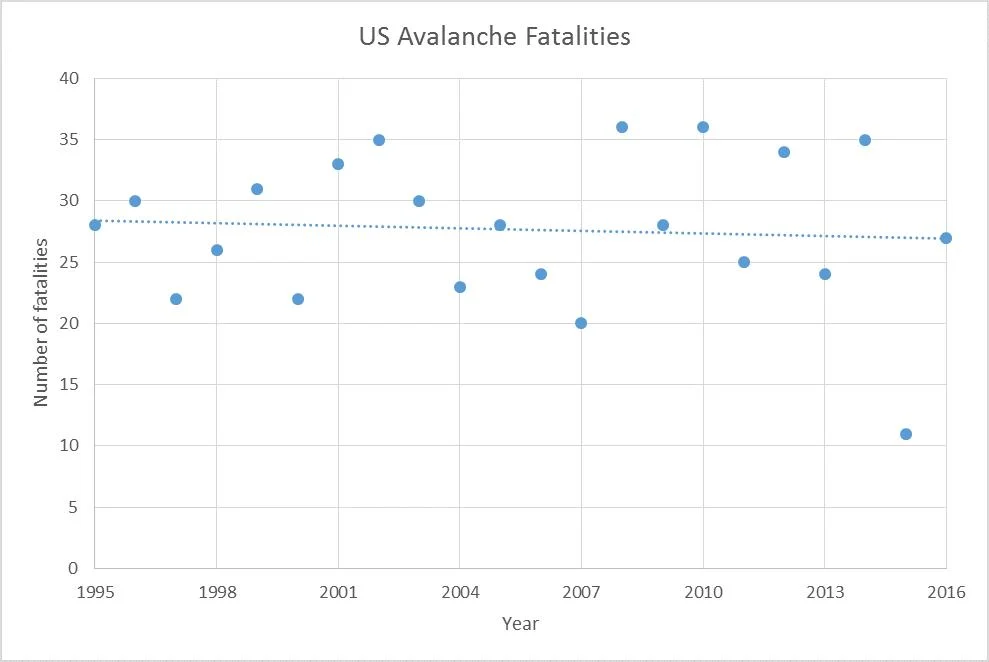
Data compiled by the Colorado Avalanche Information Center (CAIC) provides a clear picture of fatality trends from the 1994/95 season through 2015/16. Over these 22 seasons, the total number of U.S. avalanche fatalities has not shown a statistically significant increase. Figure 1 of the data set illustrates a trend line that is essentially flat, with a p-value of 0.7, indicating that any minor fluctuations are likely due to chance rather than a systemic rise in danger.
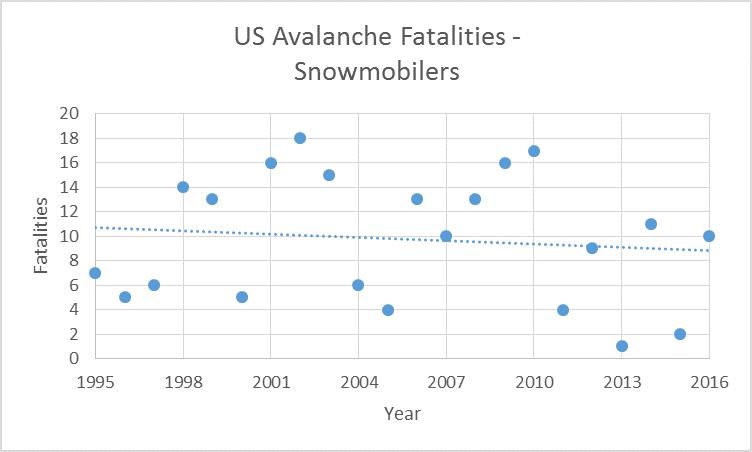
When the data is disaggregated by user group, the results remain consistent. Snowmobile-related fatalities have shown a similarly flat trend (p = 0.6), despite the massive technological leaps in mountain-sled capabilities that allow riders to high-mark deeper into avalanche-prone slopes. Among backcountry skiers and snowboarders, there is some statistical evidence (p = 0.07) of a very slight increase in fatalities, but the rise is marginal when compared to the massive influx of new participants in these sports.
The Proxy for Participation: Measuring Backcountry Use
Quantifying the exact number of people recreating in the backcountry is notoriously difficult due to the dispersed nature of the activity. There are no turnstiles at trailheads, and many users access the mountains from non-traditional points. However, researchers and avalanche professionals use "advisory usage"—the number of times the public accesses official avalanche forecasts—as a reliable proxy for participation levels.
The growth in these numbers over the 22-year period is staggering. The Utah Avalanche Center reported a 12-fold increase in advisory hits. The CAIC in Colorado saw a 17-fold increase. In Montana, the Gallatin National Forest Avalanche Center recorded a 36-fold increase, while the Northwest Avalanche Center in Seattle experienced a massive 60-fold increase in information requests.
While some of this growth can be attributed to the ease of accessing information via smartphones and social media, the magnitude of the increase points toward a fundamental shift in American winter culture. More people are venturing out of the controlled environment of ski resorts and into the "wild" snowpack than ever before.
The Calculated Decline in Fatality Rates
The core of the current analysis lies in the relationship between usage and outcomes. If one assumes a conservative estimate that backcountry participation has increased by a factor of eight since 1994—a figure well below the growth seen in advisory hits—the resulting math is profound.
If the fatality rate (the number of deaths per user-day) had remained constant while participation grew eightfold, the United States would logically expect to see upwards of 200 avalanche fatalities per winter. Instead, the number has hovered consistently around an average of 25 to 30 deaths per year. This suggests that the individual risk for a person entering the backcountry today is at least eight times lower than it was two decades ago. This reduction in the fatality rate represents one of the most significant, yet under-reported, success stories in outdoor recreation and public safety.
The Triad of Success: Education, Technology, and Information
The stabilization of fatality numbers is not an accident of geography or weather; it is the result of a concerted, multi-decade effort by the avalanche community. This success can be categorized into three primary pillars:
1. The Evolution of Education
Avalanche education has moved from a niche interest for professionals to a standard requirement for recreationalists. The "Know Before You Go" (KBYG) program, a free awareness presentation, has reached hundreds of thousands of students and casual users, instilling the basics of "get the gear, get the training, get the forecast, get the picture, and get out of harm’s way." Meanwhile, professional organizations like the American Institute for Avalanche Research and Education (AIARE) have standardized curriculum, ensuring that a Level 1 course in Washington provides the same core competencies as one in New Hampshire.
2. Technological Advancements in Safety Gear
The mid-90s user likely carried an analog beacon with a limited range and a complex "beep" system that required significant practice to master. Today’s digital, three-antenna beacons are faster, more intuitive, and significantly more accurate. Furthermore, the widespread adoption of avalanche airbags (which increase buoyancy in moving snow), Avalungs (which provide an artificial air pocket), and lightweight helmets has increased the "survivability" of an accidental slide.
3. The Regional Avalanche Center Network
The expansion of the regional avalanche center network has been instrumental. Areas that had no formal forecasting in 1994, such as the Chugach in Alaska, the Sierra Nevada at Tahoe, and Mt. Shasta in California, now benefit from daily, high-quality advisories. These centers do more than just predict the weather; they provide a daily "stability narrative" that helps users understand why the snow is dangerous, fostering a more sophisticated level of decision-making among the public.
Institutional Contributions and Data Integrity
The ability to track these trends is made possible by the rigorous data collection efforts of the CAIC and its counterparts. Documenting accidents and near-misses is a somber but vital task. By analyzing where and why accidents occur, the community can refine its messaging. For instance, recognizing the slight upward trend in skier fatalities (Figure 3) allows educators to focus more specifically on the "human factors" and heuristic traps that often lead experienced non-motorized users into trouble.
The professionalization of backcountry guiding and the proactive work of ski area operations have also played a role. Many resorts now offer "open boundary" policies supported by educational signage and partnerships with local avalanche centers, guiding the public toward safer decision-making rather than simply relying on enforcement.
Broader Impact and Future Implications
The "flat line" of U.S. avalanche fatalities is a significant achievement that should serve as a model for other high-risk outdoor activities. It proves that a combination of government-funded forecasting, private-sector innovation, and grassroots education can effectively mitigate the risks of a growing sport.
However, challenges remain. As "sidecountry" use continues to grow, a new demographic of users—who may not view themselves as "backcountry travelers"—is entering high-risk terrain. The avalanche community must continue to adapt its messaging to reach these users who might lack the traditional gear and training. Additionally, as climate change alters snowpack patterns, the historical data used to predict slides may need to be re-evaluated.
Ultimately, the data from 1994 to 2016 offers a message of hope. It demonstrates that despite the inherent dangers of the mountains and the exponential increase in those seeking their thrills, the collective efforts of the avalanche community have made the backcountry a demonstrably safer place. The goal remains zero fatalities, but the current trend is a testament to the fact that the systems currently in place are not only working—they are excelling.
