

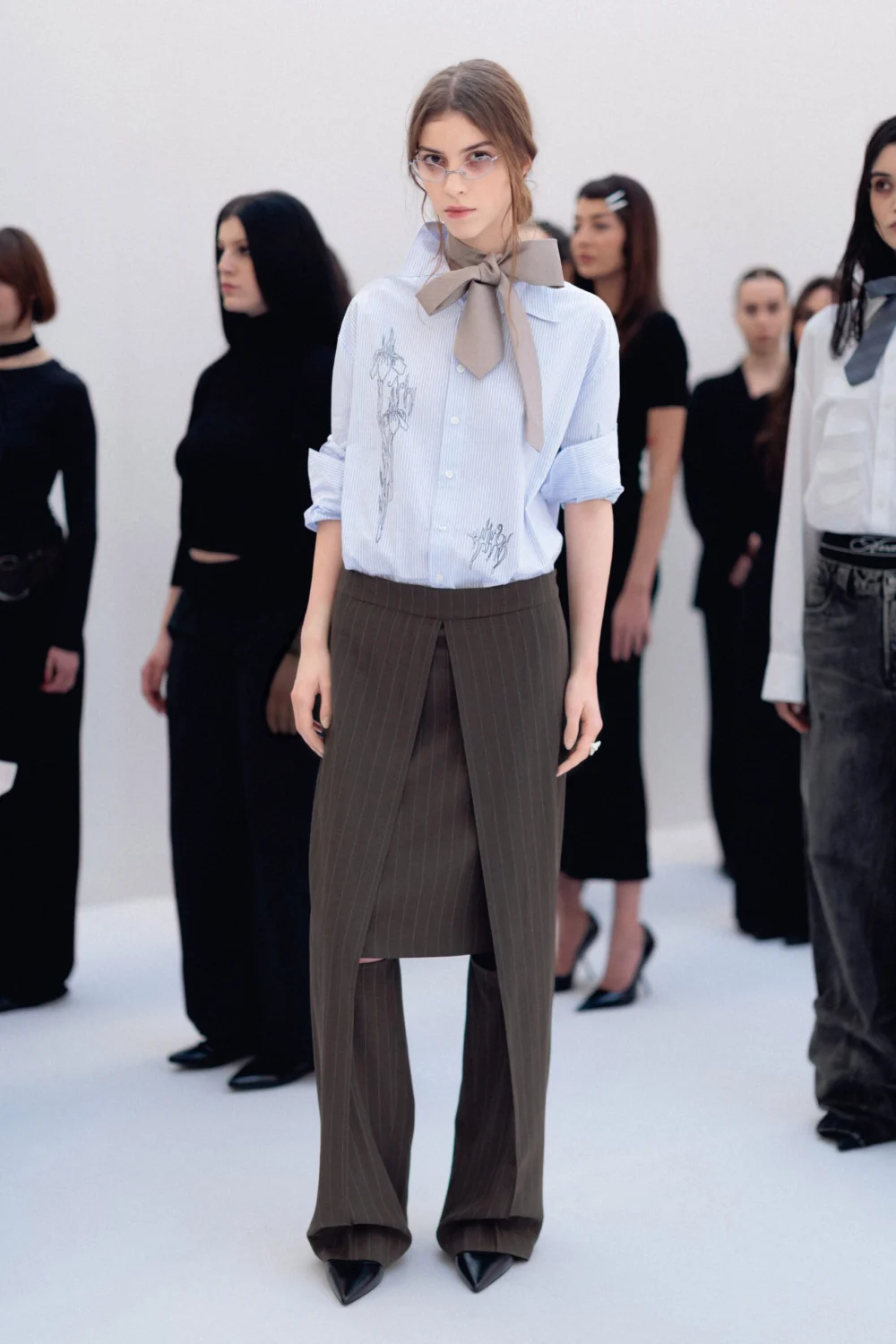
The fashion industry, long perceived as a landscape dominated by the male gaze, witnessed a compelling subversion at Avavav’s recent fall presentation. Designer Beate Karlsson, known for her avant-garde approach and willingness to challenge established norms, orchestrated an experience that intentionally shifted the focus from external validation to internal perception. This collection, presented to an intimate audience, was not merely a showcase of garments but a thoughtful exploration of female identity, empowerment, and the very act of looking within the context of fashion.
The Spectacle of the Female Gaze
Karlsson’s directorial vision for the fall presentation was immediately apparent in its staging. Guests entered a space where the traditional runway was transformed into a corridor flanked by models on either side. This deliberate arrangement, Karlsson explained in a post-presentation interview, was designed to place the audience—predominantly women—at the center of the experience. The intention was to foster a "female gaze," a perspective she believes is often overshadowed in an industry that, despite its primary consumer base being women, frequently prioritizes male aesthetic sensibilities. This move echoes historical precedents in art and performance where the observer’s role has been questioned and re-contextualized. For instance, the groundbreaking performance art piece "The Artist is Present" by Marina Abramović in 2010, where she sat silently opposite visitors, invited a profound engagement with the act of looking and being looked at. Karlsson’s runway arrangement, while stylistically different, shares a conceptual kinship in its deliberate manipulation of the observer-subject dynamic.
The concept of placing the audience within the display is not entirely novel. Imitation of Christ, under the direction of Tara Subkoff, employed a similar tactic in their Spring 2002 Ready-to-Wear show. However, Imitation of Christ’s intention then was to blur the lines between model and critic, prompting questions about who holds authority in aesthetic judgment. Avavav’s presentation, conversely, was laser-focused on the deification and inherent vulnerability of the model on display. The accompanying soundtrack, a curated selection of audio snippets featuring male designers discussing their female muses, served as a sonic counterpoint, subtly highlighting the historical discourse surrounding women in fashion—often framed through the lens of male inspiration and creation. This juxtaposition created a layered narrative, inviting reflection on the power dynamics inherent in fashion design and consumption.
A Deeper Dive into Design Philosophy
Beate Karlsson, whose personal style often leans towards an androgynous and gothic aesthetic, drew heavily from her own sartorial experiences and observations. Her journey, from dressing with men in mind to embracing a more individualistic approach when going out with female friends, informed the creative direction of the fall lineup. This collection marked a departure from previous, more expansive offerings, characterized by a tighter focus and a deeper exploration of fewer, more impactful ideas. This deliberate narrowing of scope allowed for a more profound interrogation of themes and a more cohesive presentation.
The signature rib-cage motif, a recurring element in Avavav’s design lexicon, was reinterpreted with striking versatility. It appeared as a bold print, was artfully slashed into fabrics, and meticulously embroidered, demonstrating the motif’s adaptability and enduring relevance. This recurring symbol, often interpreted as representing both fragility and strength, was central to the collection’s exploration of the female form and its perceived vulnerabilities.
Footwear continued to be a focal point, with the brand’s distinctive "Finger shoes" making a prominent appearance. These were styled in innovative ways, including being worn over pumps, a combination that created an unexpected textural and visual layering. The collection also introduced garments that echoed the volumetric forms of Avavav’s popular "Larva bag." The bulbous silhouette of the bag was ingeniously translated into a series of bubble skirts, which, in turn, felt like a natural evolution from the wired saucer skirts that had been a highlight of the previous spring collection. This continuity and evolution of signature design elements underscore Karlsson’s consistent yet progressive aesthetic.
Androgyny, Streetwear, and the Evolution of Silhouettes
A distinct tomboyish quality permeated the styling of the collection, with neckties emerging as a pervasive accessory. They were integrated directly into tops, offering a seamless blend of formal and casual, and were also tied into elegant bows, adding a touch of traditional femininity. This duality in styling—the incorporation of traditionally masculine elements into feminine silhouettes—is a hallmark of Karlsson’s design approach and speaks to her broader exploration of gender fluidity in fashion.
Remaining true to Avavav’s streetwear heritage, the collaboration with Adidas continued to yield compelling results. New pieces from this ongoing partnership showcased a playful yet sophisticated integration of athletic wear elements. The familiar logo-emblazoned waistbands of underwear were deliberately exposed, hinting at a new layering aesthetic. What appeared to be a skirt constructed from sweatpant material was, in fact, a cleverly designed skort, featuring an innovative upside-down U-shaped gusset stitched into the hem. Karlsson described these as a "mashup of an A-line skirt and basketball shorts," perfectly encapsulating their hybrid nature.
Further pushing the boundaries of silhouette, elephant-leg pants were reimagined with an internal construction designed to create a more fluid, "almost liquid-y" collapse. This innovative approach to tailoring allowed the garments to drape and move in an organic, almost sculptural manner, adding a dynamic element to the collection.
Surrealist undertones and a Bold Future
The collection also featured garments that played with volume and form in unexpected ways. Wings, reminiscent of the sides of a miniskirt, flared out from the hips of slim black trousers, creating a dramatic and architectural silhouette. Another standout piece was a pinstriped pair of trousers that seamlessly integrated a skirt, showcasing an impressive feat of patternmaking and construction. This "two-in-one" aesthetic resonated well with the collection’s more eccentric elements, such as tissue paper-stuffed bras and intentionally crooked eyeglasses.
The impending opening of the Schiaparelli exhibition at the Victoria and Albert Museum in mid-March further contextualizes the collection’s subtle nods to Surrealism. A narrow, fur-look mohair chest band could be seen as Karlsson’s contemporary interpretation of Elsa Schiaparelli’s iconic fur-lined teacup, a piece that famously blurred the lines between art and fashion with its audacious use of materials and playful subversion of expectations.
Beate Karlsson, the Swedish designer at the helm of Avavav, has consistently demonstrated a commitment to pushing creative boundaries. Her personal reflections on fashion and identity provide crucial insight into her design philosophy. "Especially when I was younger, when I was dressing for men or with men in mind, [my approach] was just less personal, less confident, more like I was fitting into something," Karlsson confided. "When I dress for other women, somehow I just want to be more like a character, more unique and special." This desire to foster individuality and self-expression is palpable in her work.
By masterfully juxtaposing traditionally male and female sartorial tropes, and by actively seeking "interesting ways of shaping the body and silhouette," Karlsson has crafted a collection that not only meets but exceeds these aspirations. The Avavav fall presentation was more than just a fashion show; it was a statement—a powerful declaration of intent to redefine aesthetic paradigms and to celebrate the multifaceted nature of female identity in the modern world. The collection’s ability to simultaneously embrace streetwear sensibilities, avant-garde construction, and a profound understanding of psychological and social influences positions Avavav as a significant voice in contemporary fashion. The implications of this focus on the female gaze extend beyond the runway, potentially influencing how brands engage with their audiences and how consumers perceive themselves and the clothing they wear. In a fashion landscape often characterized by fleeting trends, Karlsson’s deliberate and thoughtful approach suggests a lasting impact.
