

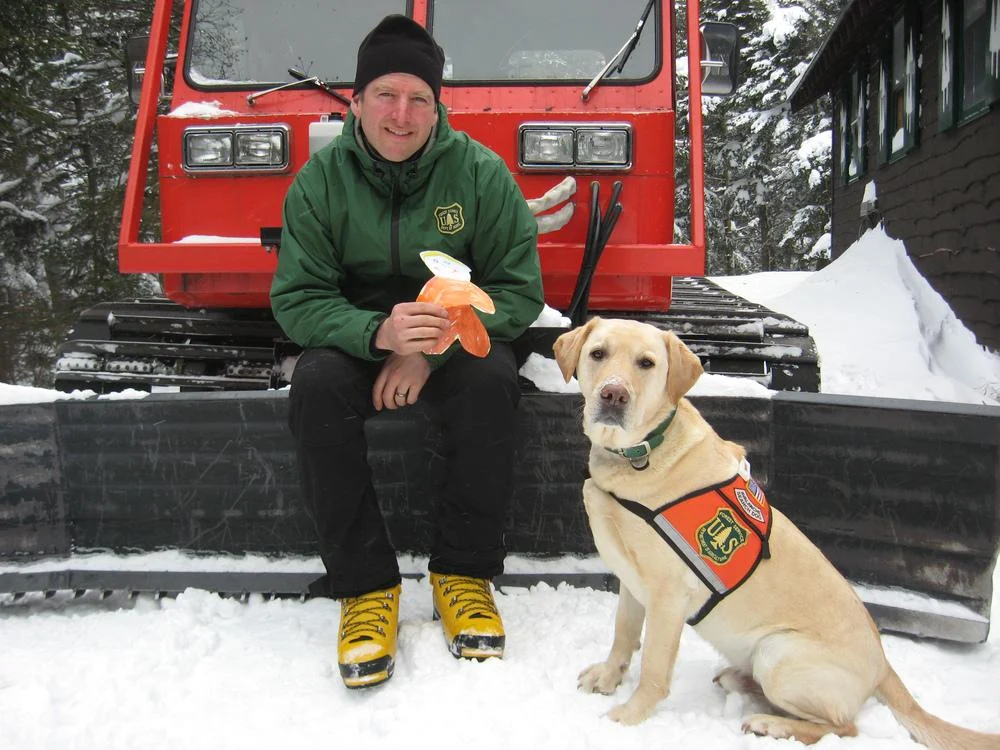
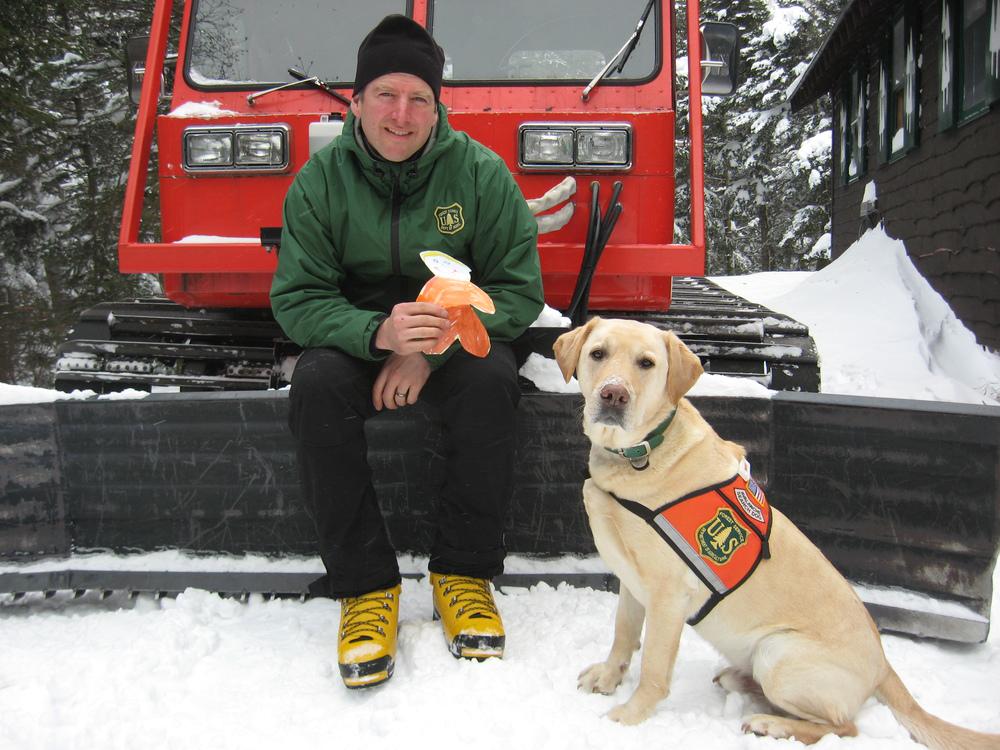
The mountaineering and search and rescue communities are mourning the loss of Cutler, a veteran avalanche rescue dog who served the Mount Washington Avalanche Center (MWAC) for over a decade. Cutler, a fixture of the White Mountain National Forest’s safety infrastructure, passed away recently at the age of 14, leaving behind a legacy of service that spanned 11 years. During his tenure, Cutler was responsible for patrolling some of the most dangerous alpine terrain in the Eastern United States, representing a critical component of the United States Forest Service (USFS) Snow Ranger program. His career was marked by a dual commitment to technical rescue proficiency and public safety education, bridging the gap between professional mountain responders and the thousands of recreationalists who visit the Presidential Range annually.
Mount Washington Avalanche Center Director Chris Joosen, who served as Cutler’s primary handler and partner throughout his career, confirmed the K9’s passing, noting that Cutler spent approximately 80% of his life dedicated to the safety of the mountain’s visitors. As the most prominent K9 unit in the region, Cutler’s presence was a staple in Tuckerman Ravine and Huntington Ravine, areas known for high-consequence avalanche terrain and extreme weather conditions. His passing marks the end of an era for the MWAC, highlighting the vital role that working dogs play in high-altitude search and rescue (SAR) operations.
A Career Defined by Vigilance and Service
Cutler’s entry into the world of mountain rescue began at a time when the use of specialized avalanche dogs was becoming increasingly vital for the US Forest Service in New England. While the White Mountains do not possess the same vertical scale as the Rockies or the Sierras, the Presidential Range is home to some of the most volatile weather on the planet. Mount Washington, in particular, is notorious for its "World’s Worst Weather," featuring hurricane-force winds and rapid snow accumulation that creates complex avalanche problems.
Over 11 years of active duty, Cutler was trained to navigate these harsh conditions. His primary responsibility was the detection of human scent buried under snowpack. In the event of an avalanche burial, time is the most critical factor in survival. Statistical data from the American Avalanche Association indicates that a victim’s chances of survival drop significantly after 15 to 30 minutes of burial. While human-led probe lines are the traditional method of searching an avalanche debris field, they are labor-intensive and slow. A single trained avalanche dog like Cutler can search a 100-meter by 100-meter area in approximately 20 minutes—a task that would take a team of 20 human rescuers up to four hours to complete with similar accuracy.
Cutler’s presence on the mountain provided the MWAC with a rapid-response capability that was essential for the high-density crowds seen in Tuckerman Ravine. During the peak spring skiing season, Tuckerman Ravine can see thousands of visitors in a single weekend. The logistical challenge of managing such a large volume of people in high-risk terrain necessitated a resource like Cutler, who could be deployed quickly to confirm or rule out burials following a slide.
The Strategic Importance of K9 Units in Mountain Rescue
The enrichment of the MWAC’s rescue capabilities through Cutler’s service cannot be overstated. Avalanche dogs are trained to utilize their olfactory senses to detect "scent cones" rising from the snow. This training involves rigorous drills where "victims" (volunteers) are buried in snow caves, and the dog must locate them and alert their handler by digging or barking.
Cutler excelled in these technical requirements, but his value extended beyond his nose. In the specialized field of mountain SAR, the "K9-Handler" bond is a force multiplier. Chris Joosen and Cutler operated as a single unit, with Joosen interpreting Cutler’s behavioral cues to assess the likelihood of a find. This partnership allowed the Snow Rangers to operate with greater efficiency during the chaotic aftermath of an avalanche.
Furthermore, the presence of a K9 unit provides a psychological benefit to both the rescue teams and the public. For rescuers, a dog provides a sense of certainty in a search area. For the public, the sight of a working dog often serves as a sobering reminder of the mountain’s inherent dangers. Cutler was not merely a tool; he was a highly specialized professional officer of the forest, contributing to a broader national network of K9 resources used by the USFS and organizations like the National Ski Patrol.
Mount Washington: A Proving Ground for Rescue Excellence
To understand the significance of Cutler’s 11-year career, one must consider the environment in which he worked. Mount Washington stands at 6,288 feet, but its reputation far exceeds its elevation. The mountain sits at the confluence of several major storm tracks, and the funneling effect of the surrounding topography creates extreme wind speeds. In April 1934, the Mount Washington Observatory recorded a wind gust of 231 mph, which remained the world record for several decades.
For an avalanche dog, these winds present a unique challenge. High winds disperse scent molecules, making the "scent cone" more difficult to track. Cutler’s ability to work effectively in the Presidential Range’s sub-zero temperatures and high-velocity winds demonstrated a level of hardiness and training that is rare even among working breeds. His work primarily focused on the eastern slopes, including the "Bowl" of Tuckerman Ravine, where snow can drift to depths of 40 to 50 feet.
The chronology of Cutler’s service aligns with a period of significant growth in backcountry skiing and winter hiking. As more people ventured into the White Mountain National Forest, the frequency of incidents increased. Data from the MWAC indicates that while avalanche fatalities in the region are relatively low compared to the Western US, the number of "near misses" and successful rescues is high. Cutler was a central figure in maintaining this safety record.
A Decade of Public Education and Outreach
While Cutler’s primary role was search and rescue, his secondary role in public relations was arguably just as impactful. The Mount Washington Avalanche Center is tasked not only with responding to accidents but also with preventing them through education. The "Snow Ranger" model relies heavily on public cooperation and adherence to avalanche bulletins.
Cutler became the "face" of the MWAC. His presence at the Pinkham Notch Visitor Center and the Hermit Lake Shelters allowed Snow Rangers to engage with the public in a way that was approachable and non-threatening. For many visitors, meeting Cutler was the entry point for a conversation about avalanche safety, beacon use, and the current "danger" rating on the daily bulletin.
"Cutler excelled at public relations," noted Joosen in his reflections on the dog’s career. By breaking the ice with visitors, Cutler helped the Snow Rangers reach a wider demographic, including casual hikers and families who might not otherwise seek out avalanche safety information. This proactive outreach is a cornerstone of modern wilderness management, where "preventative SAR" is prioritized to reduce the strain on emergency resources.
The Evolution of Avalanche Safety in the White Mountains
The passing of Cutler also serves as a moment to reflect on the evolution of the MWAC itself. Founded in the mid-20th century, the center has transitioned from a basic forecasting service to a sophisticated operation utilizing modern technology, GIS mapping, and specialized K9 units. Cutler’s career spanned a decade of these advancements.
In the early years of Cutler’s service, the focus was on establishing the K9 program as a reliable asset. By the time of his retirement, the program had proven its worth ten times over. The use of dogs in the White Mountains has set a standard for other East Coast rescue organizations. The integration of K9s into the USFS Snow Ranger program has shown that even in regions without the massive snowpacks of the Alps or the Cascades, the efficiency of a dog in a search scenario is an unmatched asset.
Implications and Future of the MWAC K9 Program
The loss of a veteran K9 like Cutler creates a temporary void in the physical assets of the MWAC, but his influence remains. The data and experience gathered during his 11 years of service will inform the training of future avalanche dogs in the region. The MWAC continues to emphasize the importance of K9 units, and plans for successor dogs often involve years of preparation and selection to find a candidate with the right temperament and drive.
The legacy of Cutler is also a testament to the dedication of the USFS Snow Rangers. These professionals work in some of the most unforgiving terrain in the country, often at great personal risk. The partnership between Joosen and Cutler exemplifies the commitment required to manage the Presidential Range safely.
As the backcountry community continues to grow, the lessons learned from Cutler’s career remain relevant. The importance of education, the need for rapid response capabilities, and the value of public engagement are all part of the blueprint Cutler helped create. His 14-year life, 11 of which were spent on the slopes of Mount Washington, stands as a record of remarkable service to the public and the natural world.
Conclusion
Cutler’s passing is a significant event for the White Mountain National Forest community. He was more than a working animal; he was a colleague to the Snow Rangers, a protector of the skiing community, and an ambassador for mountain safety. His 11 years of service represent a period of high-level performance in one of the most challenging environments in North America.
While the Mount Washington Avalanche Center will eventually move forward with new K9 units, the impact of Cutler’s tenure will be felt for years to come. He helped make the "deadliest small mountain in the world" a safer place for all who sought adventure on its slopes. As the snow continues to fall on Tuckerman Ravine, the memory of the dog who spent his life guarding those heights will endure as a symbol of the bond between humans, animals, and the mountains they serve.
