

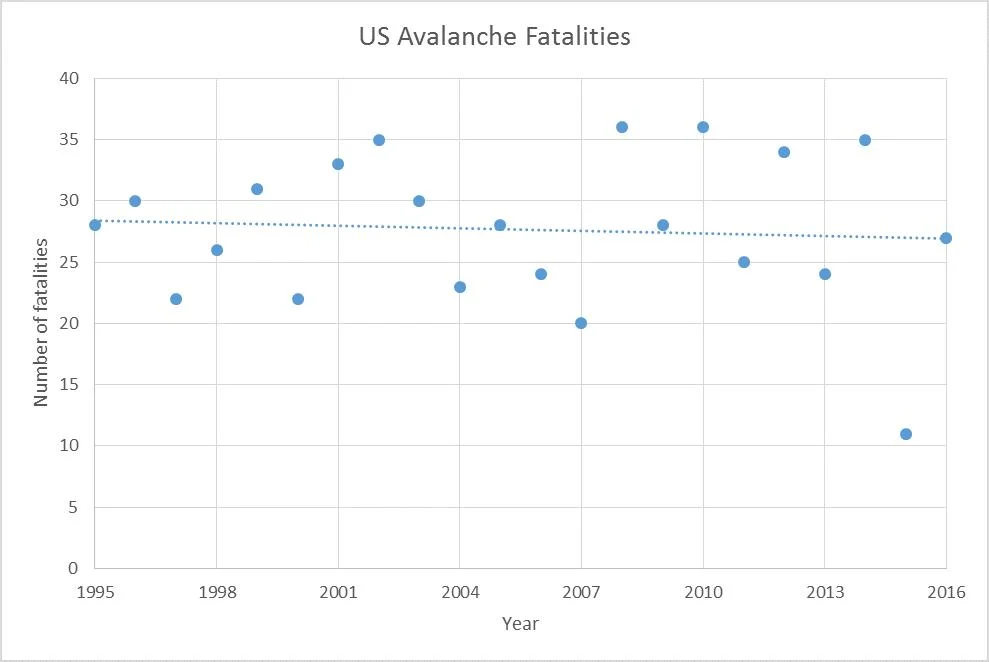
Statistical data compiled over more than two decades reveals a surprising trend in mountain safety: despite a massive surge in the number of people venturing into the American backcountry, the annual number of avalanche fatalities in the United States has remained remarkably stable. Analysis conducted by the Colorado Avalanche Information Center (CAIC) and leading snow scientists indicates that while the popularity of winter backcountry sports has grown exponentially since the mid-1990s, the expected spike in mountain-related deaths has failed to materialize. This divergence suggests a significant improvement in the safety-to-usage ratio, pointing toward the effectiveness of modern avalanche education, improved forecasting technology, and advancements in rescue equipment.
The 1994-1995 Baseline: A Different Era of Mountain Travel
To understand the current state of avalanche safety, researchers look back to the winter of 1994/95 as a pivotal benchmark. During this period, the landscape of backcountry recreation was fundamentally different from the high-tech, highly connected environment of the 21st century. At that time, the institutional framework for avalanche safety was in its relative infancy. Key figures in the field, such as Knox Williams in Denver, Bruce Tremper in Utah, and Mark Moore in Seattle, headed the only major avalanche centers in the country. Other regions, including the Chugach in Alaska, the Lake Tahoe basin, and Mount Shasta, lacked dedicated regional centers entirely.
The equipment used during the mid-90s also placed natural limits on how and where people recreated. Most backcountry skiers utilized telemark gear, often paired with leather boots that offered significantly less control and stability than modern alpine touring (AT) setups. Snowmobiles of the era lacked the power-to-weight ratios and specialized track designs of contemporary "mountain sleds," preventing riders from accessing the steep, high-elevation terrain where avalanches are most frequent. Furthermore, the concept of the "sidecountry"—accessible terrain located just outside ski resort boundaries—had not yet entered the mainstream lexicon, as most resorts maintained strictly closed boundaries.
The dissemination of safety information was similarly restricted. In 1995, the internet was only beginning to gain public traction. The first avalanche advisories were not posted to the web until the very end of that season; prior to that, recreationists relied on recorded telephone hotlines or physical bulletin boards at trailheads.
Analyzing the Statistical Flatline: 1994 to 2016
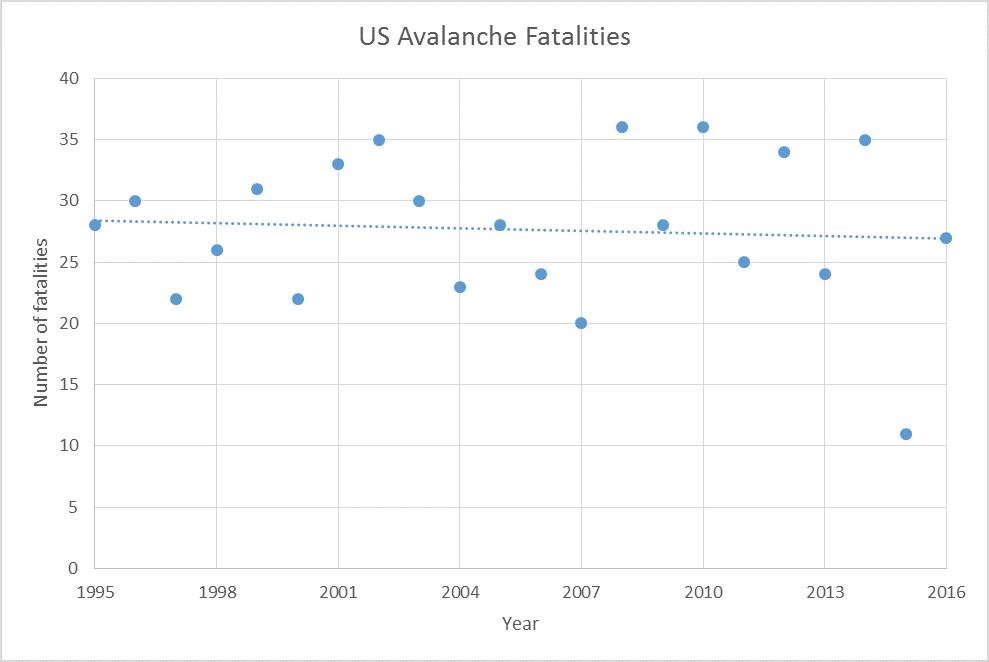
The primary metric for assessing avalanche risk is the annual fatality count. Data spanning 22 seasons, from 1994/95 through 2015/16, shows that the number of U.S. avalanche fatalities has not followed the upward trajectory of participation rates. A least-squares trend line applied to the total annual fatalities shows a slightly decreasing slope, though researchers note that this decrease is not statistically significant (p = 0.7). In statistical terms, a p-value of 0.7 indicates that there is no evidence of a definitive change in the number of deaths; the "flat line" remains the dominant feature of the data.
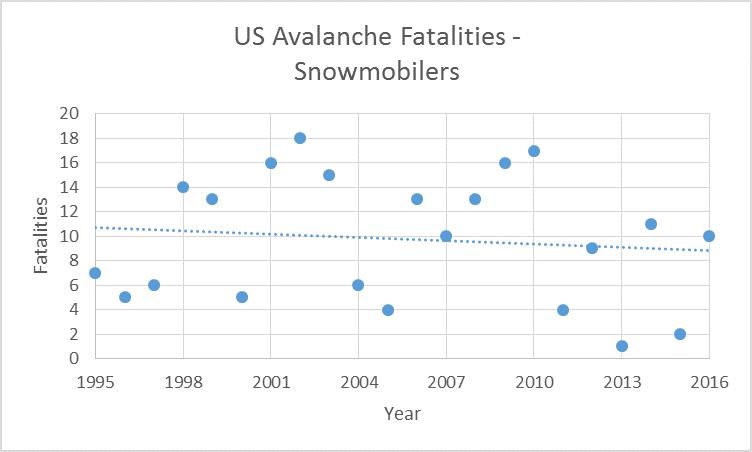
When the data is disaggregated by user group, specific trends emerge. Snowmobile-related fatalities have remained remarkably flat over the 22-year period (p = 0.6). This is particularly noteworthy given that snowmobile technology has advanced more rapidly than perhaps any other sector of the industry, allowing riders to reach deeper into the backcountry and traverse more dangerous slopes than was possible in the 1990s.
Conversely, there is some statistical evidence suggesting a slight increase in fatalities among backcountry skiers and snowboarders. With a p-value of 0.07, this trend approaches the threshold of statistical significance, though it still pales in comparison to the estimated growth in the number of people participating in these activities.
Measuring the "Explosion" in Backcountry Usage
Quantifying the exact number of people in the backcountry is notoriously difficult because, unlike ski resorts, the wilderness has no turnstiles or ticket sales. To solve this, researchers use "proxies"—indirect measurements that reflect general trends. One of the most reliable proxies is the usage of avalanche center advisories.
The growth in advisory hits over the 22-year study period is staggering. The Utah Avalanche Center reported a 12-fold increase in users accessing their forecasts. The Colorado Avalanche Information Center saw a 17-fold increase. More dramatic growth was observed in Montana, where the Gallatin National Forest Avalanche Center saw usage jump 36-fold, and in the Pacific Northwest, where the Northwest Avalanche Center recorded a 60-fold increase in engagement.
While some of this increase can be attributed to the transition from phone hotlines to mobile apps and websites, the sheer magnitude of the numbers indicates a massive influx of users. Even using a highly conservative estimate—assuming that actual backcountry use has increased by a factor of eight—the implications for the fatality rate are profound.
The Factor of Eight: A Dramatic Reduction in Relative Risk
If the number of people in the backcountry has increased eightfold while the number of deaths has remained the same, the "fatality rate" (the number of deaths per user-day) has effectively dropped by at least 800%. This is the most significant finding of the CAIC data analysis.
Snow safety experts argue that if the fatality rate had remained constant while usage grew, the United States would currently be seeing upwards of 200 avalanche deaths per winter. Instead, the annual average remains closer to 25 to 30. This suggests that a modern backcountry traveler is significantly less likely to be involved in a fatal accident than a traveler in the mid-1990s, despite the fact that today’s users are often venturing into more complex and dangerous terrain.
Drivers of Improved Safety: Education, Technology, and Infrastructure
The stability of the fatality rate is attributed to a multi-pronged evolution in the "culture of safety" within the winter sports community. Experts point to four primary pillars that have contributed to this success:
1. The Proliferation of Regional Avalanche Centers
The expansion of the National Avalanche Center network has been instrumental. Areas that were once "black holes" for information now have dedicated teams of professionals who provide daily, high-resolution terrain and snowpack analysis. These centers do more than just issue warnings; they provide the data necessary for users to make informed decisions about where—and where not—to travel.
2. Standardized and Accessible Education
Avalanche education has moved from a niche interest for professionals to a standard requirement for recreationalists. The "Know Before You Go" (KBYG) program, for instance, has introduced hundreds of thousands of people to the basics of avalanche awareness. Higher-level certifications provided by organizations like the American Institute for Avalanche Research and Education (AIARE) have standardized the way travelers assess risk and perform rescues.
3. Technological Advancements in Rescue Gear
The equipment available to the average user in 2016 was vastly superior to that of 1994. Modern digital beacons are faster and more intuitive than the analog models of the past, significantly reducing burial times. The introduction of the Avalung and, more importantly, the widespread adoption of avalanche airbag packs, has increased the chances of survival during an actual slide. Furthermore, the ubiquity of lightweight helmets and improved communication devices (such as satellite messengers) has mitigated the trauma and isolation factors of backcountry accidents.
4. Professionalism in Guiding and Ski Operations
The professional sector has also played a role. Backcountry guiding services and ski area "sidecountry" management have become more sophisticated. Resorts that once simply closed their boundaries now often provide "gates" that lead to backcountry terrain, accompanied by signage that reinforces the need for proper gear and training.
Institutional Responses and Future Implications
The findings presented by Karl Birkeland and the CAIC have been met with cautious optimism by the search and rescue community. While the "flat line" in fatalities is viewed as a major success for the avalanche safety industry, officials warn against complacency. The slight upward trend in skier and snowboarder fatalities suggests that as gear makes the backcountry more accessible, the margin for error may be shrinking.
The data underscores the necessity of continued funding for regional avalanche centers. As usage continues to grow, the demand for localized, real-time data will only increase. Public-private partnerships and federal support for these centers are now seen as essential components of public safety infrastructure in mountainous states.
Moreover, the analysis provides a roadmap for other high-risk outdoor activities. The "avalanche model"—combining professional forecasting, standardized public education, and technological innovation—is increasingly viewed as a gold standard for reducing accidents in unmanaged wilderness environments.
Conclusion
The 22-year period following the 1994/95 winter marks a transformative era in American mountain sports. The transition from leather boots and phone hotlines to carbon-fiber skis and smartphone-integrated beacons has changed the way humans interact with the winter environment. However, the most important change is not found in the gear, but in the statistics. By holding the line on fatalities during a period of unprecedented growth, the avalanche safety community has demonstrated that proactive education and robust information networks can effectively mitigate the inherent risks of the backcountry. As the community moves forward, the goal remains a "push toward zero," but the current stability of the fatality rate stands as a testament to two decades of progress in snow science and public safety.
