

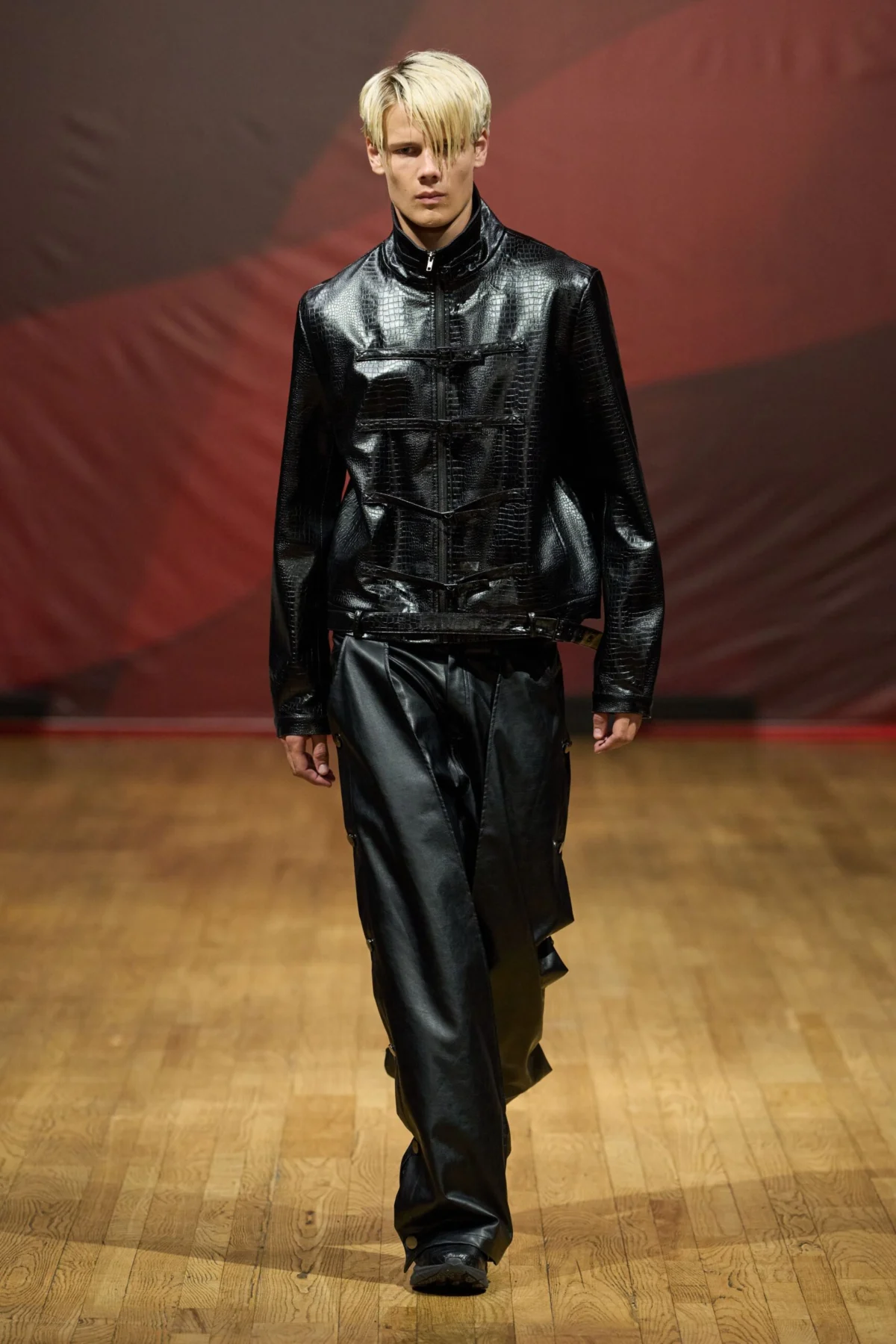
The air at the Advisry Spring 2027 Ready-to-Wear show was thick with a palpable tension, a reflection of the very sentiment designer Keith Herron sought to explore. In the wake of recent international travels, Herron, at 26, found himself grappling with a stark dichotomy: a widespread global sentiment of negativity towards the United States, juxtaposed with an enduring, almost fervent, love for its cultural output. This realization, a deeply personal yet universally resonant observation, served as the foundational impetus for his latest collection, a thoughtful and intricate exploration of American identity in a complex geopolitical moment.
Herron’s creative process for this season was deeply rooted in the 1970s, a decade marked by seismic shifts in both the political and cultural landscapes of America. This era, characterized by its own brand of societal upheaval and artistic revolution, provided a fertile ground for Herron to dissect the inherent ambivalence he perceived. “It really came from this anxiety that my generation tends to feel, that the world’s going to end,” Herron stated, articulating a sentiment of existential dread that has become increasingly prevalent among younger demographics navigating a world fraught with uncertainty. The collection, therefore, became a vehicle to unpack this generational anxiety, translating it into a tangible sartorial narrative.
Three Acts of American Identity
The Advisry Spring 2027 collection was meticulously structured into three distinct “acts,” each designed to represent different facets of how individuals and the collective psyche respond to a nation under immense pressure. Herron envisioned these acts as a journey through the emotional and intellectual responses to a country perceived as being in a state of flux. The narrative arc was not linear but cyclical, mirroring the ebb and flow of public opinion and personal resilience.
Throughout the show, the influence of artistic and cultural artifacts from the 1970s was undeniable. Herron cited Gil Scott-Heron’s seminal 1971 album, “Pieces of a Man,” as a conceptual soundtrack to the entire presentation, even if it didn’t literally play. This choice of reference speaks volumes about the collection’s thematic core: an engagement with the complexities of Black identity, social commentary, and the raw, unvarnished expression of the human condition that defined much of the era’s most impactful art. The album’s introspective and often critical examination of societal issues resonated with Herron’s own feelings about contemporary America.
Visualizing Stoicism and Unraveling Perfection
The collection’s overt embrace of American stoicism was perhaps most vividly embodied in a striking cape. This piece was intricately woven with the visages of prominent figures recognized as American icons: director Spike Lee, musician Pharrell Williams, tennis legends Venus and Serena Williams, and the late designer Virgil Abloh. The words “American Heroes” were emblazoned across the cape, leaving no room for misinterpretation. This deliberate inclusion served as a powerful visual tribute to individuals who have significantly shaped American culture and continue to inspire.
Beyond such explicit declarations, the collection’s messaging was subtly woven into the very construction and deconstruction of the garments. Act one featured straitjackets crafted from croc leather, a material often associated with control and confinement. In act three, these same garments reappeared, but reimagined. The straitjackets were reinterpreted with a looser, less constrictive silhouette, suggesting a liberation from societal or internal pressures. This evolution from constraint to a more fluid form symbolized a potential path towards healing and adaptation.
Furthermore, finely woven jackets were presented with frayed seams, a sartorial metaphor for the pursuit of perfection in the face of inevitable unraveling. This detail speaks to the precariousness of established ideals and the inherent beauty found in imperfection and the ongoing process of becoming. Another compelling piece was a denim jacket, ingeniously reimagined. It was flipped upside down and transformed into a dress, a striking visual representation of inversion and the deconstruction of traditional forms, challenging conventional notions of garment construction and gendered dressing.
The Evolution of Advisry and Brand Codes
Keith Herron’s journey with Advisry is a testament to his early entrepreneurial spirit. Having founded the brand at the remarkably young age of 13, Herron has guided Advisry through numerous iterations and evolving creative directions. After debuting his Spring/Summer 2024 collection at New York Fashion Week, the designer took a two-year hiatus, re-emerging on the fashion calendar last year. This period of reflection and recalibration appears to have been crucial in solidifying the brand’s identity.
Currently, Herron is focused on establishing and reinforcing Advisry’s signature aesthetic. This season, recurring silhouettes like the blazer cape made a reappearance, this time rendered in a refined bouclé wool, showcasing a commitment to evolving signature pieces while maintaining brand continuity. The consistent presence of plaid fabric, a recurring motif that appeared as tartan in SS27, further solidifies Advisry’s visual language. Advisry’s now-classic sparkly sweaters and pearl adornments also graced the runway, pieces that have become recognizable hallmarks of the brand. The inclusion of these established elements, often seen worn by attendees from previous seasons, underscores Herron’s strategy of building a cohesive and recognizable brand narrative.
“A lot of the mission of the collection is to continue establishing brand codes and repeating silhouettes so that they can become a part of this language,” Herron explained. This deliberate approach to brand building is crucial for a young designer seeking to carve out a distinct space in the competitive fashion industry. By consistently reinterpreting and refining core design elements, Herron aims to create a recognizable and enduring visual vocabulary for Advisry.
Context and Industry Reaction
The Advisry Spring 2027 show took place within the bustling framework of New York Fashion Week (NYFW), a globally recognized platform for designers to showcase their latest collections. NYFW, held semi-annually in February and September, is a cornerstone of the fashion calendar, attracting designers, buyers, press, and influencers from around the world. For emerging designers like Herron, NYFW offers an invaluable opportunity to gain visibility, connect with industry professionals, and build their brand’s reputation.
Herron’s decision to return to the NYFW calendar after a two-year break signals a renewed commitment to the established fashion system. His focus on building "brand codes" and "repeating silhouettes" aligns with industry best practices for brand development. Established brands often rely on recognizable motifs and consistent design elements to build customer loyalty and brand recognition. By prioritizing these aspects, Herron is positioning Advisry for sustained growth and influence.
Industry analysts have noted the increasing trend of designers using their collections to address broader social and political themes. Herron’s exploration of American identity, with its inherent complexities and contradictions, taps into a contemporary zeitgeist. The fashion industry, often seen as a barometer of cultural sentiment, frequently provides a platform for designers to comment on the world around them. Herron’s approach, blending personal reflection with historical context and cultural commentary, is a sophisticated way to engage with these pressing issues.
Broader Implications and Future Outlook
The dual focus of Herron’s collection—acknowledging global discontent while celebrating American cultural achievements—raises important questions about national identity and perception in the 21st century. In an era of heightened global connectivity and rapid information dissemination, the image of a nation is constantly being shaped and reshaped. Herron’s work suggests that while political or economic critiques may be prevalent, the soft power of a country’s cultural output—its art, music, fashion, and entertainment—can endure and even thrive.
The implications of this duality are significant. For policymakers and cultural institutions, it highlights the enduring importance of fostering and promoting a nation’s creative industries. For consumers, it suggests a nuanced approach to engaging with foreign cultures, separating critical analysis from genuine appreciation for artistic contributions.
As Advisry continues to mature, the industry will be watching to see how Keith Herron further refines these developing codes. The success of his strategy will lie in his ability to maintain the authenticity of his vision while evolving his aesthetic to meet the ever-changing demands of the fashion landscape. His commitment to thoughtful design, coupled with his willingness to engage with complex societal issues, positions Advisry as a brand with the potential to make a lasting impact. The journey from a young entrepreneur to a designer addressing profound themes of national identity at NYFW is a narrative in itself, one that promises continued evolution and compelling contributions to the world of fashion.
