

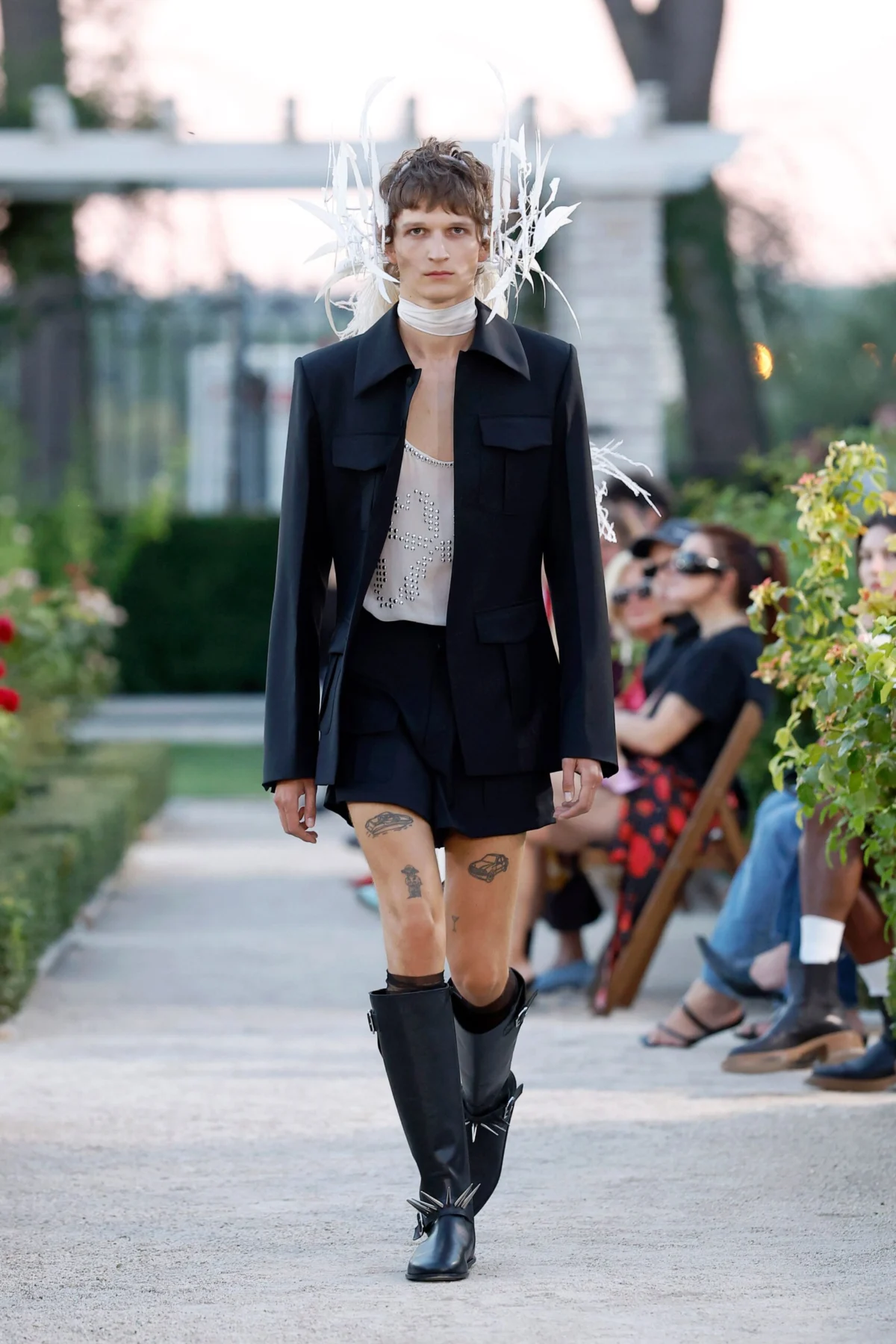
The recent presentation by Spanish designer Alejandro Gómez Palomo, christened "Arcadia," marked a pivotal moment in his burgeoning career, solidifying his reputation as a boundary-pushing visionary in the contemporary fashion landscape. Held against the backdrop of a highly anticipated fashion week, the collection not only showcased Palomo’s distinctive aesthetic but also reinforced his overarching philosophy of sartorial liberation, blurring the lines between traditional menswear and womenswear with audacious flair. The collection’s introduction, featuring a model in a striking ensemble of black shirt, vibrant pink trousers, and a green bow cummerbund, was accessorized with a copy of Virginia Woolf’s seminal novel, Orlando. This choice was a deliberate and potent symbol, referencing a protagonist whose life spans centuries and whose gender transitions from male to female, mirroring Palomo’s own journey of dismantling gendered clothing conventions. This narrative resonance underscored the collection’s thematic core: a celebration of fluidity, transformation, and an inclusive vision of beauty.
The Genesis of Arcadia: A Vision of Inclusive Glamour
Alejandro Gómez Palomo, known for his eponymous label Palomo Spain, has consistently challenged established norms since his brand’s inception. His approach to fashion is deeply rooted in a desire to create an "ideal society where everyone is glamorous and beautiful and we all live happily ever after in peace and everyone is welcome." This utopian ideal, as articulated by the designer himself, served as the bedrock for the "Arcadia" collection. The collection’s name itself evokes a pastoral, idealized realm, a stark contrast to the often rigid and exclusive world of high fashion.
Palomo’s trajectory has been marked by a rapid ascent. Having initially gained international acclaim for his avant-garde menswear, he strategically expanded into womenswear with a highly anticipated launch slated for June 2025. The "Arcadia" collection represents a crucial phase in this evolution, demonstrating his commitment to seamlessly integrating his established menswear sensibilities with his developing womenswear offerings. The designer himself acknowledged the inherent challenges in this endeavor, stating, "Palomo is still learning how to mesh womenswear with his core, menswear, while at the same time making his mark in ready-to-wear, which is challenging." However, the collection’s execution suggested a confident stride forward, as the gender divide seemed less a barrier and more an invitation for creative exploration.
A Tapestry of Inclusivity: Genderless Silhouettes and Embellishments
The "Arcadia" collection eschewed rigid gender distinctions, embracing a spirit of universal glamour. The runway was a vibrant testament to this ethos, featuring a harmonious blend of traditionally masculine and feminine elements applied to all models. The mantra for the season appeared to be "cargos, rhinestones, and feathers for all," a democratic approach to adornment that celebrated individual expression over prescribed gender roles. While the models may not have worn identical garments resized, the stylistic vocabulary was shared, creating a cohesive and inclusive vision.
The collection’s primary theme revolved around elevating everyday classics into luxurious statements. This was achieved through the use of opulent fabrics and an abundance of dazzling embellishments. Denim, a ubiquitous material, was reimagined with an artisanal touch. Jeans were seen adorned with intricately couched rhinestones and feathers, or embellished with studs meticulously arranged in delicate rose patterns. This reinterpretation of denim speaks to Palomo’s ability to imbue even the most casual items with an air of high fashion and sophisticated craftsmanship.
Palomo expressed particular pride in the collection’s tailored womenswear pieces, highlighting a "trim women’s pantsuit" and a "bias-cut slip dress," both rendered in a striking, vibrant red. These pieces exemplify his mastery of silhouette and his confident use of bold color, demonstrating a growing fluency in designing for a female audience while retaining his signature avant-garde edge. The bias cut, a technique known for its ability to drape fluidly and flatter the body, was employed to create garments that were both elegant and sensual.
Beyond the Everyday: Extravagance and Signature Palomo Touches
While the collection championed accessible luxury, it also embraced moments of unapologetic extravagance. One standout look featured a fabric heavily beaded with rows of fringed scallops, artfully paired with opulent velvet. This combination showcased Palomo’s penchant for textural interplay and his ability to create garments that are both visually arresting and tactilely rich.
Feather embellishments and accessories have become a recognizable hallmark of Palomo Spain’s collections. In "Arcadia," these elements continued to feature prominently, perhaps to the point of becoming an established signature. While they undoubtedly contribute to the brand’s distinctive identity, the repetition raises questions about the evolution of his signature motifs.
A particularly noteworthy piece that encapsulated the "peak Palomo" aesthetic was a pink jacquard dress. Its design featured a strategically placed strap that fell seductively off the shoulder, worn over a studded white slip that echoed the same silhouette. This juxtaposition of classic elegance with edgy detailing was a recurring theme. However, the collection also presented a codpiece crafted from the same pink jacquard fabric. While undeniably audacious and true to Palomo’s penchant for pushing boundaries, this particular piece served as a stark reminder of his deep roots in menswear and his fearless exploration of historically masculine sartorial elements within a contemporary, fluid context.
Contextualizing the Collection: Fashion Week’s Evolving Landscape
The presentation of "Arcadia" took place within the dynamic ecosystem of a major fashion week. These events, typically held biannually in global fashion capitals like Paris, Milan, London, and New York, serve as crucial platforms for designers to showcase their latest collections to a global audience of buyers, press, and influencers. The schedule for these events is meticulously planned, with designers vying for prime slots to maximize visibility and impact.
For a designer like Palomo, who is navigating the expansion into womenswear while solidifying his ready-to-wear presence, the timing and placement of his show are critical. The industry has been observing his progress with keen interest, particularly his ability to translate his unique design language to a broader market. Industry analysts have noted a growing demand for gender-neutral or gender-fluid fashion, a trend that Palomo has been instrumental in championing. Data from fashion research firms indicates a significant increase in consumer interest in brands that offer inclusive sizing and gender-fluid collections, with market projections suggesting continued growth in this segment.
The impact of a successful fashion week show extends beyond immediate sales. It shapes brand perception, influences editorial coverage, and sets trends that trickle down through the industry. For Palomo Spain, "Arcadia" aimed to reinforce its position as a forward-thinking brand committed to inclusivity and creative innovation. The positive reception from critics and attendees alike would translate into increased media attention, stronger relationships with retailers, and ultimately, a more robust global presence.
The Palomo Spain Philosophy: Beyond Clothing
Alejandro Gómez Palomo’s design philosophy is more than just about creating beautiful garments; it is a form of activism. By consistently challenging traditional gender roles in fashion, he is contributing to a broader cultural conversation about identity, self-expression, and societal expectations. His work resonates with a generation that is increasingly rejecting binary thinking and embracing a more fluid understanding of self.
The inclusion of Orlando as an accessory was a subtle yet powerful statement, linking his designs to a literary work that has long been a touchstone for discussions on gender and identity. Virginia Woolf’s novel, first published in 1928, was groundbreaking for its exploration of a protagonist who lives for centuries and changes sex. The novel’s enduring relevance lies in its prescient examination of the social constructs surrounding gender, a theme that Palomo’s collections directly address.
Looking Ahead: Implications for the Fashion Industry
The success of "Arcadia" has significant implications for the fashion industry. It reinforces the viability of gender-fluid design and demonstrates that inclusivity can be a commercial asset. As more brands grapple with the evolving demands of consumers and the societal shifts towards greater acceptance of diverse identities, Palomo’s approach offers a compelling blueprint.
The challenges Palomo faces in merging his menswear heritage with his womenswear aspirations are not unique. Many designers are exploring similar avenues, seeking to create collections that appeal to a broader audience without compromising their artistic integrity. The "Arcadia" collection suggests that with a clear vision and a commitment to innovation, these challenges can be overcome.
The fashion industry, often criticized for its conservatism, is at a critical juncture. Brands that embrace authenticity, inclusivity, and forward-thinking design, like Palomo Spain, are poised to lead the way. "Arcadia" is not merely a collection of clothes; it is a statement of intent, a celebration of individuality, and a glimpse into a more inclusive and glamorous future for fashion. The designer’s unwavering commitment to his vision, coupled with his growing mastery of design and execution, positions him as a significant force shaping the future of contemporary fashion.
