

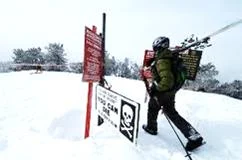
The distinction between managed ski resort terrain and the rugged wilderness of the American backcountry has become increasingly blurred, leading to a rise in high-stakes incidents involving winter sports enthusiasts. While many of the premier ski destinations in the United States are situated on or immediately adjacent to expansive public lands, a dangerous misconception persists among the skiing and snowboarding public: the belief that proximity to a chairlift equates to safety. This specific subset of terrain, colloquially known as the "sidecountry," represents a unique jurisdictional and safety vacuum. Although accessed through gates located at the top of commercial lifts, these areas are neither patrolled nor mitigated for avalanche hazards. Once a rider passes through a boundary gate, they transition from a highly regulated environment—where professional ski patrols use explosives and "ski cutting" to stabilize the snowpack—to a raw, "Rated R" wilderness where the responsibility for survival rests entirely on the individual.
The Illusion of Proximity and the Definition of Sidecountry
The term "sidecountry" is frequently criticized by snow safety experts because it implies a "backcountry-lite" experience. In reality, the snow does not recognize the nylon rope or the wooden sign marking the resort boundary. The physical characteristics of the terrain—slope angle, aspect, and snowpack layering—remain identical on both sides of the fence. However, the management of those two spaces is diametrically opposed. Inside the boundary, the resort assumes a duty of care to mitigate known hazards like avalanches. Outside the boundary, even if the terrain is visible from the lodge, it is functionally as remote as the deepest wilderness.
The "Rated R" designation, a concept championed by avalanche safety advocates like Doug Abromeit, serves as a metaphor for the maturity and preparation required to navigate these areas. Just as an R-rated film contains content deemed unsuitable for unsupervised minors, sidecountry terrain contains objective hazards that require an adult level of risk assessment, technical skill, and specialized equipment. The central concern for safety officials is the "parking lot factor": parents often drop their children off at a resort under the assumption that they are in a controlled environment, unaware that those same children may be venturing through boundary gates into terrain for which they have neither the training nor the tools to survive.
Historical Context and the Evolution of Access
The current state of sidecountry access is the result of a decades-long evolution in land management and equipment technology. Historically, many ski resorts maintained "closed boundary" policies, where exiting the resort was strictly prohibited and could result in the revocation of lift tickets or even legal prosecution. However, during the 1990s and early 2000s, pressure from the public and changes in US Forest Service (USFS) philosophies led to a "managed access" model. Under this system, resorts located on public land are generally required to provide access to the surrounding national forests.
This policy shift coincided with a revolution in ski and snowboard technology. The advent of "fat" skis and splitboards made deep powder more accessible to intermediate riders who previously lacked the technique to navigate ungroomed snow. As the equipment made the terrain easier to ride, the number of people exiting resort gates skyrocketed. This surge in participation has not been matched by a proportional increase in avalanche education. Consequently, the "sidecountry" has become one of the most dangerous sectors of the winter sports industry, as it attracts the highest concentration of unprepared recreationists.
Statistical Trends in Avalanche Fatalities and Incidents
Data from the Colorado Avalanche Information Center (CAIC) and the Northwest Avalanche Center (NWAC) highlight a sobering trend in winter recreation. Over the last twenty years, the United States has averaged approximately 27 avalanche fatalities per season. While the majority of these occur in the deep backcountry, a significant and recurring percentage involves riders who accessed the terrain via a ski resort lift.
Analysis of accident reports reveals several recurring factors in sidecountry incidents:
- Lack of Essential Gear: A staggering number of sidecountry riders are found without the "big three" safety items: an avalanche transceiver, a probe, and a collapsible shovel.
- The "Expert Trap": Riders often follow existing tracks through a gate, assuming that if someone else rode the slope, it must be stable. In snow science, this is known as "social proof," and it is frequently a fatal fallacy.
- Inadequate Rescue Training: Even among those carrying gear, many lack the practice required to execute a companion rescue within the critical 15-minute window before a buried victim suffocates.
- Solo Riding: Many riders venture into the sidecountry alone or become separated from their group, making a successful rescue nearly impossible if an slide occurs.
According to national data, nearly 90% of avalanches that involve human subjects are triggered by the victim or someone in the victim’s party. In the sidecountry, where traffic is high, the risk of "remote triggering"—where one person’s weight collapses a snow layer that causes an avalanche on a nearby slope—is significantly elevated.
The Jurisdictional Reality and the Burden on Search and Rescue
One of the most critical misunderstandings among sidecountry users is the role of the Ski Patrol. Professional patrollers are experts in mountain safety, but their primary mandate is the safety of the paying customers within the resort’s operational boundaries. When an accident occurs outside the gate, the responsibility for rescue typically falls to the county sheriff’s office and local volunteer Search and Rescue (SAR) teams.
The logistics of a sidecountry rescue are complex and hazardous. Because the terrain is uncontrolled, SAR teams must first evaluate the safety of the slope for their own members before entering the debris field. This process can take hours, whereas an avalanche victim’s chances of survival drop below 30% after just 30 minutes of burial. Furthermore, the cost of these operations is often staggering, involving helicopters, specialized medical equipment, and dozens of personnel. In many jurisdictions, the individual rescued may be held liable for the costs of the operation if they are found to have been negligent or entered a closed area.
Human Factors and Heuristic Traps
Modern avalanche education, such as the curriculum provided by the American Institute for Avalanche Research and Education (AIARE), focuses heavily on the "human factors" that lead to poor decision-making. In the sidecountry, these "heuristic traps" are amplified.
- Familiarity: Because the terrain is close to a familiar resort, riders underestimate the danger.
- Scarcity: The desire to get "fresh tracks" before others can lead riders to ignore obvious red flags in the snowpack, such as recent "whumpfing" sounds or visible cracks.
- Social Buffer: The presence of other people nearby creates a false sense of security, leading individuals to believe that help is just a shout away.
The "Rated R" analogy fits perfectly here: it suggests that the terrain requires a level of "adult" skepticism. An adult risk-taker looks at a slope and sees a potential fracture line; a "juvenile" risk-taker (regardless of actual age) sees only a playground.
Industry Responses and Safety Initiatives
In response to the growing number of sidecountry incidents, the ski industry and avalanche centers have launched aggressive educational campaigns. Many resorts have installed "transceiver check" stations at boundary gates, which beep to confirm that a rider’s beacon is transmitting. These stations serve as both a safety tool and a psychological deterrent, reminding riders that they are entering a zone where life-saving equipment is mandatory.
Furthermore, organizations like Avalanche.org serve as central hubs for daily forecasts, providing color-coded danger scales (Low, Moderate, Considerable, High, Extreme). Experts emphasize that a "Moderate" rating can be particularly dangerous, as it implies that while avalanches are not certain, they are "possible" on specific features—features that are often the most tempting to sidecountry riders.
Implications for the Future of Mountain Recreation
The debate over sidecountry access touches on the fundamental tension between personal freedom and public safety. As ski resorts continue to expand and more people seek an escape from crowded, groomed runs, the pressure on uncontrolled public lands will only increase.
The legal implications are also evolving. While "Skier Safety Acts" in many states protect resorts from liability regarding the inherent risks of skiing, the nuances of boundary management are frequently litigated. If a resort fails to clearly mark a boundary or leaves a gate open during high-hazard conditions, they may face legal challenges, even if the incident occurred on USFS land.
Ultimately, the "Rated R" nature of the sidecountry demands a cultural shift. It requires a move away from the "lift-served" mindset toward a "mountaineering" mindset. For the parent waving goodbye in the parking lot, the message is clear: the resort is a controlled environment, but the gate is a portal to a world where nature makes the rules. Education, proper equipment, and a sober assessment of one’s own skills are the only ways to ensure that a day in the sidecountry does not end in tragedy. The mountains are indifferent to whether a rider has a lift ticket; they respond only to the physics of the snow and the choices made by those who dare to traverse them.
