

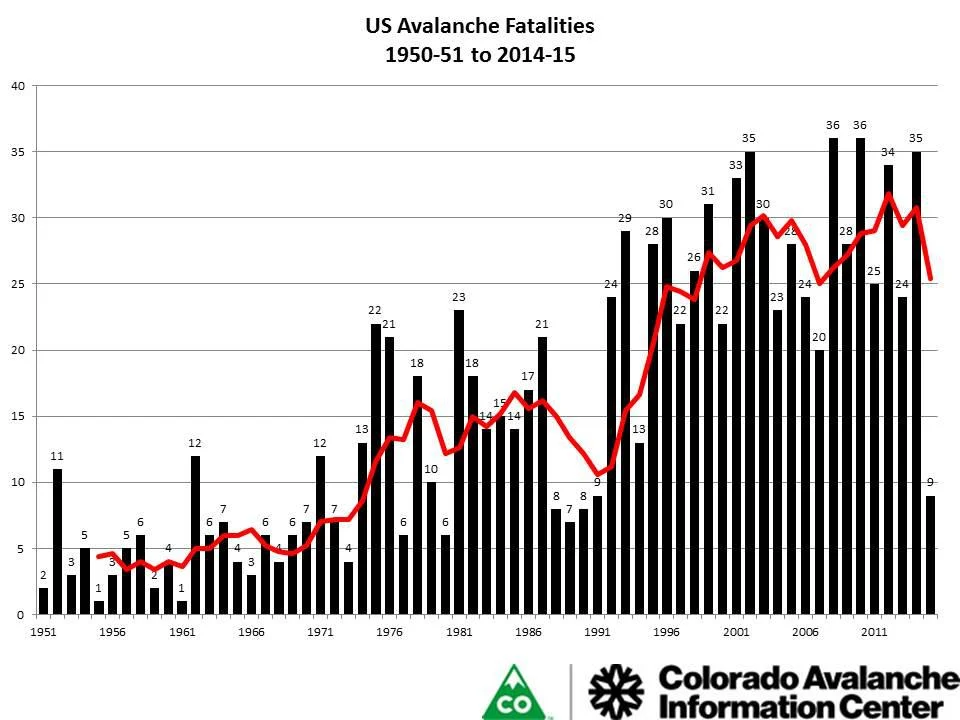
As the calendar turns to April 30, marking the traditional conclusion of the primary avalanche monitoring season in the United States, data released by national safety organizations reveals a significant and encouraging decline in winter backcountry fatalities. For the 2014-2015 season, the United States recorded a total of nine avalanche-related deaths, the lowest figure documented since 1991. This sharp decrease comes as a relief to safety officials and land managers, particularly following a decade characterized by a surge in backcountry recreation. While the loss of any life remains a tragedy for the outdoor community, the single-digit fatality count represents a substantial departure from the 5-year moving average, which has historically fluctuated between 25 and 30 deaths per year.
Experts attribute this notable decline to a combination of two primary factors: anomalous weather patterns that resulted in a less reactive snowpack across much of the Western United States, and the increasingly effective reach of avalanche education and forecasting services. The 2014-2015 season served as a unique case study in how environmental conditions and human behavior intersect to determine the relative safety of the mountain environment.
Climatological Drivers: The Impact of Warm Temperatures and Low Snowfall
The primary driver behind the reduced fatality rate appears to be the atypical meteorological conditions that defined the 2014-2015 winter. Throughout much of the West Coast, particularly in the Sierra Nevada of California and the Cascades of Oregon and Washington, the season was characterized by a "snow drought." Record-low snowpack levels were reported in these regions, with many high-altitude areas seeing bare ground during months that usually feature several feet of accumulation. In the absence of a significant snowpack, the physical requirements for large-scale, life-threatening avalanches were simply not met in many popular backcountry destinations.
Further inland, across the Intermountain West and the Rocky Mountains, the season was defined by unseasonably warm temperatures rather than a total lack of precipitation. In a typical winter, cold temperatures can lead to the development of "facets" or "depth hoar"—weak, sugary layers of snow near the ground that act as a precarious foundation for subsequent storms. These "persistent weak layers" are often responsible for the most unpredictable and deadly deep-slab avalanches. However, during the 2014-2015 cycle, the warmth helped the snowpack settle and gain strength more rapidly.
According to data maintained by the Colorado Avalanche Information Center (CAIC), the warmer-than-average temperatures facilitated a process of snow metamorphism that favored stability over instability. While spring-like "wet slide" cycles occurred, these are generally more predictable and easier for recreationists to avoid than the "cold-smoke" powder avalanches or deep-slab releases common in colder, more volatile winters. Consequently, the "avalanche danger" ratings issued by regional centers remained at "Low" or "Moderate" for extended periods, reducing the overall window of high risk for skiers, snowboarders, and snowmobilers.
The Evolution of Backcountry Safety: Education as a Lifesaving Tool
Beyond the favorable weather, safety officials are pointing toward the success of public education campaigns as a secondary, yet vital, reason for the low fatality count. The United States Forest Service (USFS) National Avalanche Center and the CAIC have spent the last decade modernizing their approach to risk communication. These efforts have moved beyond simple daily bulletins to include sophisticated mobile applications, real-time social media updates, and interactive maps that allow users to visualize terrain hazards.
The "Know Before You Go" program, a collaborative effort between various avalanche centers and industry partners, has been credited with reaching a younger and broader demographic of backcountry users. By emphasizing five key pillars—Get the Gear, Get the Training, Get the Forecast, Get the Picture, and Get Out of Harm’s Way—the program has standardized the safety curriculum across the country.
In Colorado specifically, the CAIC has been instrumental in maintaining the U.S. avalanche accident database, a task overseen by researchers such as Spencer Logan. This database allows experts to analyze not just where and when accidents happen, but why they happen. By studying human factors—the psychological heuristics that lead people to make poor decisions in high-risk terrain—educators have been able to tailor their messaging to address the "expert halo" effect and social pressures that often lead to accidents.
Analyzing the Five-Year Moving Average: Stability in a Growing Market
One of the most compelling aspects of the 2014-2015 data is how it fits into long-term trends. Over the past 15 years, the outdoor industry has reported a "skyrocketing" increase in the sale of backcountry-specific equipment, such as alpine touring (AT) bindings, splitboards, and snowmobile modifications. Participation in backcountry skiing and snowshoeing has grown by double-digit percentages annually in some regions.
Logically, a massive increase in the number of people entering avalanche terrain should result in a proportional increase in fatalities. However, the 5-year moving average has remained remarkably stable, holding steady between 25 and 30 deaths per year. The fact that the fatality rate is not rising alongside the participation rate suggests that the "death rate per capita" among backcountry users is actually declining.
This stability indicates a "leveling up" of the average user’s knowledge. Fifteen years ago, it was common for users to enter the backcountry without a beacon, probe, or shovel. Today, these tools are considered the bare minimum, and an increasing number of recreationists are also investing in avalanche airbags—devices designed to keep a victim on the surface of a slide. While gear is never a substitute for good decision-making, the combination of better equipment and better information appears to be creating a safety buffer that is keeping the annual death toll from spiraling upward.
Regional Variations and the Role of the CAIC
The Colorado Avalanche Information Center remains the gold standard for avalanche forecasting and data collection in North America. By providing the graphic and data for the 2014-2015 season, the CAIC highlighted the importance of inter-agency cooperation. Spencer Logan and the CAIC staff work closely with the USFS to ensure that data from remote mountain ranges in Alaska, the Wasatch in Utah, and the Tetons in Wyoming are all synthesized into a cohesive national picture.
In a typical year, Colorado leads the nation in avalanche fatalities due to its "continental" snowpack, which is notoriously thin and weak. However, the 2014-2015 season saw a shift where the risks were more evenly distributed or, in many cases, suppressed by the aforementioned weather patterns. The ability of the CAIC to maintain this database is crucial for federal funding and for the strategic placement of forecasting staff in high-use areas.
Broader Implications and the Future of Avalanche Forecasting
While the nine fatalities of 2014-2015 are a historic low, experts caution against complacency. The "low" numbers are largely seen as a statistical outlier caused by a specific set of climatic conditions that may not repeat in the coming years. In fact, some researchers suggest that as climate change leads to more extreme weather volatility, future seasons could see "boom and bust" cycles of avalanche activity.
A return to a "normal" or "heavy" snow year, particularly one with early-season cold snaps, could easily push fatality numbers back toward or above the 30-person average. The challenge for the Forest Service and state-funded centers will be to maintain the current momentum of educational outreach even when the "danger" is not as visible as it was during the record-breaking winters of the late 2000s.
Furthermore, the 2014-2015 season highlights the necessity of "situational awareness." In a year with low overall danger, the accidents that do occur often happen during isolated storm events where users are caught off guard by a sudden change in conditions. The data underscores the reality that even in a "safe" year, the mountains remain a dynamic environment where the margin for error is slim.
Conclusion: A Season of Success and Reflection
As the 2014-2015 avalanche season winds down, the outdoor community can reflect on a year that was unexpectedly safe. The figure of nine fatalities is a testament to the hard work of forecasters, the effectiveness of modern safety campaigns, and a stroke of atmospheric luck.
Moving forward, the focus of organizations like the CAIC and the USFS will remain on the long-term trend. The goal is to decouple the participation rate from the fatality rate permanently. If the 5-year moving average can be pushed below its current 25-30 person plateau, it will signal a new era of backcountry safety where technology and education finally outpace the inherent risks of the winter wilderness. For now, the 2014-2015 season stands as a benchmark—a reminder of what is possible when favorable conditions and informed users coincide.
