

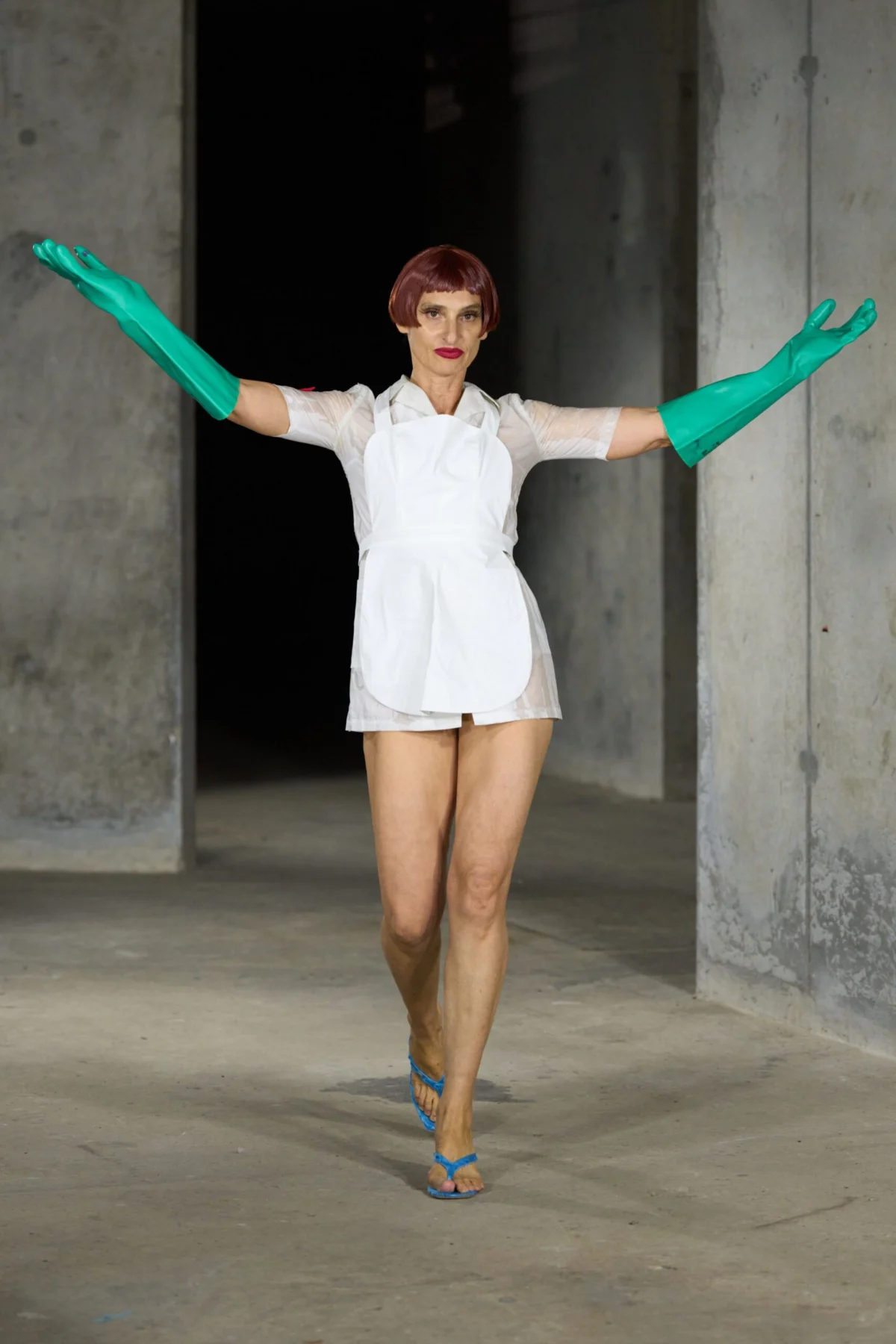
The fashion world convened in a subterranean London venue, a former brutalist theater, for Natasha Zinko’s Spring 2027 collection, aptly titled "Pay Per View." This season, Zinko delved into the complex and often unsettling dynamics of being perpetually observed, a theme deeply rooted in contemporary society’s pervasive engagement with live-streaming and social media. The designer’s exploration was not merely conceptual but manifest in a groundbreaking presentation that blurred the lines between performance art, fashion, and the very nature of identity in the digital spotlight.
Genesis of a Concept: Role-Play and the Panopticon
Zinko’s creative process for "Pay Per View" began with a profound contemplation of role-playing. "Every day offers people a new role to play," the designer stated in her west London studio, which uniquely functions as her atelier and factory, just prior to the show. This realization led her to question the necessity of elaborate costumes or external stimuli to adopt different personas. Her own studio environment, where patterns are meticulously cut in-house and many looks are constructed for high-profile clients like Charli XCX and Doja Cat, served as a microcosm of this idea, demonstrating the creative capacity inherent in her directorship.
The conceptual bedrock of "Pay Per View" was significantly influenced by Michel Foucault’s examination of Jeremy Bentham’s panopticon. This architectural model of a prison, characterized by a central observation tower within a circular structure, instills in inmates a self-regulating behavior due to the perpetual, albeit uncertain, possibility of being watched. Zinko translated this into a sartorial commentary on modern life. "Modern society revolves around live-streaming and social media, and it forces us to behave as if we are constantly being perceived," she explained, highlighting the intrinsic link between digital visibility and self-consciousness.
A Theatrical Unveiling: Surveillance as Spectacle
The chosen venue, an underground brutalist former theater, was orchestrated to mirror the panoptic concept. The space was arranged in the round, with the cast positioned in individual windows across two levels. Lights illuminated each performer sporadically and capriciously, compelling the audience to swivel their heads, mimicking the disorienting experience of being under constant, unpredictable scrutiny. This staging underscored Zinko’s intention to immerse the audience in the very sensation of being watched.
The casting itself was a deliberate cross-section of cultural figures, chosen for their unique public personas and their resonance within British culture. Attendees included musicians, artists, performers, models, and influential personalities such as Kelly Osbourne, Faris Badwan of The Horrors, and the well-known media personality Katie Price. The ensemble was further diversified with opera singers, skaters, pole dancers, and athletes, each bringing their distinct presence and performative capabilities. Crucially, each individual was invited to bring a personal prop and to consider their actions once their spotlight appeared. This directive was designed to foster an ambiguity between Zinko’s intended characterizations and the performer’s inherent identity, creating a rich tapestry of curated authenticity. For instance, Badwan, clad in leather, engaged with a laser, while Osbourne, in a maid’s outfit, playfully twirled a bat ornament that had belonged to her late father, adding layers of personal narrative to the curated performance.
Deconstructing Archetypes: The Unsettling Fluidity of Identity
Zinko’s collection presented familiar archetypes that were deliberately distorted and stretched to their limits. The unpredictable lighting would settle on a tenor dressed in a sheer pink latex jacket and rubber gloves, accompanied by women in salmon-pink, plasticky aprons and ruffle-bustled skirts, their actions ambiguously mimicking the nurturing acts of burping and soothing babies. A sailor, sporting a striped, backless halter crop top and a matching low-slung skirt, adopted poses for phantom phone cameras, their expressions fluctuating between fetishistic allure, club-ready confidence, theatrical drama, and even an echo of personal protective equipment (PPE). This deliberate oscillation prevented any single interpretation, ensuring that each look remained in a state of flux, resisting easy categorization.
The materiality and prints employed by Zinko further amplified this sense of unreality and performance. The designer’s adept use of satin and silks was intentional, chosen for their inherent shine and their capacity to convey a sense of performance. In a gleeful act of deconstruction, Zinko visibly subjected hot pink pumps to a steel grater, signifying a disruption of conventional polish. Corseted pieces were padded around the hips, creating organic, bulbous forms with bonded fabrics that possessed a stiff, papery quality, evoking a sense of artificiality.
A standout piece, a pink rose-adorned mini-dress, originated from a bouquet of flowers that Zinko allowed to wilt in her studio, symbolizing a transformation of the ephemeral into the tangible. This dress had already made a public appearance, worn by Charli XCX in her "Wink Wink" music video, a subtle nod to the pervasive nature of fashion visibility and its circularity.
Money served as another significant motif within the collection. A skirt crafted from fleshy tan leather, designed to contour the sacrum, featured a small coin purse pointedly placed on the navel, a bold statement on the commodification of the body and attention. A similar detail was incorporated into the cups of a bra, worn beneath an unbuttoned lace apron, further emphasizing the theme of financial inscription onto personal presentation.
The craftsmanship throughout the collection was notably high, particularly in the satin and leather pieces. A leather jacket and pants set, intricately contoured with a python print, featured lace-up slashes that remained open, adding an element of provocative rawness. The collection’s most understated yet profoundly impactful piece was a white column dress adorned with ghostly paint strokes around the waist, offering a moment of quiet contemplation amidst the performative spectacle.
Broader Implications: The Cost of Constant Visibility
Natasha Zinko’s "Pay Per View" collection offers a timely and incisive commentary on the pervasive nature of surveillance and the performative demands of modern life. In an era where every interaction can be documented, shared, and monetized, Zinko’s work prompts a crucial dialogue about the psychological and social implications of constant visibility. The collection cleverly sidesteps the potential for didacticism, instead embracing a mischievous spirit that reflects the often absurd reality of living under the digital gaze.
The implications of Zinko’s "Pay Per View" extend beyond the runway. As individuals increasingly curate their online personas, the collection highlights the blurring boundaries between genuine selfhood and performed identity. The economic undertones, symbolized by the coin purses and the very title of the collection, underscore the monetized nature of attention in the digital age. This raises questions about the value we place on authenticity versus curated appeal, and the potential for self-exploitation in the pursuit of online validation.
The successful integration of performance art and fashion, as demonstrated by Zinko’s casting and presentation, also points to a growing trend within the industry. Brands are increasingly seeking immersive experiences that engage audiences on multiple sensory and intellectual levels. Zinko’s approach, which prioritizes concept and experience over traditional runway presentation, sets a precedent for future collections that aim to provoke thought and foster deeper engagement with their themes.
The collection’s success in transforming a potentially grim subject into a visually compelling and thought-provoking experience is a testament to Zinko’s artistic vision. By literalizing the abstract concept of surveillance and self-presentation, she invites her audience to reflect on their own roles in this ongoing societal drama. As the fashion cycle continues to evolve, collections like "Pay Per View" serve as important cultural markers, capturing the zeitgeist and prompting essential conversations about who we are, and who we become, when we know we are being watched. The final question posed by the collection, "Any spare change?", serves as a poignant, albeit playful, reminder of the transactional nature of attention in our hyper-connected world.
