

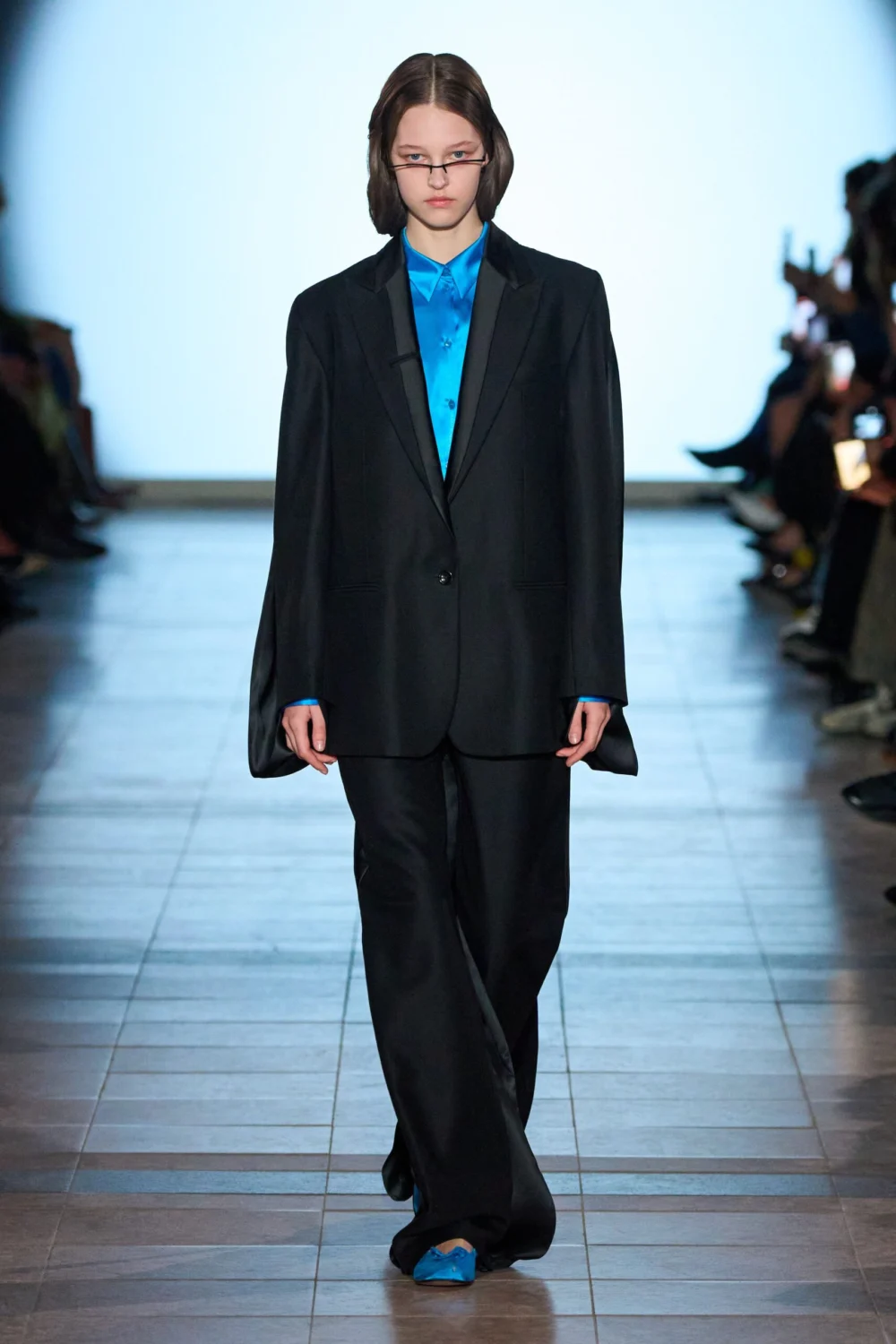
The concept of "aura" has permeated internet culture, often associated with fleeting online personas and digital mystique. However, for LVMH Prize semi-finalist Julie Kegels, the inspiration behind her latest fall collection was far more grounded in the tangible power of clothing to shape perception. Kegels delved into the philosophical musings of Andy Warhol, specifically his assertion in The Philosophy of Andy Warhol (From A to B and Back Again) that an individual possesses a distinct aura until they speak, revealing a deeper layer of their identity. This provocative idea served as the bedrock for a collection that masterfully manipulates shadow, form, and illusion to explore the intricate relationship between outward appearance and inner self.
Kegels articulated her vision during a preview, stating, "I really love Warhol’s thinking. It’s quite funny and it’s true. We live in a very public time, where everything is visible. So I wanted to explore how your clothes can shield the real you." This sentiment underscores a contemporary relevance, as individuals increasingly navigate a world saturated with visual information, where first impressions are often formed instantaneously and digital footprints are meticulously curated. The collection, therefore, can be seen as a sartorial response to this phenomenon, offering garments that act as both a shield and a statement, allowing the wearer to control the narrative of their presence.
The genesis of Kegels’ exploration lay in the deliberate use of shadow. She envisioned shadow as a tangible representation of an individual’s aura, something that could be artfully distorted and influenced by the very architecture of clothing. This conceptual approach was vividly brought to life during the runway presentation. Models were accompanied by projected shadows, meticulously filmed in a studio prior to the show, that sometimes deviated from their physical movements. These "misbehaving" shadows served as a visual metaphor, hinting at the inherent complexities and potential discrepancies between how we present ourselves and who we truly are. "It’s important to me that a Julie Kegels girl might always try to control everything, but there’s always imperfection, and always some humor," Kegels explained, highlighting the designer’s signature blend of sophistication and playful subversion.
Further enriching the collection’s conceptual framework was the inclusion of Korean artist Kyungwoo Chun on Kegels’ mood board. Chun is renowned for his portraiture, which involves extended interview sessions with his subjects, resulting in blurred final images. These evocative portraits, achieved through a prolonged process of engagement and observation, are said to "speak to a person’s aura" without overtly revealing facial features. This artistic parallel resonated deeply with Kegels’ intention to create garments that communicate an essence, a discernible presence, without necessarily laying bare the entirety of the wearer’s identity. The artist’s technique, which prioritizes the subtle emanation of personality over precise depiction, mirrors Kegels’ aspiration to imbue her designs with a similar nuanced expressiveness.
A Darker Palette and Austere Silhouettes: The Autumn Collection Unveiled
In contrast to Kegels’ previous collections, often characterized by a lighter and more vibrant aesthetic, the fall offering embraced a decidedly darker palette. The silhouettes were elongated and imbued with an austere, protective quality. This thematic inclination towards protective layering and structured forms has been a discernible trend among women’s designers in Milan and other major fashion capitals during the recent Autumn/Winter showcases, suggesting a broader cultural zeitgeist reacting to global uncertainties and a desire for sartorial comfort and resilience.
Kegels’ design process began with an in-depth exploration of shadow manipulation. She meticulously studied how shadow forms could alter the perceived shape of garments, observing their transformative potential on skirts and shirts. This experimental phase manifested in the collection through a series of striking designs. Navy and gray skirts featured deliberately "wonky" lines and curved thigh slits, creating an intriguing visual dissonance that challenged conventional proportions.
Beyond mere distortion, Kegels actively sought to manipulate shadow to achieve specific sartorial effects. The sleeves of tailored jackets were cut in a rounded fashion. When models walked with their arms at their sides, this intentional design choice created the illusion of hands placed on hips, a pose that connotes confidence and assuredness. "It’s so you look confident, even if you’re not," Kegels remarked, demonstrating the subtle yet powerful impact of this detail. Furthermore, the armholes on shirts and jackets were strategically shifted backward, with sections of the lining deliberately spilling over the shoulders. This unconventional treatment was intended to evoke a sense of forward momentum, "give the feeling of being ahead of yourself," as the designer put it.
The collars of many garments were lined with wool and then subjected to a high-temperature wash. This technique resulted in an imperfect, super-starched stiffness and a distinct asymmetry around the neck, adding a touch of raw, almost defiant character to the otherwise refined pieces. The collection also incorporated a bold use of raw, jagged-cut leather. This material was employed in the creation of shoes and leather caps, rendered in evocative shades of tangerine, black, and teal. Kegels described these pieces as embodying something "aggressive, and protective," further solidifying the collection’s thematic exploration of outward presentation as a form of armor.
The ‘Bubble’ Effect: Manifesting the Aura as a Garment Double
To further embody the concept of aura, Kegels introduced a recurring design element: a bubble-like cape of fabric attached to the back of certain garments. Described by Kegels as "a double of your garment that always follows you as a protection," these ethereal additions served as a visual manifestation of the wearer’s personal space and protective aura. This motif appeared in various forms throughout the collection, from a subtle green silk panel at the back of navy trousers to a more dramatic, billowing white silk "bubble" trailing from the back of a nightgown.
These modular additions offered a dynamic element to the collection, demonstrating Kegels’ commitment to creating garments that are both conceptually rich and functionally adaptable. They could be attached at the nape of the neck or the waistband to achieve the desired bubble effect, or allowed to hang freely to create a dramatic train. This versatility allowed the wearer to modulate their "aura" and presence according to their mood or the occasion, offering a personalized approach to expressing oneself through fashion. The adaptability of these elements speaks to a growing demand for clothing that can transcend single-use scenarios and adapt to the multifaceted lives of contemporary individuals.
Illusion and Multiplicity: A Finale of Deception and Perception
The finale of the collection offered a sophisticated deconstruction of perception, building upon Kegels’ previous season’s exploration of magician’s techniques. This time, however, the focus shifted to a series of looks that responded to one another, creating a captivating series of optical illusions. The runway culminated in a striking demonstration of layered appearances.
The sequence began with a model exiting the runway in a pristine white silk gown, carrying several white bags and hat boxes. The subsequent look featured a gray tailored wool coat, meticulously constructed to mimic the exact silhouettes of the boxes and bags carried by the previous model. In shadow form, this coat appeared virtually indistinguishable from the carried items, highlighting the deceptive nature of visual representation.
The final act in this sartorial illusion involved a silk dress adorned with the imprint of the gray coat. This dress, when presented, created the visual effect of the coat seemingly blocking its own light source, further emphasizing the interplay between presence, absence, and the perception of form. "It’s three layers of appearance," Kegels explained, underscoring the deliberate complexity of the finale. "Your appearance is always perceived differently by everyone, so I also wanted to show that."
This final presentation served as a powerful conclusion to the collection’s overarching theme. It demonstrated that fashion, in Kegels’ hands, is not merely about adornment but about engaging in a dialogue with perception. The collection suggests that our outward presentation is a curated performance, a deliberate construction that influences how we are seen and understood. By playing with shadow, form, and illusion, Kegels invites wearers to consider the power they hold in shaping their own "aura" and the myriad ways in which their appearance can be interpreted. The success of such a conceptually driven collection, particularly in its ability to translate abstract ideas into wearable art, bodes well for Kegels’ future in the fashion industry, positioning her as a designer who not only understands current trends but also possesses the intellectual depth to push the boundaries of sartorial expression. The fashion world will undoubtedly be watching to see how Kegels continues to evolve this compelling narrative in her future endeavors, further solidifying her reputation as a visionary talent.
