

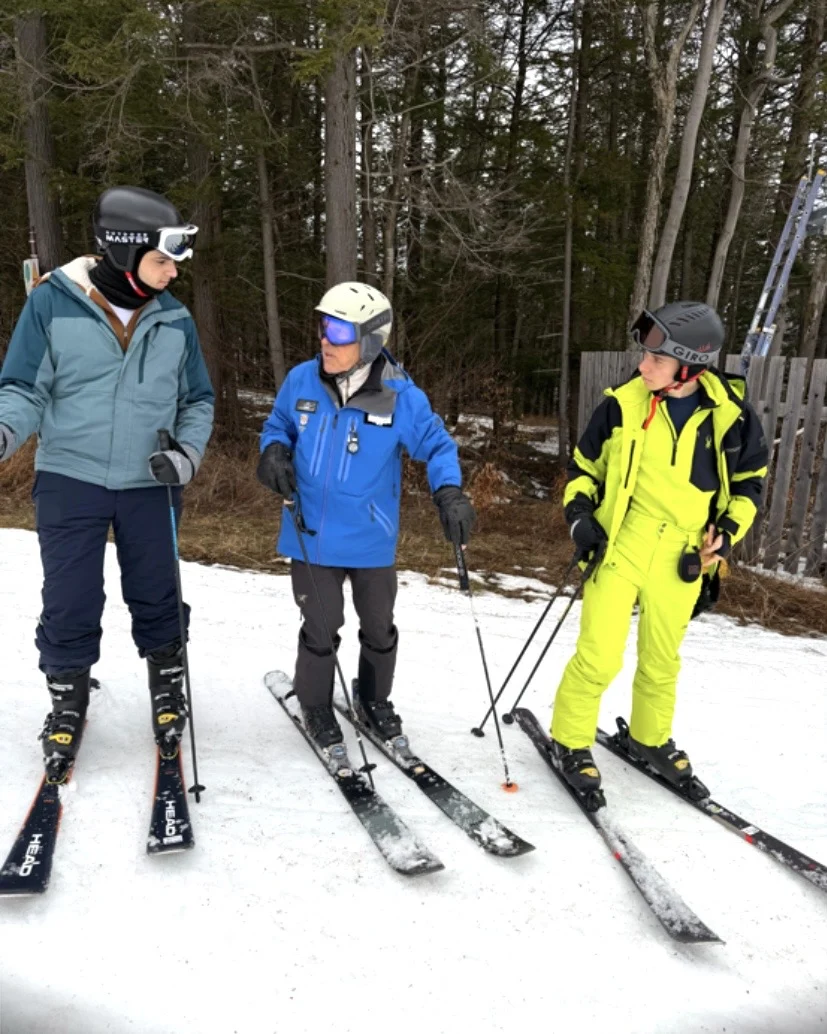
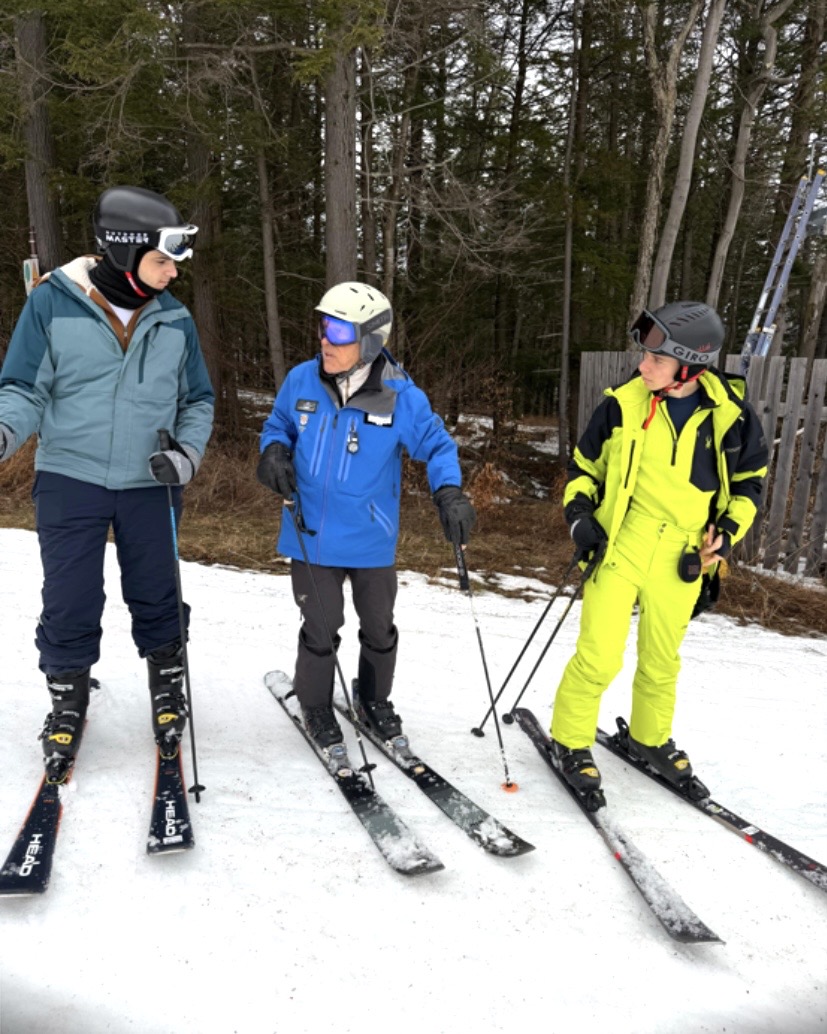
A piercing shot of wind swirled the snow as the Otis Quad chair crested its unloading ramp at New York’s Hunter Mountain. The jacket thermometer registered a stark -5°F, but the biting wind made the ambient temperature feel closer to -30°F. Skis squeaked on the cold, dry snow as a group glided down the ramp to a halt near Ralph Perlberger and three other intrepid individuals. While most guests sought refuge in the warmth of the lodge, some jockeying for a coveted spot near the fireplace, Ralph Perlberger stood ready. It was his 95th birthday, and true to his unwavering philosophy of embracing every snow condition and weather challenge, he was preparing for another run. His wife, Carol, and two fellow ski instructor friends, David Raindorf and Steve Cohen, were by his side. Leslie Surprenant, an Alpine Level II instructor and Children’s Specialist 1 at Hunter Mountain, coaching a weekly women’s clinic, introduced Ralph to her group, proud of his enduring grit and spirit. The scene encapsulated a remarkable blend of human resilience and an unyielding passion for skiing, setting a profound example for all who witnessed it.
“When I grow up, I want to be Ralph,” David Raindorf once remarked, a sentiment echoed by Steve Cohen, who added, “Ralph is my idol.” The spontaneous rendition of “Happy Birthday” by the assembled group, their voices muffled by frozen face masks, brought a grin to Ralph’s face. He thanked them, then led the way down West Side Glide, an intermediate trail that winds gracefully among the snow-laden pines and hemlocks. His fluid motion on the skis belied his age, a testament to decades of dedication to the sport. Victoria Mercado, the Senior Manager of Hunter Mountain’s Ski and Ride School, articulated the collective admiration: “Ralph is an inspiration. He’s not only skiing, but teaching! Skiing and riding truly keep you young. When I watch Ralph ski, I can’t believe he’s 95. His energy, skill, and passion on the mountain defy his age. It’s an absolute pleasure to work alongside him.” This extraordinary display of vitality highlights not just an individual’s achievement, but also the profound benefits of lifelong engagement in physical activity.
A Life Forged in Adversity: Hope Prevails Over Despair
Ralph Perlberger’s remarkable zest for life and skiing is profoundly shaped by a childhood experience that few could imagine, an ordeal that instilled in him an extraordinary sense of resilience and an appreciation for every moment. In 1940, as Nazi Germany cast its dark shadow across Europe, Ralph and his family were living in Amsterdam. His father, foreseeing the imminent danger, departed for New York City to arrange for the family’s immigration to the United States. He arrived on May 10, the very day Nazi forces launched their invasion of the Netherlands, trapping his family in a rapidly deteriorating situation.
The following year, at the tender age of nine, Ralph, his mother, and his two older brothers were forcibly removed from their Amsterdam home. They were first imprisoned in Westerbork transit camp in the Netherlands. Westerbork, initially a refugee camp for Jews fleeing Germany, was transformed by the Nazis into a transit point for Dutch Jews being deported to extermination camps. Over 100,000 people passed through its gates, most destined for Auschwitz or Sobibor. Conditions were harsh, but the uncertainty of their ultimate fate was perhaps the most terrifying aspect. In February 1944, the Perlberger family was transferred by railroad cattle car, in unimaginably inhumane conditions, to the Bergen-Belsen concentration camp in Germany.
Bergen-Belsen, while not primarily an extermination camp, became notorious for its horrific conditions, overcrowding, starvation, and rampant disease, particularly towards the end of the war. Ralph endured the ravages of both typhus and typhoid fever, illnesses that claimed countless lives. Yet, despite the pervasive despair and suffering that surrounded him, Ralph maintained an unwavering certainty that he and his family would survive. He credits his parents for instilling in him this profound sense of confidence, security, and hope. Early on, he even harbored the youthful belief that he would simply have "quite a story to share with friends" once the war concluded, a testament to his innate optimism in the face of unimaginable horror.
During these agonizing years, Ralph’s father in New York City had no way of knowing if his family had survived. However, at war’s end, he received the life-affirming news that they were in the Russian-occupied village of Tröbitz, Germany. The family had arrived there aboard what became known as the "Lost Transport," one of three trains on which the Nazis, in a desperate and cynical maneuver, sent approximately 7,500 Jewish prisoners, intending to exchange them for German prisoners of war.
The "Lost Transport" was a harrowing journey that lasted for two weeks, constantly stopping and rerouting due to destroyed tracks and the chaos of the collapsing Third Reich. It never reached its intended destination for the prisoner exchange. Instead, it finally came to a halt on a destroyed bridge over the Elster River, just outside Tröbitz. On April 23, 1945, Russian troops liberated the train’s emaciated and critically ill prisoners. Hundreds had already succumbed to typhus, typhoid, and starvation during the torturous journey. The liberation of the "Lost Transport" survivors, while a moment of profound relief, also revealed the depths of human suffering endured. During the five months that followed, while the family’s visa applications for the United States were pending, Ralph’s father, through the Red Cross, sent them vital packages of food and hygiene products, a lifeline across a war-torn continent.
In February 1946, Ralph, his two brothers, and his mother finally immigrated to the United States, making their new home in New York City. The transition was immense. Ralph, with characteristic determination, swiftly learned to speak English and excelled in school, demonstrating the same resilience that had carried him through the war. His father, meanwhile, painstakingly reconnected with the family he had been separated from for six long years, rebuilding their lives together in a new land. This early exposure to the fragility of life and the power of human endurance undoubtedly shaped Ralph’s perspective, fostering a deep appreciation for freedom, opportunity, and the simple joy of living.
A Lifelong Pursuit: From Sun Valley to Hunter Mountain
Ralph Perlberger’s love affair with skiing began far from the battlefields of Europe, during a winter break while he was studying economics at Stanford University. His father, keen to provide experiences denied during the war, sent him and his two older brothers to Sun Valley, Idaho, a renowned ski destination that had quickly gained fame as America’s first destination ski resort. The majestic mountains, the crisp air, and the thrill of gliding down snow-covered slopes immediately captivated him. He was, in his own words, "hooked." This nascent passion continued to flourish even as he pursued a rigorous academic path, earning his law degree at Harvard University. Skiing became a constant, a source of joy and challenge, a counterbalance to the intellectual demands of his studies and burgeoning legal career. He pursued it at every opportunity, from the iconic slopes of Taos to various European resorts, and eventually, to Hunter Mountain in the Catskills.
Decades of recreational skiing and countless lessons honed his skills, but a pivotal moment arrived in 2002. An advertisement caught Ralph’s eye: for $85, he could attend a weekend of instructor training and candidate selection at Hunter Mountain. If chosen, a second weekend of training and final selection would be free. This presented an opportunity not just for discounted skiing, but to deepen his engagement with a sport he adored and to share that passion with others. He was among those selected to become an instructor candidate, a testament to his existing skill and demeanor. Yet, with characteristic humility, he recognized that there was still much to learn about the art and science of teaching skiing.
Today, Ralph Perlberger is a Professional Ski Instructors of America (PSIA) Level II Alpine instructor. PSIA certification is a rigorous process, requiring instructors to demonstrate not only exceptional skiing ability but also effective teaching skills across various terrains and conditions. A Level II certification signifies a high level of proficiency and a commitment to ongoing professional development within the snow sports industry. Ralph’s dedication to mastering his craft led him to absorb wisdom from many, but he often points to fellow ski instructor and PSIA Alpine Examiner Charlie Knopp as providing some of the best advice he ever received: “Lift your inside hip!” This seemingly simple instruction is a cornerstone of advanced alpine technique, crucial for efficient edge control and balance, especially in dynamic turn initiation.
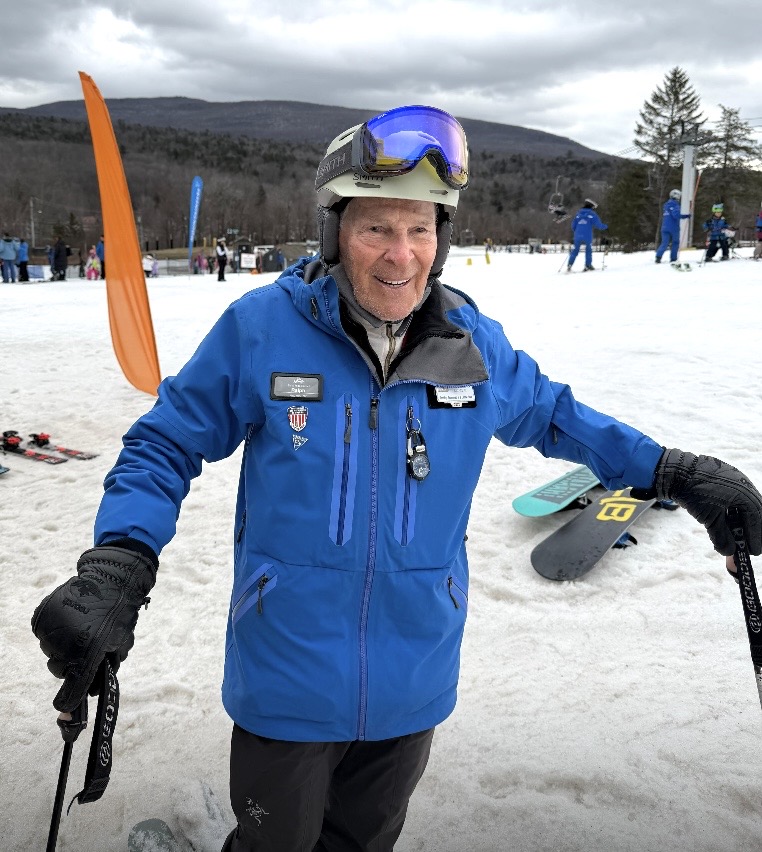
Ralph is beloved by the Hunter Mountain ski and ride school community, where his colleagues express profound awe and appreciation for the example he sets. Luca Arrigoni, a member of the Eastern Alpine Development Team, shared his admiration: “Ralph has a special place in my heart. I shadowed him as a new instructor and was inspired by his patient, gentle, and knowledgeable way with beginners. He still proudly wears the Hunter uniform, which shows his love for, and dedication to, the sport and teaching.” This speaks volumes about the impact Ralph has, not just on his students, but on his peers, embodying the ideal of a lifelong learner and mentor.
The Art of Instruction: Guiding Intermediates to Mastery
Ralph especially loves helping adult intermediate skiers. He often begins his lessons by asking students to describe how they make their skis turn. A common response, he observes, is, “I don’t know; I just turn.” This highlights a fundamental gap in understanding for many recreational skiers. Ralph’s keen observational skills quickly pinpoint common technical deficiencies. He notes that many intermediate skiers primarily initiate turns using leg rotation on flat skis, a less efficient and more strenuous method. Furthermore, he identifies a lack of understanding regarding fundamental principles: maintaining their center of mass (CM) over their base of support (stance), effectively directing pressure to their outside skis, and controlling edge angles throughout the turn.
To address these issues, Ralph employs a methodical and sensory-focused coaching approach. He coaches skiers to actively feel their shins against the tongue of their boots during all phases of a turn. This constant shin-to-boot contact is critical for proper fore-aft balance, allowing skiers to effectively pressure the front of their skis and engage the edges. When he observes skiers leaning back – a common habit that compromises control and fatigues the legs – he asks them to stop and notice how their quadriceps feel. Most respond with "tired" or "burning," instantly recognizing the physical cost of poor posture. He then directs them to consciously notice where their bodies are in relation to their feet, gently reminding them to maintain that crucial shin contact with the front of their boots. This immediate, kinesthetic feedback allows students to connect cause and effect, understanding how their body position directly impacts their comfort and performance. In the end, Ralph says, every student improves, has fun, and leaves with a newfound understanding and appreciation for the nuances of skiing, invariably thanking him for his patient guidance.
A Legacy of Longevity and Inspiration
The ski instructors at Hunter Mountain span an impressive eight decades in age, creating a diverse and vibrant community. To the youngest instructors, those just embarking on their teaching careers, Ralph offers a simple yet profound piece of advice, distilled from nearly a century of life experiences: “Keep at it and don’t give up! Don’t let anything stop you. Ski in all conditions and all weather.” This counsel transcends the ski slopes, serving as a powerful metaphor for navigating the challenges and opportunities of life itself.
Having recently completed his 24th season of instructing, Ralph Perlberger has no plans to hang up his skis or retire from teaching. His continued presence on the mountain is a testament to the physical and mental benefits of sustained activity. Research consistently shows that engaging in complex physical activities like skiing can significantly contribute to cognitive health, balance, strength, and overall well-being in older adults. Ralph embodies these findings, demonstrating that age is truly just a number when passion and purpose drive an individual.
Reflecting on his remarkable journey, Ralph often muses, “Maybe someone above is watching over me.” He also draws inspiration from the legendary Baseball Hall of Famer Satchel Paige, who famously said, “Don’t look back; something might be gaining on you.” For the skiers navigating the trails of Hunter Mountain, that "something" isn’t a threat, but rather the inspiring, enduring, and ever-forward-looking figure of Ralph Perlberger, a living legend who continues to defy expectations and enrich the lives of everyone he encounters on the snow. His story is a powerful reminder that resilience, passion, and a commitment to lifelong learning can lead to an exceptionally fulfilling and impactful existence, regardless of age or past adversity.
