

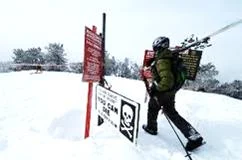
The distinction between the managed slopes of a commercial ski resort and the untamed wilderness that lies just beyond its boundaries is often as thin as a single strand of yellow rope. For many winter sports enthusiasts, this boundary represents the entrance to the "sidecountry"—a term used to describe backcountry terrain that is easily accessible via a ski lift. While the proximity to resort infrastructure provides an illusion of safety, snow safety experts and avalanche professionals warn that these areas are frequently "Rated R" due to their inherent risks, lack of mitigation, and the absence of professional patrol services. As more skiers and snowboarders venture past the boundary gates, the gap between perceived safety and the lethal reality of uncontrolled mountain terrain continues to widen, leading to a rise in avoidable accidents and fatalities.
The Illusion of Proximity and the Definition of Sidecountry
The term "sidecountry" has become a fixture in the modern skiing lexicon, often marketed as a way to access "fresh tracks" and "powder stashes" without the grueling uphill climb associated with traditional backcountry touring. However, the nomenclature itself is a source of contention among safety professionals. Many avalanche educators argue that the word "sidecountry" creates a false sense of security, implying a middle ground between the safety of a resort and the dangers of the wilderness. In reality, once a rider passes through a boundary gate, they are in the backcountry.
Inside the resort boundary, professional ski patrols perform extensive avalanche mitigation. This includes the use of explosives to trigger controlled slides, "boot packing" to stabilize snow layers, and constant monitoring of slope conditions. Outside the gate, none of these protections exist. The terrain is unpatrolled, and the snowpack is left to the whims of the wind, temperature, and precipitation. This transition is immediate. A skier can be on a groomed, patrolled run one minute and on a high-risk, avalanche-prone slope the next, often without fully realizing the gravity of the shift.
The Evolution of Access and the Rise of "Slackcountry"
The growth of the sidecountry phenomenon is a relatively recent development in the history of North American skiing. In the 1980s and early 1990s, many ski resorts maintained "closed boundary" policies, where ducking a rope could result in a revoked lift ticket or even criminal trespassing charges. However, as public demand for off-piste terrain grew and the U.S. Forest Service—which leases land to many major resorts—pushed for more open access to public lands, many resorts transitioned to "open boundary" policies.
This shift coincided with a revolution in equipment. The introduction of "touring" bindings that allow for both downhill performance and uphill mobility, combined with wider "fat" skis designed for deep powder, lowered the barrier to entry for steep, unmanaged terrain. What was once the domain of elite mountaineers became accessible to intermediate resort skiers. This democratization of access has led to the rise of "slackcountry" skiing, where riders use lifts to gain elevation before exiting the resort to find ungroomed snow, often returning to the resort via a traverse or a lower access road.
Statistical Trends in Avalanche Fatalities
Data from the Colorado Avalanche Information Center (CAIC) and the American Avalanche Association (AAA) highlight the consequences of this increased accessibility. Over the last two decades, the United States has seen an average of approximately 25 to 30 avalanche fatalities per winter season. A significant and growing subset of these incidents involves "out-of-bounds" or sidecountry riders.
Statistical analysis shows a recurring pattern: many victims are found within a few hundred yards of the resort boundary. In many cases, these individuals were not carrying essential safety gear—such as an avalanche transceiver, a probe, and a shovel—because they did not view their excursion as a "real" backcountry trip. According to CAIC data, the "human factor" or "heuristic traps" play a major role in these accidents. The "familiarity heuristic" leads skiers to believe that because they have skied a specific out-of-bounds run many times before without incident, it is safe regardless of the current snowpack conditions.
Furthermore, the "social facilitation" trap occurs when a large number of tracks are visible on a slope. Skiers often assume that if others have skied the slope, it must be stable. In reality, avalanche conditions are highly localized and can change within hours, and the weight of an additional skier can be the final stressor that triggers a catastrophic slide.
The Role of Ski Patrol and Public Land Management
The legal and operational reality of the sidecountry is often misunderstood by the public. Most major ski resorts in the Western United States operate on permits from the U.S. Forest Service. This means that while the resort manages the lifts and the designated runs, the land itself is public. When a skier exits a resort gate, they are entering land where the resort has no legal obligation to provide safety services.
Ski patrols are trained for rapid response within resort boundaries. They have established sled routes, communication networks, and medical caches. Once a rescue moves into the backcountry, the responsibility shifts to the local county sheriff’s office and volunteer Search and Rescue (SAR) teams. These operations are significantly more complex and time-consuming. A rescue that might take 15 minutes on a groomed run can take six to twelve hours in the backcountry, often requiring helicopters and dozens of personnel. In many cases, by the time SAR teams reach a sidecountry avalanche site, the mission has shifted from a rescue to a recovery.
The "Rated R" Metaphor: Expert Perspectives
The "Rated R" metaphor, popularized by avalanche experts like Doug Chabot of the Gallatin National Forest Avalanche Center, serves as a stark warning to parents and young riders. In a resort setting (the "PG" environment), the risks are managed by professionals. In the sidecountry (the "R" environment), the risks are raw and potentially lethal.
Chabot and other educators emphasize that the "gate" is a portal into a world where self-reliance is the only safety net. "After a parent waves goodbye in the ski area parking lot, do they know what the kids are doing?" Chabot asks. This question underscores a growing concern regarding younger skiers and snowboarders who may have the technical skill to ride steep terrain but lack the mountain sense and education to evaluate snow stability. The "Rated R" designation implies that the terrain requires a level of maturity, training, and equipment that many casual resort visitors simply do not possess.
Education and the "Know Before You Go" Initiative
In response to the rising number of sidecountry incidents, the snow safety community has launched aggressive educational campaigns. The "Know Before You Go" (KBYG) program is a primary example. This initiative focuses on five key pillars:
- Get the Gear: Always carry a transceiver, probe, and shovel.
- Get the Training: Take an American Institute for Avalanche Research and Education (AIARE) Level 1 course.
- Get the Forecast: Check daily avalanche bulletins provided by local forecast centers.
- Get the Picture: Observe weather and snow conditions in real-time.
- Get Out of Harm’s Way: Travel one at a time and avoid stopping in runout zones.
Despite these efforts, a gap remains. While dedicated backcountry skiers often seek out this training, the "incidental" backcountry user—the resort skier who decides on a whim to duck through a gate—often misses these messages. Industry leaders are now calling for resorts to take a more active role in education at the boundary line, using more descriptive signage and "beacon check" stations that beep to alert riders if their transceiver is not turned on.
The Economics and Logistics of Sidecountry Rescue
The rise in sidecountry usage has placed a significant strain on local resources. Volunteer SAR teams, which form the backbone of mountain rescue in the U.S., are seeing a higher volume of calls. These missions are not only dangerous for the volunteers, who must enter unstable terrain to reach victims, but they are also costly.
While some states have laws allowing authorities to charge for the cost of a rescue if the individual acted recklessly, these are rarely enforced. The financial burden often falls on taxpayers and donors. Furthermore, the psychological toll on rescuers is immense. Recovering a young person from a sidecountry avalanche is a traumatic event that affects entire mountain communities.
Future Implications and the Need for Cultural Change
As climate change leads to more erratic weather patterns—including "atmospheric rivers" followed by long periods of drought—the snowpack is becoming increasingly unpredictable. Deep persistent slabs, which are difficult to manage and can be triggered by a single skier even weeks after a storm, are becoming a more frequent threat in the sidecountry.
The solution, according to many in the industry, is a cultural shift. The "sidecountry" needs to be rebranded as the "backcountry" to eliminate any ambiguity. There must be a move away from the "slackcountry" mindset toward a "mountain-craft" mindset, where entering unpatrolled terrain is viewed as a serious undertaking requiring preparation and respect.
The "Rated R" nature of the sidecountry is not a deterrent meant to keep people out, but a warning to ensure they come back. As the boundaries between resorts and the wilderness continue to blur, the responsibility for safety rests solely on the shoulders of the individual. Without the proper gear, education, and a sobering understanding of the risks, the allure of the sidecountry will continue to lead to tragic outcomes in some of the world’s most beautiful, yet unforgiving, landscapes.
