

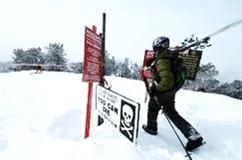
The boundary between a managed ski resort and the wild backcountry is often nothing more than a single strand of yellow rope, yet the transition represents a total shift in safety protocols, legal responsibility, and life-threatening risk. For decades, the term "sidecountry" has been used by equipment manufacturers, magazines, and enthusiasts to describe the easily accessible terrain located just outside the marked boundaries of commercial ski areas. While the name suggests a middle ground between the safety of a resort and the isolation of the deep wilderness, avalanche experts and search-and-rescue personnel are increasingly warning that the "sidecountry" is a dangerous misnomer. In reality, once a skier or snowboarder passes through a boundary gate, they have entered the backcountry—a realm where the snow is uncontrolled, the terrain is unpatrolled, and the individual is solely responsible for their own survival.
The Illusion of Proximity and the Halo Effect
Many of the most popular ski resorts in the United States, particularly those in the Rocky Mountains and the Pacific Northwest, operate under special-use permits on public lands managed by the U.S. Forest Service. This proximity allows for convenient access to vast stretches of high-alpine terrain that often looks identical to the groomed runs and glades within the resort. However, this visual similarity creates what psychologists and safety experts call the "halo effect." Because a skier can see the chairlift, the resort lodge, or the parking lot from an out-of-bounds ridge, they often subconsciously believe they are still within the resort’s safety net.
This psychological trap is exacerbated by the presence of "access gates." These points are designed to allow legal passage into public lands, but they are frequently misinterpreted as an endorsement of the terrain’s safety. Within the resort boundary, professional ski patrols work tirelessly, often starting before dawn, to mitigate avalanche risks using explosives, ski cutting, and snow fences. They provide a "controlled" environment. The moment a person steps through a gate, that control vanishes. The snowpack becomes a natural, volatile entity, and the cliffs, chutes, and gullies beyond the rope are what experts describe as "R-rated" terrain—areas where the consequences of a mistake are often permanent.
The Rising Toll: Statistical Trends in Sidecountry Incidents
The rise of the "sidecountry" phenomenon has coincided with a significant shift in winter recreation statistics. Data from the Colorado Avalanche Information Center (CAIC) and the American Avalanche Association (A3) indicate that a substantial percentage of avalanche fatalities now occur in these out-of-bounds areas adjacent to ski resorts. Over the last two decades, advancements in equipment—such as wider skis, "walk-mode" boots, and lightweight splitboards—have made it easier for intermediate-level riders to access steep, complex terrain that was once reserved for elite mountaineers.
According to national data, the average avalanche victim is no longer a novice who wandered off-course by accident. Instead, the demographic frequently involves males between the ages of 20 and 35 who are highly skilled in their sport but lack formal avalanche education. These individuals often possess the physical ability to ride "R-rated" terrain but lack the analytical skills to assess the stability of the snowpack or the discipline to carry essential rescue gear, such as a beacon, probe, and shovel. The ease of access provided by high-speed lifts removes the "physical tax" of hiking, which traditionally served as a barrier that forced backcountry travelers to slow down and observe their surroundings.
Administrative Realities: The Role of Ski Patrol and Public Land Policy
One of the most critical points of confusion for the general public is the legal and operational mandate of the ski patrol. Within the resort, the patrol is a medical and safety agency responsible for trail maintenance and emergency response. However, their jurisdiction typically ends at the rope line. While many patrols will attempt to assist in out-of-bounds rescues if called upon, they are not legally obligated to do so, and their primary responsibility remains the safety of the paying guests within the boundary.
Furthermore, out-of-bounds rescues are governed by different protocols. When an accident occurs in the backcountry, the responsibility for rescue falls to the local county sheriff’s office and volunteer search-and-rescue (SAR) teams. These operations are often hindered by weather, light conditions, and the inherent dangers of the terrain. A rescue that might take 15 minutes on a resort run can take six to twelve hours in the sidecountry, often requiring helicopters and dozens of personnel. In some jurisdictions, the cost of these rescues can be billed to the individual, leading to financial liabilities that reach into the tens of thousands of dollars.
The Chronology of a Sidecountry Incident
The typical trajectory of a sidecountry accident begins long before the snow starts to slide. It often starts in the resort parking lot, where groups of friends—sometimes including minors—plan to "duck out" for a quick run in the trees or a hike to a nearby ridge. The "R-rated" nature of the terrain is frequently ignored during the morning excitement.
- The Decision Point: A group decides to leave the boundary, often following existing tracks (the "lemming effect") under the false assumption that if others went before them, the slope is stable.
- The Boundary Crossing: The group passes through a gate or ducks a rope. At this moment, they transition from a managed environment to a wilderness environment.
- The Trigger: As the group enters a steep slope, often exceeding 30 degrees, the weight of a single rider can collapse a weak layer in the snowpack, triggering a slab avalanche.
- The Crisis: Without the immediate presence of a patrol and without proper rescue gear, the victims are often buried for 15 to 30 minutes before help can be summoned. In avalanche burials, the survival rate drops precipitously after the first 15 minutes.
- The Response: By the time a 911 call is placed and SAR teams are mobilized, the mission often shifts from a rescue to a recovery.
Expert Perspectives: "Sidecountry" as a Dangerous Marketing Term
Doug Chabot, a veteran avalanche forecaster and a prominent voice in the mountain safety community, has been a vocal critic of the term "sidecountry." In his analysis, he emphasizes that the term creates a false sense of security that parents and young riders are particularly susceptible to. "After a parent waves goodbye in the ski area parking lot, do they know what the kids are doing?" Chabot asks. "Are they leaving the ski area for R-rated terrain?"
The "R-rated" analogy is used to highlight that while the resort is "PG" or "PG-13" due to its managed risks, the backcountry is an adult environment where the "rating" refers to the gravity of the consequences. There are no "slow" signs, no padded lift towers, and no one to hear a cry for help if a rider is buried or injured. Professional guides and educators argue that the industry should abandon the term "sidecountry" altogether and replace it with "lift-access backcountry" to reinforce the reality of the environment.
Broader Implications and the Path Toward Education
The growing popularity of out-of-bounds skiing has forced a reckoning within the ski industry and government agencies. Some resorts have experimented with stricter boundary policies, including "closed" boundaries that carry legal penalties for crossing. However, on U.S. Forest Service land, "open" boundary policies are more common, placing the burden of safety squarely on the individual.
To combat the rising trend of incidents, avalanche centers across North America have launched targeted awareness campaigns. These programs, such as "Know Before You Go," aim to reach younger demographics through social media and school-based presentations. The core message is simple: the mountains do not know where the resort boundary is. If you are not carrying a beacon, probe, and shovel, and if you have not checked the daily avalanche forecast, you have no business crossing the rope.
The future of winter recreation depends on a cultural shift from "sidecountry" entitlement to backcountry responsibility. As ski resorts continue to expand and equipment becomes even more accessible, the distinction between the "controlled" and the "wild" must be clearly understood by everyone from the professional athlete to the weekend hobbyist. The "R-rated" terrain is always there, waiting just beyond the gate; the only question is whether the person passing through it is prepared for the reality of what lies on the other side.
