

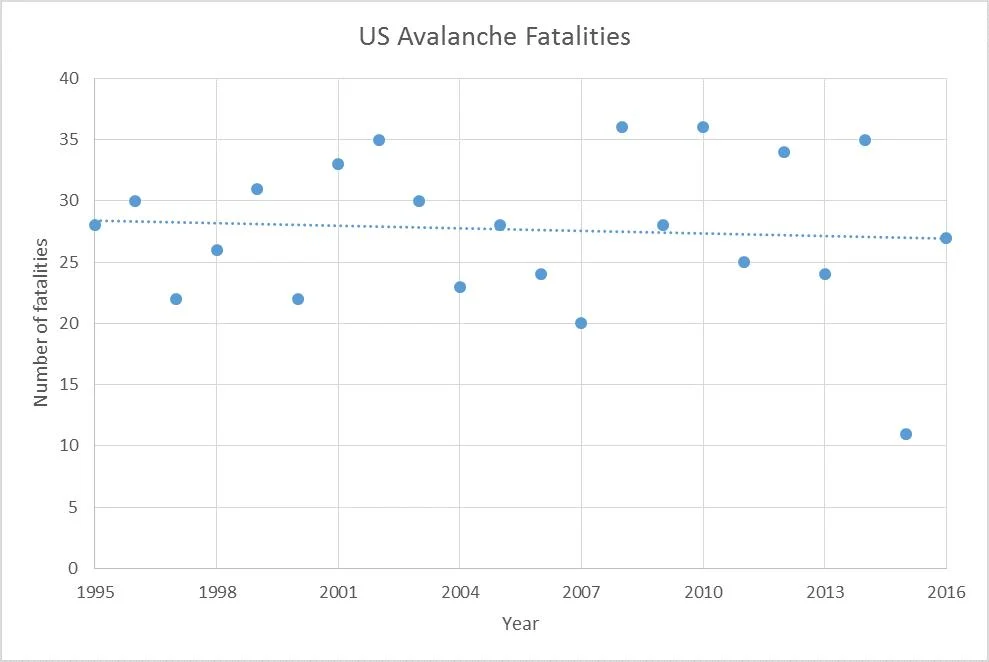
Data compiled over a twenty-two-year period reveals a surprising statistical plateau: despite a massive influx of enthusiasts into the American backcountry, the annual number of avalanche-related fatalities in the United States has not increased since the mid-1990s. This finding, based on an analysis of winter seasons spanning from 1994/95 through 2015/16, challenges the intuitive assumption that higher participation rates in high-risk winter sports would naturally lead to a proportional rise in tragic outcomes. Instead, the data suggests a significant and successful intervention by safety educators, technological innovators, and regional forecast centers.
To understand the magnitude of this trend, one must look back at the landscape of winter recreation in the winter of 1994/95. At that time, the infrastructure for avalanche safety was in its relative infancy. Key figures such as Knox Williams in Denver, Bruce Tremper in Utah, and Mark Moore in Seattle oversaw the primary avalanche centers in the country. Other regions had even less coverage; the Gallatin National Forest Avalanche Center in Bozeman, Montana, was only in its fifth season, and prominent centers in the Chugach Mountains of Alaska, Lake Tahoe, and Mount Shasta had not yet been established.
The equipment used during that era was similarly primitive by modern standards. Backcountry skiers predominantly utilized telemark gear, often paired with leather boots that offered limited support and control compared to modern carbon-fiber shells. Snowmobiles lacked the power-to-weight ratios of contemporary machines, restricting riders to less vertical and complex terrain. Furthermore, the concept of "sidecountry"—resort-adjacent backcountry accessed via ski lifts—was virtually non-existent, as most ski areas maintained strictly closed boundaries. Perhaps most significantly, the digital age had not yet arrived; the first avalanche advisories were only just beginning to appear on the nascent World Wide Web toward the end of the 1995 season.
A Statistical Analysis of Fatality Trends
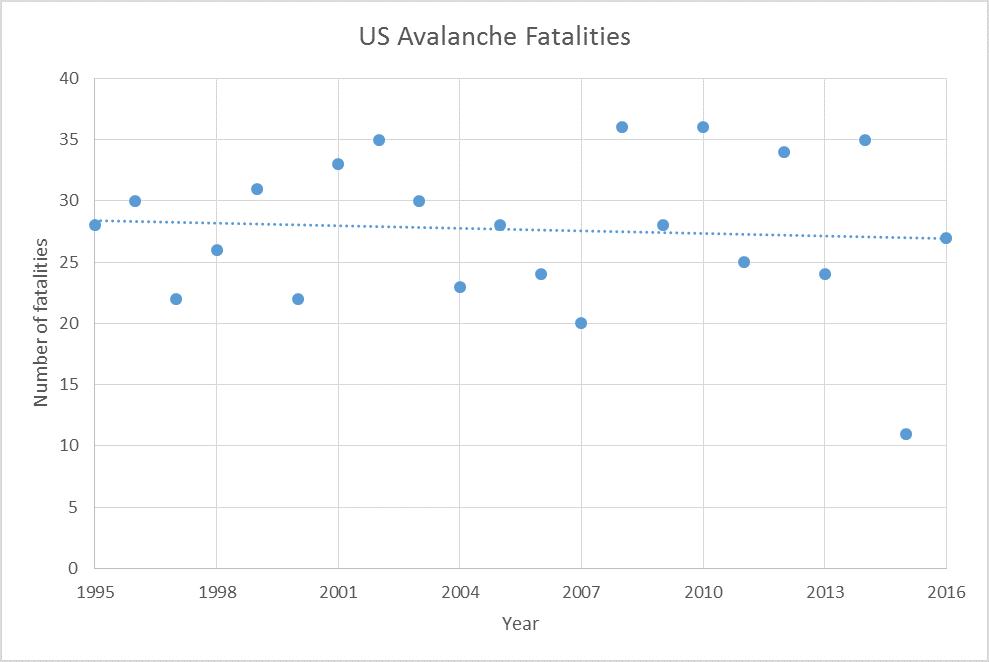
Despite the transition from analog to digital and the subsequent "explosion" in backcountry use, the raw numbers of seasonal avalanche fatalities have remained remarkably steady. Statistical analysis of the period between 1994/95 and 2015/16 shows a "flat line" in total deaths. According to Figure 1 of the study, the least squares trend line for U.S. avalanche fatalities shows a slight decrease, though this is not considered statistically significant. With a p-value of 0.7, researchers conclude there is no empirical evidence of a change in the number of annual fatalities over these two decades.
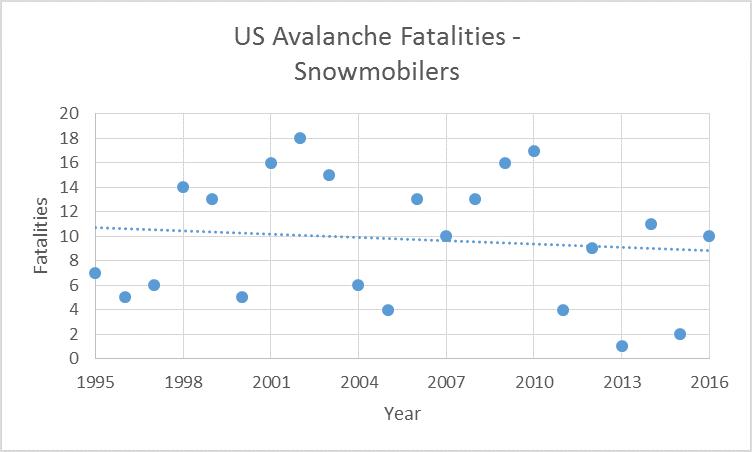
When the data is disaggregated by user group, further insights emerge. Figure 2 illustrates that fatalities among snowmobilers have remained flat over the same 22-season period. This is particularly noteworthy given that snowmobile technology has advanced more rapidly than perhaps any other category of backcountry equipment, allowing riders to high-mark steeper slopes and penetrate deeper into the wilderness than was possible in 1994. The p-value for this trend stands at 0.6, indicating stability.
Conversely, Figure 3 highlights a slight divergence in the data regarding backcountry skiers and snowboarders. While the trend remains relatively flat, there is marginal statistical evidence (p = 0.07) suggesting a slight increase in fatalities for this specific demographic. However, even this potential uptick is dwarfed by the estimated growth in the total number of people skiing and riding in the backcountry.
Measuring the "Explosion" in Backcountry Use
Quantifying the exact number of people who recreate in the dispersed winter backcountry is notoriously difficult, as there are no turnstiles or ticket sales to track participation. However, experts utilize the consumption of avalanche advisories as a reliable, if imperfect, proxy for participation. The growth in advisory usage across the United States has been nothing short of astronomical.
Over the 22-year study period, the Utah Avalanche Center reported a 12-fold increase in the number of people accessing its daily advisories. The Colorado Avalanche Information Center (CAIC) saw usage grow by a factor of 17. Even more dramatic increases were recorded in other regions: the Gallatin National Forest Avalanche Center documented a 36-fold increase, while the Northwest Avalanche Center in Seattle saw usage skyrocket by a factor of 60.
While some of this growth can be attributed to the transition from phone hotlines to mobile apps and websites—making information easier to obtain—the sheer scale of the increase indicates a massive surge in the number of individuals entering avalanche-prone terrain. Even using a highly conservative estimate that backcountry use has increased eightfold over the last two decades, the implications for safety are profound.
The Safety Multiplier: A Dramatic Drop in Fatality Rates
If the number of fatalities remains steady while the number of participants increases eightfold, the "fatality rate"—the number of deaths per backcountry user day—has dropped precipitously. The data suggests that the risk of dying in an avalanche for an individual user has decreased by at least a factor of eight since 1994.
This reduction is a major achievement for the winter recreation industry. Analysts suggest that if the fatality rate had remained constant as participation grew, the United States would likely be seeing upwards of 200 avalanche fatalities every winter, rather than the current average, which typically fluctuates between 25 and 30. This "saved" lives count represents the cumulative success of several different sectors within the outdoor industry.
Factors Driving the Downward Trend in Risk
The stabilization of fatality numbers is not an accident of geography or weather; rather, it is the result of a multi-pronged approach to safety that encompasses education, technology, and information dissemination.
The Role of Avalanche Centers
Regional avalanche centers have evolved from small operations into sophisticated hubs of real-time data. By providing daily, localized forecasts, these centers allow users to make informed decisions before they ever leave their homes. The expansion of the network to include areas like the Chugach and Tahoe has closed critical gaps in public safety.
Educational Initiatives
The "Know Before You Go" (KBYG) program is frequently cited as a turning point in avalanche awareness. By targeting younger demographics and motorized users with high-impact, easy-to-understand safety messages, educators have moved the needle on backcountry culture. Professional-level courses have also become more standardized and accessible, moving beyond simple snow-pit analysis to focus on human factors and terrain management.
Technological Advancements
The equipment available to the modern backcountry traveler is vastly superior to that of 1994. Digital, three-antenna beacons have replaced slower, less intuitive analog models, significantly reducing burial recovery times. The widespread adoption of avalanche airbag packs—which use the principle of "inverse segregation" to keep a victim on the surface of a slide—has further increased survival probabilities. Other innovations, such as the Avalung and lightweight helmets, have also played a role in mitigating trauma and asphyxiation risks.
Professionalization and Industry Standards
The growth of the "sidecountry" and the professionalization of backcountry guiding have created a safer environment for novices. Ski areas that now allow uphill travel or provide access points to the backcountry often include "beacon check" stations and educational signage, integrating safety into the resort experience.
Institutional Collaboration and Data Integrity
The ability to track these trends is dependent on rigorous data collection. The Colorado Avalanche Information Center (CAIC) serves as the primary repository for avalanche accident data in the United States. This centralized system allows researchers to identify patterns, such as the specific types of terrain where accidents occur or the demographic shifts in victim profiles.
Karl Birkeland, a prominent figure in the avalanche research community, noted that the entire community owes a debt of gratitude to the personnel who document these accidents. By analyzing "lessons learned" from tragic events, the community can refine its educational curriculum and forecasting models. This feedback loop is essential for maintaining the flat fatality trend as new technologies, such as electric snowmobiles and more accessible splitboards, continue to bring new users into the mountains.
Broader Implications and the Path Toward Zero
The flat fatality trend is a rare success story in the world of high-risk outdoor recreation. It demonstrates that targeted public safety campaigns and technological innovation can effectively decouple participation growth from mortality rates. However, stakeholders emphasize that there is no room for complacency.
The ultimate goal remains to push the number of annual fatalities toward zero. While the fatality rate has dropped, every individual death represents a tragedy for the community and a loss for a family. As the "sidecountry" continues to blur the lines between controlled and uncontrolled terrain, and as social media continues to encourage users to seek out high-consequence "hero shots," the challenges facing avalanche centers will only intensify.
The findings from the 1994/95 to 2015/16 study serve as both a validation of past efforts and a roadmap for the future. The data proves that the current strategy—combining high-quality forecasting with robust public education and advanced rescue gear—is working. For a community that operates in an environment as unpredictable as the winter mountains, this statistical "win" is a testament to the power of collective action and informed decision-making.
