

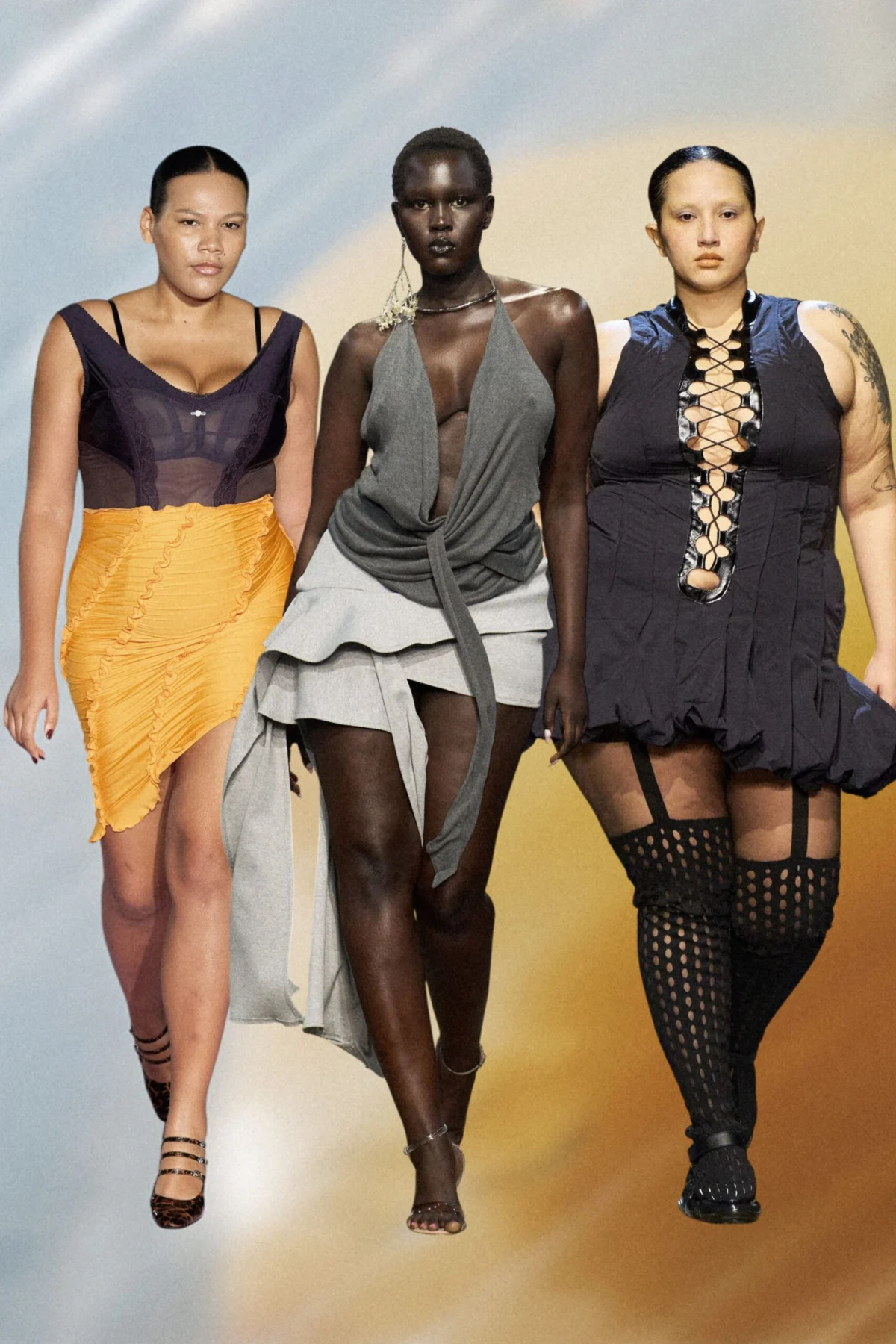
The fashion industry’s persistent pursuit of an ever-slimmer silhouette continues to be a significant challenge for designers committed to size inclusivity. Despite growing calls for broader representation, recent data from Vogue Business Size Inclusivity reports reveals a concerning trend: a significant decline in the presence of mid and plus-size representation on the runways of Paris and London. This decline is particularly stark when designers like Ester Manas, Sinéad O’Dwyer, and Karoline Vitto, who consistently champion body diversity, are absent from major fashion weeks.
This season, O’Dwyer opted for an early runway presentation at the V&A in July, while Vitto showcased her designs at Rio Fashion Week in April. Their strategic choices, while impactful, highlight a broader issue. In London, for instance, the percentage of plus-size looks plummeted to a mere 0.5%, a decrease from the previous season’s 0.8%. Mid-size representation also saw a significant drop, falling from 6.5% to 3.6%. Conversely, straight-size looks surged to 95.9%, up from 92.7%. A similar pattern, though less severe, was observed in Paris.
However, the return of Ester Manas, co-founded by Ester Manas and her husband Balthazar Delepierre, to the Paris runway after a two-year hiatus brought a noticeable improvement in body diversity. Their consistent prioritization of curve models resulted in a season where 42.4% of looks were mid-size and 36.4% were plus-size. This stands in contrast to Paris’s overall figures for the season: 0.5% plus-size looks (an increase from 0.1% previously), 2% mid-size (up from 0.4%), and 97.5% straight-size (down from 99.5%). These figures underscore the direct correlation between the presence of dedicated size-inclusive designers and the visibility of diverse body types on the catwalk.

The Unwavering Commitment of Trailblazers
While many established brands may occasionally feature a curve look, often on a well-known plus-size model, designers like Manas, O’Dwyer, and Vitto integrate size inclusivity into the very fabric of their brands, season after season. Their commitment extends beyond the runway; they actively design, produce, and sell clothing for mid and plus-size individuals, cultivating dedicated communities of customers who value creative, well-fitting luxury fashion.
These designers consistently rank highly in size inclusivity reports, often alongside brands that have engaged in tokenistic gestures – a single curve model for one season, a celebrity casting, or a few athletic models at the lower end of the mid-size spectrum. Recognizing this disparity, Vogue convened a virtual discussion with these leading size-inclusive designers ahead of the Spring/Summer 2027 season. The conversation aimed to delve into their successes, their frustrations with the industry, their strategies for navigating institutional structures, and their vision for the future of inclusive fashion.
Defining Size Inclusivity: A Personal and Professional Imperative
For Ester Manas, the brand’s inception was rooted in personal necessity. "At the beginning, it was maybe from a selfish point of view," she admitted. "I’m a size EU 44, 46, or 48 depending on the brand. So I decided to do something for myself because I was in the design industry, designing every day for a size EU 38 or 36 or 34." Her husband and co-creative director, Balthazar Delepierre, added, "When we launched, it had such a big reaction. I think it’s super nice that we can talk all together today. We each have a specific take on inclusivity and what it means in design. And I think we are all super different."
Sinéad O’Dwyer’s journey into size inclusivity was deeply intertwined with her personal experiences. "I think I always struggled with being in the industry and being around its exclusionary practices," she shared. "I had an eating disorder when I was younger, and saw how much that shaped so many of my moments and relationships. I feel so deeply for young people experiencing luxury today, because we all experience luxury, even if we don’t buy it." O’Dwyer elaborated on the profound mental health impacts of a singular, narrow representation of beauty, particularly for vulnerable young individuals. "As much as the last few years have been so difficult, what I haven’t been able to shake is this empathy I feel for my younger self. I can viscerally feel how much [the lack of representation in luxury] impacted me."

Karoline Vitto echoed the sentiment of personal motivation driving her brand’s ethos. "For me, it was a little bit like what Ester said. It was very self-indulgent in the sense that I wanted to try my own pieces. So it did start from a private point of view, but then quickly I found other women that related to what I was saying." Vitto expressed a powerful aspiration: "At the moment, we are working towards the idea of sizing being something that we don’t even have to talk about. I would love it if we – all of us in this conversation – didn’t have to be seen as ‘these guys are doing something that no one else is doing’. I would love it if we were not the exception."
Industry Support: A Stagnant Landscape
The Spring/Summer 2027 Size Inclusivity Report from Vogue Business highlighted a significant regression in size inclusivity across the industry. Reflecting on their careers, the designers discussed the evolution of industry support for size-inclusive brands.
Delepierre observed a shift from an era where inclusivity was novel and experimental to one where the industry’s true limitations have become apparent. "I think we have jumped from a point where it was like, ‘This is kind of a new thing,’ where people were using the body as a new field of design and experimentation, to now, where we’ve seen the mask fall down," he stated. "We are able to reach new customers and be visible by being size inclusive, without relying on fashion channels [like social media buzz] and people and institutions [like multi-brand stores]."
Ester Manas noted a perceived slowdown in their own brand’s outward presentation. "Weirdly, today I feel like we are slower and more discreet [at Ester Manas]. It’s maybe less sexy from a brand point of view, but if at the end we are actually dressing women, our goal is achieved. I think that’s the main thing."

O’Dwyer elaborated on the persistent challenges in establishing wholesale partnerships. "What you’re both saying really resonates with me. I tried really hard to do wholesale for so many years and it’s just so hard," she explained. "Being small, there’s so much against you. Even if you were literally making the easiest dress in the world for size 8 only, being an independent brand already is this enormous thing to contend with, and then trying to offer a broad range of sizes, and actually having a design vision, makes it almost impossible to stick within these like standard routes." She recounted frustrating experiences with large retailers who, despite stocking extended sizes, failed to promote them. "There’s been seasons where I’ve produced up to a US 20 for a very large store, a lot of pieces, and they just don’t market them. They won’t even put them on the curve section of the website. It’s like, why did you buy these sizes if you’re not going to even hint that you have them? We put all this energy and love into making all these clothes that are not being accessed by the right people. So it just feels frustrating and not worth it at all. Whereas when you actually work with one person on a custom [look], at least it is a relief in knowing that the effort is being enjoyed."
Vitto echoed these sentiments, highlighting the success of a direct-to-consumer (DTC) model. "We don’t really do wholesale at Karoline Vitto," she confirmed. "We do a few small boutiques that we really believe in, that believe in us, and are willing to show the sizes and talk about the sizes. The beauty of it for us is, with DTC, we got so much closer to the customer than if I had just jumped into stores straight away. When we receive a notification of an order, sometimes I know customers by their name, which is a really great feeling."
Navigating Institutional Hurdles and Industry Frustrations
The designers expressed significant frustrations with the current industry structure, which often prioritizes superficial inclusivity over genuine commitment.
"The frustration I have is when brands say they are inclusive, but in the end, it’s just a one-off communication stunt," stated Ester Manas. "They can involve a lot of super famous curvy girls, because they can, then a lot of media report on it. Everyone then thinks this is what the brand stands for. There’s a lot of pretense from brands. But we are doing the real work, and we’re not as big on the internet so people don’t see it. With money you can lie, and I’m not OK with it. I am shocked every season." She recounted an instance where an interview for a position at a larger house was abruptly terminated when she expressed her intention to develop the brand’s sizing. "At one point, when we had just launched the brand, we were in touch with a lot of people from the industry, and the goal was to be able to run a big house, still with our size inclusive [ethos]. But we did some interviews [at bigger houses], and I was like, ‘If we continue the interview, I would like to develop the sizing at the brand.’ The interview was shut down immediately."

O’Dwyer was direct in her assessment of the industry’s ethical landscape. "It shows fashion’s true colors. I’m not sure we’re in the right industry for a whole lot of ethics. That’s sort of how I feel at the moment."
Vitto found the industry’s resistance perplexing, especially given the success of inclusivity in other sectors. "I still don’t understand because the mass market has already solved it," she observed. "Like they are totally fine with curve [models] in campaigns. Cosmetics, also – they are putting a lot of non-skinny girls in their campaigns. Why can’t luxury do it?"
The Ambiguity of "Inclusivity" in Fashion Reporting
A point of contention raised by Vogue was the inclusion of brands that engage in tokenistic inclusivity within size inclusivity reports. The designers shared their perspectives on this nuanced issue.
"For me, it’s always interesting," Vitto commented. "Certain brands will say, ‘All of our models were mid-size,’ but they were literally a size 8. You can see it. But more broadly, I’m of the perspective that I would rather brands include one or two curve models rather than no curve models at all. I think it’s better to have some curve models than none." She acknowledged the bittersweet nature of her brand’s recognition. "It makes me feel a level of responsibility to continue the work that we are doing. It’s a very strange feeling."

Ester Manas expressed a stronger stance against the inclusion of tokenistic gestures. "Karoline, you mentioned that you are happy when a brand puts one or two curvy girls in their show. But for me, it’s a pity. Not because they are two curve girls, but because they are always famous [supermodels]," she argued. "For me they should not be included in the Vogue Business Size Inclusivity Report. It’s not inclusive to [cast] them. And in the report with these big brands, it’s usually the same [famous] faces every time." She also highlighted the practical challenges of casting. "I know it’s difficult to put on a [size inclusive] show. In London maybe it’s better; I don’t want to speak for you guys, but for us in Paris, the choice is super tricky season to season. It’s always ‘What kind of model is in town? What kind of budget do we have to properly showcase the collection as we want to?’"
O’Dwyer offered a more nuanced view, acknowledging the cultural impact of visible representation, even from brands with limited inclusivity. "I always find it a bit funny, because at the end of the day, runway sizing is so small that I would love to see a US 4; I’m dying to see a US 6," she said. "These runway models are [so small] that it’s concerning, culturally. So when there are brands that have one of the famous curve models or an actress or someone on the runway, I still think that’s super impactful, even though I agree with you that the brand shouldn’t necessarily be getting a gold star. But culturally, it’s important for people to see a really beautiful, famous woman who’s above US 8."
The Media’s Role in Fostering Inclusivity
The conversation turned to the media’s influence in driving industry-wide change. O’Dwyer suggested a renewed focus on educating the public about the extreme thinness prevalent on runways. "For some of the people looking at runway images, I don’t feel like people truly understand how small the people they are looking at are," she observed. "That’s why everyone’s vision of themselves gets very skewed. I think maybe [the media] should have more conversations about the reality of that again. Back when it was really bad in the early 2000s, Model Alliance and the media were sort of trying to educate people how small models had gotten."
Vogue highlighted the current difficulty in quantifying this trend, particularly in the context of evolving societal influences. "It’s difficult for us in the GLP-1 era, because within the report, we can’t quantify that the small is getting smaller," Vogue noted. "There’s no way to do it unless the brands give us exact measurements, which they would never do. It makes the time we are in quite strange." A concerning trend observed was the construction of garments to mimic curves on already slender models. "When I’m watching shows, I feel like the models are shrinking, but then the garments are constructed to mimic curves – we’re distorting the proportions of garments to create huge hips or a bigger bust, even if the model has neither. Is that something that you’ve noticed? And how do you all feel about that, as people who work the opposite way?"

Vitto expressed strong disapproval of this practice. "That’s the ultimate piss take. I hate it," she declared. "My question is why are you not just going with a model that is maybe two sizes bigger than what you used? Why not work with a body that is already there, and then you can have more interesting design possibilities?" She criticized the underlying message: "It’s saying, ‘I’m dictating exactly where your proportions should be, and that’s beautiful. But if you’re naturally like that, it’s not OK.’"
The Power of Community and Customer Connection
Despite the industry’s challenges, the designers found immense validation in the communities they have built.
"When I get to do a pop-up, that is the most validating moment – certain customers come in and buy so many things, and everything fits them perfectly," O’Dwyer shared. "Sometimes, especially with wholesale and online, it feels a bit like screaming into a void. [But when] this person comes in that is just who you were designing for, it feels totally worth it."
Vitto echoed this sentiment. "When we see the girls coming through the door and spending their money on clothes that we spent months making, and they’re happy to do so. At one sample sale, the girls ignored the dressing room, and everyone just started trying everything on together and looking at each other and hyping each other up. It felt like the ultimate girlhood moment."

Ester Manas recounted similar experiences. "We have the same story. The same customer is coming back, coming back, and coming back. We even receive emails like, ‘Take all my money, please!’"
A Call for Systemic Change and Education
As the conversation drew to a close, the designers offered parting messages to the industry and a vision for a more inclusive future.
Delepierre emphasized the profound impact of their work: "Obviously, we are not saving lives, but we are making lives better. All of us are now in this weird [landscape], and truly we have power by being able to speak to you. We need all the support we can get to make it happen."
O’Dwyer identified financial barriers as a key impediment to broader inclusivity. "I’m still waiting for a fund, perhaps from a patron, someone who believes in extended sizing, to offer a certain amount of grants per season to brands who want to start to develop a second sample size," she proposed. "I think the barrier is money. Not for larger brands, but for small brands, so many people I know actually want to improve their casting to resonate more with the audiences that they’re trying to go after."

Vitto added, "There needs to be more initiatives in place. We are now facing this pandemic of people shrinking themselves, and we don’t really know what consequences there will be for that in the future. How is it going to affect teenage girls who are looking at these shows?"
Ester Manas stressed the importance of education in fostering systemic change. "Change can come from the bottom also. I think schools need to teach in a different way and stop only buying mannequins in EU 36," she urged. "Students can’t all do a free internship at Ester Manas, Sinéad O’Dwyer and Karoline Vitto. But without that, they will not learn to work around a different body. Everything has to come from the top, yes, but also maybe the other way – these ideas need to come from education."
The ongoing struggle for size inclusivity in fashion is a multifaceted challenge. While dedicated designers are forging ahead with unwavering commitment, systemic changes in industry practices, media representation, and educational frameworks are crucial to ensure that the runways, and indeed the entire fashion landscape, truly reflect the diversity of the people they aim to serve.
