

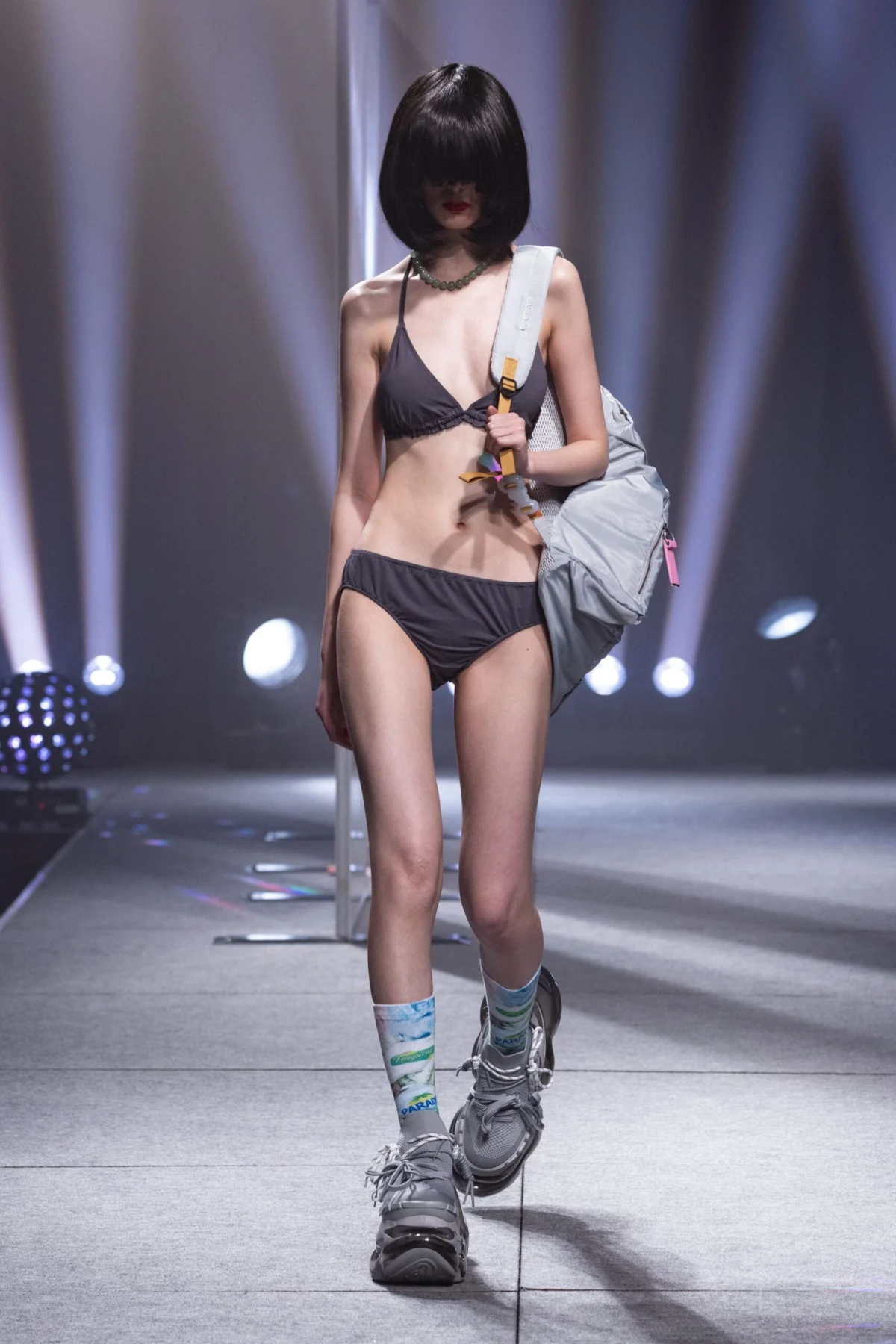
The iconic La Foret, a multi-story temple to youth culture and trend-driven retail nestled within Tokyo’s vibrant Harajuku district, provided an unexpectedly resonant backdrop for Mikio Sakabe’s latest collection. The designer, known for his ability to excavate the undercurrents of Japanese pop culture and recontextualize them into desirable, often ironic fashion, presented a collection that delved into the complex pursuit of fantasy within the mundane. The genesis of this provocative presentation? Japan’s ubiquitous gravure magazines. These publications, characterized by their vaguely erotic imagery featuring young models in various states of undress and cosplay, served as a left-field inspiration for Sakabe, who envisioned the entire affair as a "swimsuit show held in a shopping mall."
Sakabe articulated his rationale for this unconventional venue and theme, stating, "There’s something interesting about the concept of a fashion show in a Japanese fashion mall. It feels bright and showy but it’s also a little sad." This sentiment was visually underscored by the runway itself, deliberately strewn with the detritus of consumer culture: discarded coffee cups and drink cans, transforming the typically pristine fashion runway into a poignant reflection of urban ephemerality and the disposable nature of trends. The collection, a juxtaposition of straightforward bikinis and Sakabe’s signature deconstructed, oversized tailoring and shirting, saw models emerge in garments that were slashed, layered, and shaped into deliberately chaotic forms. Some pieces were adorned with an abundance of frills, while others featured floppy appendages that evoked the whimsical, almost childlike silhouette of bunny ears, a subtle nod to the "bambi-eyed" models often featured in gravure.
A unifying element across all looks was Sakabe’s distinctive eye-obscuring, helmet-like wigs, a stylistic signature that has become synonymous with his aesthetic over the past several seasons. "Somehow I really like them," he admitted, indicating a personal affinity for the transformative and enigmatic quality these headpieces impart. Further cementing the collection’s cohesive identity were the models’ footwear: the gravity-defying bubble-soled sneakers from Sakabe’s highly successful footwear project, Grounds. Launched in 2019, Grounds has rapidly evolved into a significant global enterprise, now employing approximately 100 individuals worldwide, a testament to Sakabe’s entrepreneurial acumen alongside his creative vision.
The Subversive Power of Contrast: Gravure, Malls, and the Illusion of Escape
Mikio Sakabe’s artistic trajectory has consistently been marked by his astute ability to mine the depths of underground culture and translate its elements into fashion that, while sometimes ironic, remains undeniably desirable. This talent has cultivated a substantial and loyal following across Asia, drawn to his unique brand of commentary through clothing. The current collection, much like his previous works, grappled with the pervasive human desire to escape the confines of reality, and perhaps more importantly, the inherent futility of such attempts.
The collection’s thematic core lay in the stark contrast between the hyperreal, often curated superficiality of gravure imagery and the decidedly banal, everyday context of a shopping mall. This juxtaposition served to amplify the inherent artificiality present in both realms, questioning the authenticity of the fantasies presented and pursued within these spaces. The ultimate statement of this thematic exploration arrived with the final look: a half-worn shirtdress. Adorned with strategically placed slits of shimmering silver fabric, the garment appeared not as mere clothing, but as portals, suggesting openings to alternate dimensions or, perhaps, the elusive escape Sakabe’s collection sought to both explore and ultimately critique. This powerful visual metaphor encapsulated the collection’s overarching narrative of seeking solace or excitement in manufactured realities, only to be confronted with their inherent limitations.
Background and Context: Harajuku’s Evolving Landscape and Sakabe’s Design Philosophy
Harajuku, a district synonymous with avant-garde street style and youth subcultures for decades, has undergone significant shifts in recent years. While it retains its reputation as a hub for fashion innovation, the proliferation of international fast-fashion brands and the gentrification of some areas have introduced a complex dynamic. La Foret, in particular, has long been a focal point for emerging and established Japanese designers, serving as a barometer for contemporary trends. Its dense retail environment, packed with diverse boutiques catering to a young demographic, offers a microcosm of Japan’s consumer culture.
Mikio Sakabe, a graduate of the prestigious Royal Academy of Fine Arts in Antwerp, where he studied alongside influential designer Demna Gvasalia, has consistently demonstrated a keen understanding of cultural nuances. His early career was shaped by the rigorous, conceptual approach fostered in Antwerp, but he has since forged a distinct path, infusing his work with a distinctly Japanese sensibility. His collections often explore themes of identity, alienation, and the search for meaning in a hyper-modern, consumer-driven society. The choice of a shopping mall as a venue for a fashion show is not merely a stylistic choice; it is a deliberate act of commentary, placing his creations within the very ecosystem of consumption they aim to critique or re-examine.
The gravure magazine inspiration itself speaks to a particular facet of Japanese popular culture, one that has evolved significantly over time. From its origins, gravure has occupied a space that is both commercially driven and culturally specific, often appealing to a male demographic through idealized portrayals of femininity. Sakabe’s decision to draw from this source material, particularly in the context of a fashion show, invites a deeper consideration of how idealized imagery is consumed and how it intersects with personal desires for escapism.
Supporting Data and Broader Implications
The success of Sakabe’s Grounds footwear project, employing around 100 people globally, offers concrete data on his growing influence and the commercial viability of his design ventures. This expansion beyond purely artistic expression into a robust business enterprise indicates a strategic approach to his brand development. The global reach of Grounds suggests that Sakabe’s aesthetic, while rooted in Japanese subcultures, possesses a universal appeal that resonates with international consumers.
The implications of Sakabe’s collection extend beyond the immediate fashion industry. By highlighting the "sadness" lurking beneath the "bright and showy" facade of consumer spaces and idealized imagery, he prompts reflection on the societal pressures to find fulfillment through consumption and manufactured realities. In an era increasingly dominated by social media curated realities and the relentless pursuit of aspirational lifestyles, Sakabe’s work serves as a timely reminder of the potential disconnect between our desires and the often-unfulfilling sources we turn to in their pursuit.
Furthermore, the deliberate use of discarded materials on the runway can be interpreted as a subtle commentary on sustainability and waste within the fashion industry, a topic of growing global importance. While not explicitly stated as a primary theme, the visual disruption caused by the litter suggests a subversion of the expected pristine environment of a fashion show, aligning with a broader critique of excess.
Expert and Industry Reactions (Inferred)
While direct quotes from other designers or industry analysts are not available in the provided text, the choice of La Foret and the conceptual underpinnings of the collection would likely elicit a range of reactions within the fashion community. Fellow designers who operate within similar conceptual frameworks might recognize Sakabe’s adeptness at marrying artistic commentary with commercial appeal. Fashion critics, accustomed to Sakabe’s provocative approach, would likely interpret the gravure and mall juxtaposition as a sophisticated exploration of contemporary Japanese society. Retail analysts might view the success of Grounds as a case study in building a globally recognized brand from a unique design proposition. The fashion press, in general, would likely focus on the collection’s thematic resonance and its ability to spark dialogue about the nature of fantasy, reality, and consumption in the modern world.
Chronology of Sakabe’s Vision
The narrative of this collection can be traced through several key points:
- Inspiration: The initial spark for the collection originates from Japan’s gravure magazines, a cultural artifact of idealized imagery and male-marketed fantasy.
- Conceptualization: Sakabe conceives of the collection as a "swimsuit show held in a shopping mall," merging the themes of idealized femininity with the mundane reality of consumer spaces.
- Venue Selection: La Foret, a quintessential Harajuku mall, is chosen as the stage, its inherent consumerist environment serving as a crucial element of the narrative.
- Runway Design: The intentional littering of the runway with discarded coffee cups and drink cans establishes a tone of urban decay and the ephemeral nature of consumerism.
- Collection Presentation: Models showcase a blend of swimwear and Sakabe’s signature deconstructed tailoring, unified by distinctive wigs and Grounds footwear.
- Thematic Culmination: The final look, a half-worn shirtdress with silver slits, serves as a visual metaphor for the elusive search for escape.
- Brand Expansion: The simultaneous success of Sakabe’s Grounds footwear project, employing 100 people globally, demonstrates his expanding influence and commercial reach.
Mikio Sakabe’s latest offering is more than just a fashion presentation; it is a carefully constructed commentary on the spaces where we seek escape and the often-illusory nature of those fantasies. By placing a provocative collection within the very heart of consumerism, Sakabe challenges audiences to look beyond the glittering surface and consider the deeper, perhaps melancholic, realities that underpin our pursuit of the ideal.
