

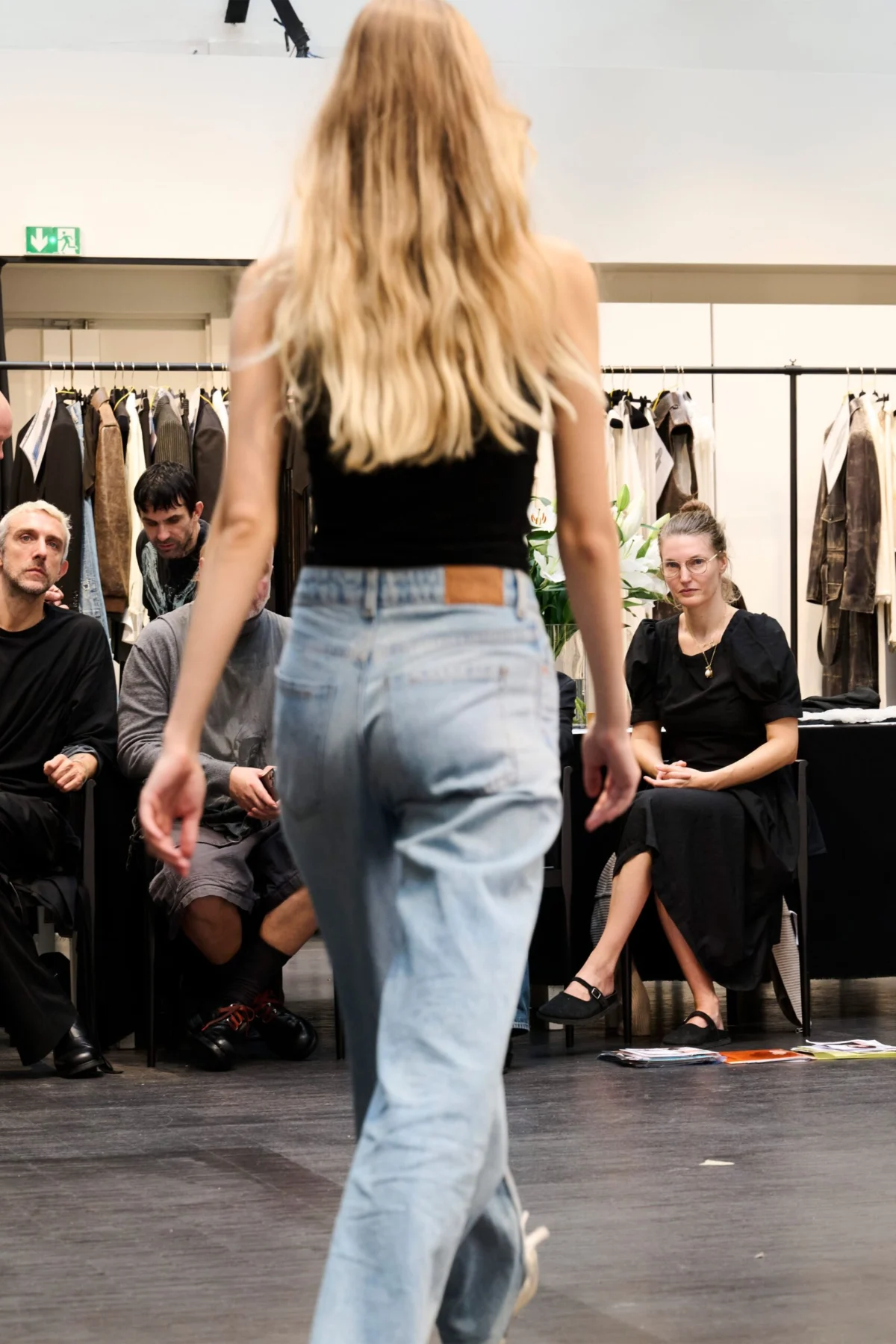
A flurry of activity, barely contained within the elegant confines of the Ann Demeulemeester studio in Paris’s Marais district, signals the imminent approach of a highly anticipated fashion show. Days before the runway presentation at Paris Fashion Week, a procession of aspiring models fills the foyer, their portfolios clutched with hopeful anticipation. Casting director Ben Grimes, alongside creative director Stefano Gallici and his team, orchestrates a meticulous ballet of observation. Each model enters, offers a polite greeting, presents their photograph, executes a brief walk, and departs. The room becomes a silent theatre of decisions, with discreet piles of "yes," "no," and "maybe" photographs accumulating on the floor, awaiting a more thorough review. For those who advance, subsequent fittings and further evaluations precede the ultimate unveiling on the runway.
“When someone walks towards you, you’re going to have two reactions,” explains Grimes, a seasoned professional who has contributed to eight other major shows during the Spring/Summer 2027 season, including those for Jil Sander, Victoria Beckham, Missoni, MM6 Maison Margiela, and Erdem. “You’re going to have one that’s personal to you, and you’re going to have one that is very analytical, one that’s ‘right for my client.’” While the live casting session appears to be the apex of the process, it represents merely the visible culmination of a far more intricate and often protracted journey that commences long before any model steps into the room.
The sheer scale of modern fashion demands a highly organized and efficient casting operation. Julia Lange, another prominent casting director, oversees approximately 18 shows across New York, London, Milan, and Paris during a single fashion month. Her eponymous agency, established in 2011, now boasts a formidable team of 17 professionals. Meeting in Milan, near the Fendi show venue, just hours before a crucial client meeting, Lange highlights the relentless pace. “We have five team leaders that we are dividing between all the shows,” she states, with Max Märtzinger, a key member of her team, present. “Sometimes, it’s two clients a day. On two days of Paris Fashion Week, I will be between five clients. You just have to be efficient. Efficient is my middle name, I guess.” This demanding schedule, often involving swift travel between appointments via moto-taxis, underscores the logistical prowess required to navigate the global fashion calendar.

The Evolution of Fashion Casting
The landscape of fashion casting has undergone a significant transformation over the past decade. Previously, brands often relied on internal teams or a more limited pool of established agencies to select models for their campaigns and runways. “Casting has [evolved] because of the volume of projects that brands feel like they need to do,” Grimes observes. “You can’t just have a campaign that’s out in magazines for four months and then move on to the next. People are scrolling all day, so they need new imagery to see.” This insatiable demand for fresh content, driven by the pervasiveness of social media and the rapid consumption of visual media, has amplified the importance and complexity of casting. Luxury houses, in particular, now frequently present five or six runway shows annually, supplemented by near-monthly campaigns across diverse product categories, from accessories to eyewear, necessitating a constant influx of suitable talent.
Julia Lange concurs, noting that “casting has become much more of a job today.” She recalls a time when “there were only a very few casting directors out there, and clients would do a lot of the casting themselves.” Lange’s own trajectory exemplifies this shift. Beginning her career at the tender age of 21 as the youngest bookings director at Vogue Germany in the early 2000s, she was responsible for producing shoots and securing models. Over the subsequent 15 years, she has cultivated an impressive client roster, including prestigious houses like Fendi, Hermès, Versace, and Alexander McQueen, alongside contemporary designers such as Phoebe Philo and emerging labels like August Barron. One of her most memorable achievements was casting Dario Vitale’s celebrated and distinctive fashion show for Versace. "It was really wonderful to work with someone who has such a strong vision and to cast into that," Lange reflects. "It was a long, interesting process with Dario. We were working on it for at least half a year and building a language together.” This extended collaboration highlights the creative partnership that can develop between designers and casting directors.
Ben Grimes’s perspective on casting is shaped by her own early career as a teenage model. This firsthand experience of the industry from the other side of the lens provided her with invaluable insights before she launched her own agency in 2013. “I think the thing is, we know so little about [casting] because it is actually a really tricky subject to talk about,” she admits. “You are judging people on the way they look, because ultimately, that is the job. I’m trying to question myself constantly around it and listen and inform myself on what beautiful even means.” This introspective approach underscores the ethical considerations inherent in a profession that involves subjective evaluations of appearance.
The Casting Process: Beyond the Pretty Face
The contemporary fashion show typically seeks a harmonious blend of emerging talent, established models, and occasionally, celebrity endorsements. This approach represents a departure from earlier eras where a narrower cadre of top models dominated the runways. “When I started out, everyone wanted the same top 50 girls,” Lange recalls. In her nascent stages, when securing these coveted big names proved challenging, and she was collaborating with emerging photographers like Harley Weir, Lange adopted a more expansive search strategy. “I was like, let’s look into small agencies and see if we find a hidden jewel. I also started casting on Instagram, and we went out on the streets. We started to look wider than purely model agents.”

Today, Julia Lange Casting employs a dedicated scouting team responsible for unearthing fresh faces that align with specific client briefs. “Our team scouted all over Italy and beyond for Dario’s Versace,” she explains. “There was a whole mix. There was a German actor who was walking, there was an Onlyfans star-slash-ballerina, and there was [Olly Elyte] who performs at the Cicciolina parties in Paris.” This deliberate diversification reflects a broader industry trend towards embracing individuals with unique backgrounds and talents, moving beyond traditional modeling archetypes.
The initial phase of any show casting involves an in-depth consultation with the designer. This crucial dialogue delves into the collection’s inspiration, the intended narrative, the persona of the models required, and the budgetary constraints. Following this, casting directors meticulously assess potential candidates, considering their availability, existing commitments, and the need to discover new talent. Their curated selections are then presented to the designer for review and approval.
“Models aren’t available for every brand. It’s not the case that every girl they want, or that we want, is unconditionally available,” Lange points out. “So there’s this very creative process where you need the right eye and the right understanding and vision for the brand. The other part is making those models available for it.” This negotiation and strategic maneuvering with agents and models themselves forms a significant, often unseen, aspect of the casting director’s role.
Emma Matell, another casting director with a reputation for street casting and championing body diversity, has worked on eight shows during the SS27 season, including those in her native Copenhagen. Her collaborations with designers like Sinéad O’Dwyer, a brand consistently recognized for its size inclusivity, have garnered significant attention. “I guess part of me felt like I had something to contribute to casting, and that I could do things a bit differently,” Matell states. “I feel like with Sinéad, we’ve definitely managed to create attention at some point on key issues. When we put disabled models on the runway, for example, it caused a lot of conversation.” This conscious effort to push boundaries and challenge industry norms highlights the evolving social consciousness within fashion.

Navigating the Politics and Practicalities
The logistical intricacies of orchestrating a fashion show are considerable, with the assembly of up to 100 models in one place, ready to walk, presenting a significant challenge. When asked about potential pitfalls encountered by the Julia Lange Casting team during the recent season, Märtzinger, a casting director on Lange’s team, offers a candid analogy: “You tend to forget, it’s like giving birth.” This vivid comparison underscores the intensity and often overwhelming nature of the process.
Lange identifies "probably the politics behind it all" as a primary hurdle. This refers to the complex negotiations and potential conflicts that arise when models and their agents may hold out for more prominent clients or prioritize brands that align with their specific career aspirations. “I guess one of the biggest challenges is to keep the struggles away from the client. There are a lot of politics in terms of which model is doing what. Then, there’s this psychological challenge, where you have to tell people in a way that they understand and won’t get too offended that something is not possible.” The ability to deliver difficult news with tact and professionalism is paramount in maintaining client relationships and ensuring a smooth operational flow.
Matell echoes this sentiment, describing the experience as managing "a lot of threads happening." She often finds herself in communication with over 80 agents simultaneously, negotiating model availability and terms before presenting her final selections to the client. “You might have one agent saying, [this model] can do it, but her call time will be two hours later. But that girl needs a hair look, which is more complex, and so we need her to be there earlier. So therefore, we can’t have that girl. There are so many things with each individual model that you have to take into account and keep track of.” The sheer volume of detail and the need for constant vigilance are critical components of successful casting.
Once negotiations conclude and the client makes their final selections, typically from a curated slide deck of model images, invitations are extended for live castings. For the Cecilie Bahnsen SS27 show, which featured 30 looks, Matell reviewed 120 models over a two-day casting period. Across the entire season, Lange’s team estimated they had assessed more than 800 individual models. This volume alone speaks to the scale of operations within major fashion weeks.

For smaller brands, budgetary limitations can present further complications. “Nobody ever gives you the perfect ingredients,” observes casting director Simone Schofer. “Either there’s no money, or there’s no travel budget, dates move, a person misses a flight, or doesn’t show up on set. There’s a lot of troubleshooting. But it’s also kind of exhilarating – it makes it quite fun.” This adaptability and resourcefulness in the face of adversity are hallmarks of experienced casting professionals.
Grimes shares this perspective, acknowledging the inherent challenges. “There’s always a disaster, but like, no one’s died,” she remarks with a touch of wry humor. “And as long as you fix it, which you have to, it’s OK. There are tons of things you guys never need to know about. We are putting out fires all the time.” This behind-the-scenes reality often remains hidden from public view, a testament to the dedication and problem-solving skills of the casting teams.
Cultivating Personalities on the Runway
At the Cecilie Bahnsen casting during Paris Fashion Week, Emma Matell observes the models as they walk, having already secured several key individuals. Among them is Danish curve model Ronja Josephsen, whose debut at Paris Fashion Week is anticipated with excitement. Matell has also incorporated unique faces discovered through broader cultural channels, including Danish actor Elke Eisenbender and Sabrina Fuentes, the lead singer of the New York-based band Pretty Sick. These models are vying for the remaining coveted spots in the show.
To maintain efficiency and manage the flow of hopefuls, Matell employs a system of quick text messages to her assistants stationed in the foyer, using codes like “FTG” (free to go) to guide the models. This ensures a smooth and orderly process, mitigating the risk of overcrowding and potential discomfort. “I am worried about having too many in the entrance, because it gets really crowded,” she explains, emphasizing the need to “move fast.” Similarly, at Ann Demeulemeester, Grimes instructs a team member to ensure models move smoothly, expressing concern that an overly crowded waiting area might force models to wait outdoors in inclement weather.

“At the end of the day, models are people, and a lot of the time in this industry they get treated like they’re not,” Matell states empathetically. “It’s hard because there’s a huge demand for newness and for more and more and more. Finding time for the individual is really hard, but I really try to do that.” Matell prioritizes briefing all models, whether street-cast or agency-represented, on the casting process and expectations for the day. This transparency aims to prevent any surprises or disappointment, fostering a more positive experience for all involved.
Simone Schofer, working with the Spanish brand Paloma Wool for the first time during Paris Fashion Week, outlines her mission: “I am determined to do a better job [for Paloma] than the people before me.” The brand’s brief was to curate a group of individuals with significant cultural relevance in diverse fields, moving beyond traditional modeling. “The brief was to create a community of people with cultural relevance in other fields, so to speak. Photographers, creatives, artists. People that do something other than modeling basically.”
Schofer reached out to her own network, enlisting individuals such as magazine editor Tish Weinstock and French singer-songwriter Santa (Samanta Cotta), who resides in close proximity to the Paloma Wool studio in Paris’s 11th arrondissement. “[Santa] just came to say hi, and then we kind of roped her into [walking]. She looked great, and she really enjoyed it,” Schofer recounts. Like Lange, Schofer began her career at Condé Nast as a booking director for Glamour and Vogue in the UK before establishing her own agency in 2018. While her primary focus remains commercial and editorial casting, she selectively undertakes a few runway shows each season, including Paloma Wool in Paris, Cos in New York, and Ashley Williams in London.
Schofer’s long-standing relationship with Cos, spanning eight years, offers insight into brand evolution. Initially, Cos aimed to feature architects and professionals in London. “We would go to [high-end restaurant] Coya and cast the chef, we’d go to Zaha Hadid [Architects], as that’s who they felt the customer was at the time. But after a lot of market research, this consumer was actually a very small percentage of who actually buys the brand,” Schofer explains. Under the new creative direction of Karin Gustafsson, the brand shifted towards featuring more prominent models. “It was a very long process to get there,” Schofer notes, but the brand’s recent campaigns have featured top models like Vittoria Ceretti, while established names such as Awar Odhiang and Hejia Li have walked in their shows.

Ultimately, the clothes themselves are the ultimate arbiters on the runway. During castings, designers and casting directors are not merely assessing faces but evaluating how individuals embody and bring the garments to life. “There is definitely a big element of who works in which look,” Lange states. “And then there’s a casting melody that you can create in terms of who you put where. I’m asking, ‘How do they interact with each other?’ It’s like a picture you are painting.” This holistic approach, considering the interplay between the model, the garment, and the overall narrative of the collection, defines the art and science of modern fashion casting. The intricate dance of selection, negotiation, and creative vision ensures that the faces gracing the runway are not just beautiful, but integral to the storytelling of the designer’s collection.
