

The landscape of winter recreation in the United States has undergone a seismic shift over the last three decades, transitioning from a niche pursuit for a dedicated few into a mainstream industry characterized by high-tech equipment and massive public participation. Despite this "explosive growth" in backcountry usage, a comprehensive analysis of historical data reveals a counter-intuitive phenomenon: the annual number of avalanche-related fatalities in the U.S. has remained remarkably steady for more than twenty years. This statistical plateau, persisting amidst a surge in mountain traffic and the evolution of high-performance snowmobiles and alpine touring gear, suggests a profound victory for public safety initiatives, technological innovation, and the national network of avalanche forecasting centers.
Historical Context: The 1994 Benchmark
To understand the current state of avalanche safety, one must look back to the winter of 1994/95, a pivotal era for the American backcountry. At that time, the infrastructure of avalanche safety was in its relative infancy. The national landscape was overseen by a handful of veteran experts: Knox Williams led the Colorado Avalanche Information Center (CAIC) in Denver, Bruce Tremper managed the Utah Avalanche Center, and Mark Moore directed the Northwest Avalanche Center in Seattle. Regional centers were fewer and further between; Jim Kanzler operated the center in Jackson Hole, Brad Ray led efforts at Mount Washington, and Karl Birkeland had recently established a center in Bozeman, then in its fifth season of operation.
The physical reality of the backcountry in 1994 was vastly different from the modern experience. Most skiers utilized telemark equipment, often paired with leather boots that offered minimal support compared to modern plastics. Snowmobiles were significantly heavier, less powerful, and lacked the mobility required to access the steep, deep-powder terrain that is routinely navigated today. Furthermore, the concept of "sidecountry"—lift-accessed backcountry terrain—was virtually non-existent, as most ski resorts maintained strictly closed boundaries. The digital age had not yet arrived for the winter sports community; the first avalanche advisories were only just beginning to appear on the nascent World Wide Web toward the end of that 1995 season.
The Data: A Statistical Flatline
In the twenty-two seasons following the 1994/95 winter, the U.S. witnessed a revolution in mobile technology, social media connectivity, and lightweight carbon-fiber gear. Logic would dictate that as more people entered the wilderness with more capable machines and easier access, the number of accidents and fatalities would rise proportionally. However, the data compiled by the Colorado Avalanche Information Center (CAIC) tells a different story.
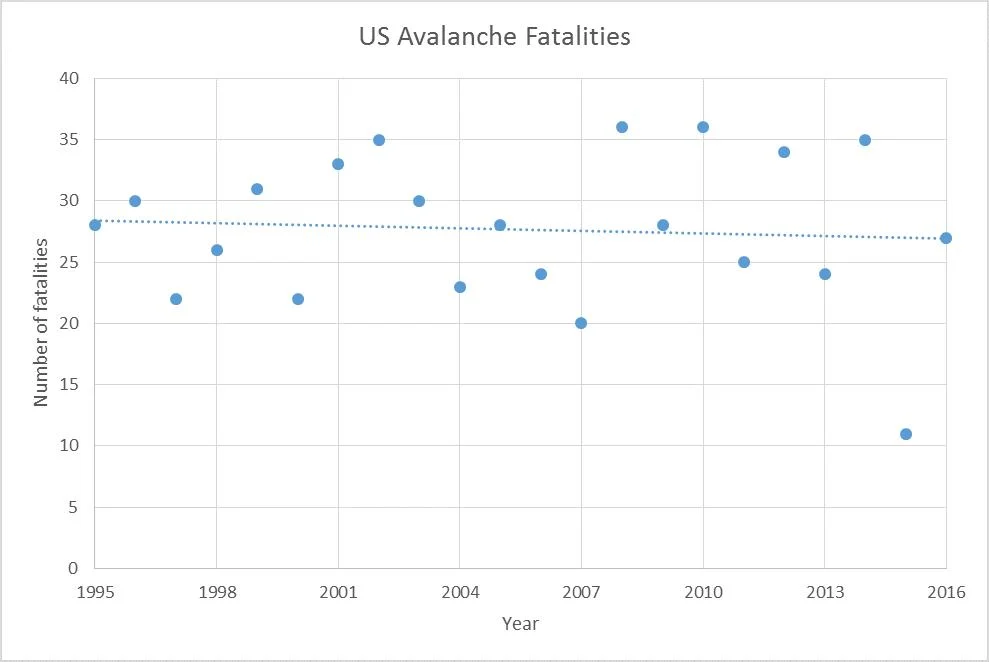
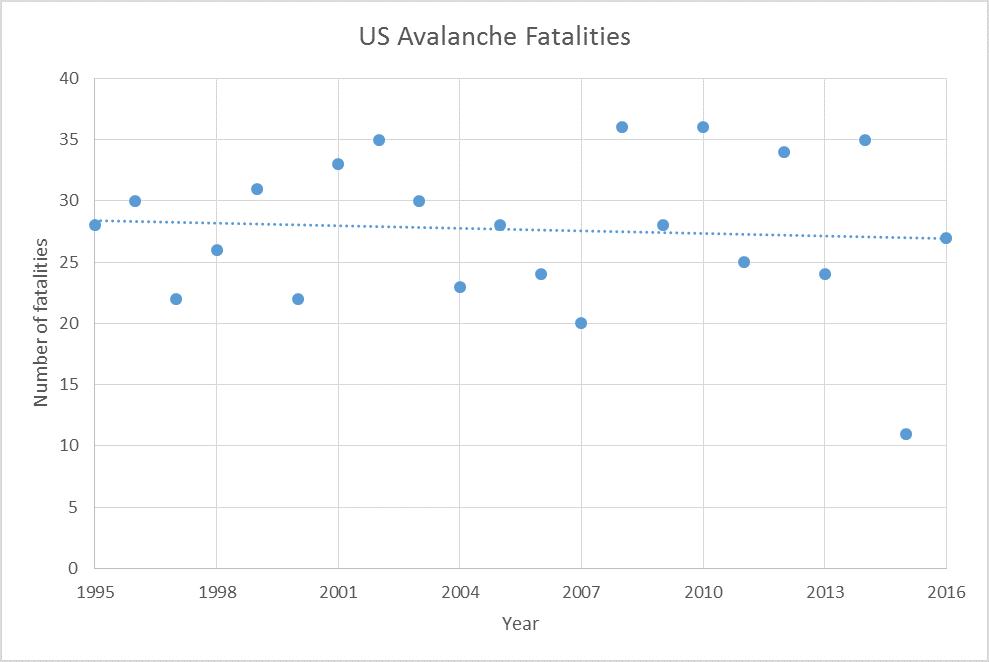
From 1994/95 through 2015/16, the trend line for total U.S. avalanche fatalities remained statistically flat. Figure 1 of the CAIC data illustrates a trend line with a slightly decreasing slope, yet with a p-value of 0.7, the trend is not statistically significant. This indicates that despite year-to-year fluctuations driven by snowpack variability, there has been no documented increase in the overall number of deaths.
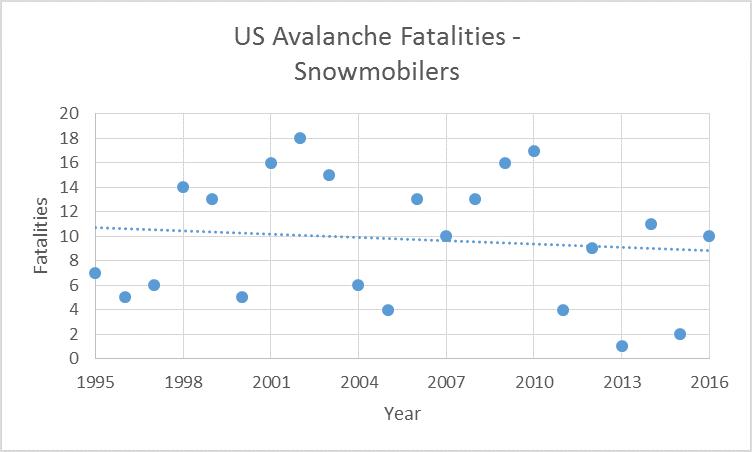
When the data is segmented by user group, the stability of these figures becomes even more apparent. Snowmobile-related fatalities have shown no significant change over the 22-year period, with a p-value of 0.6. This is particularly noteworthy given that modern "mountain sleds" have enabled riders to reach high-elevation, high-consequence terrain that was inaccessible to the previous generation of machines. Among backcountry skiers and snowboarders, there is some statistical evidence of a very slight increase (p = 0.07), yet even this minor uptick fails to match the massive increase in the number of participants.
Proxy Metrics for Backcountry Usage
While the number of fatalities has remained steady, the number of people entering the backcountry has surged. Tracking "dispersed recreation" is notoriously difficult because there are no turnstiles or ticket booths at trailheads. However, experts utilize the consumption of avalanche advisories as a reliable, albeit imperfect, proxy for participation.
The growth in advisory usage across the United States is staggering. Over the 22-season study period, the Utah Avalanche Center reported a 12-fold increase in users accessing their safety forecasts. The Colorado Avalanche Information Center saw a 17-fold increase. In Montana, the Gallatin National Forest Avalanche Center recorded a 36-fold increase, while the Northwest Avalanche Center in Washington and Oregon experienced a 60-fold increase in advisory hits.
While some of this increase is undoubtedly linked to the ease of accessing information via smartphones and the internet, it serves as a clear indicator of a massive expansion in the user base. Analysts suggest a conservative estimate would place the increase in backcountry usage at approximately eight times the 1994 levels.
Calculating the Fatality Rate
The most significant takeaway from this data is the plummeting "fatality rate"—defined as the number of deaths per backcountry user day. If the number of participants has increased eightfold while the number of fatalities has remained constant, the fatality rate has effectively dropped by a factor of eight.
To put this in perspective, if the fatality rate had remained the same as it was in the mid-1990s, the United States would likely be seeing upwards of 200 avalanche-related deaths per winter today. Instead, the annual average has hovered consistently in the range of 25 to 30. This suggests that the "danger" of the backcountry is being managed more effectively by the modern recreator than by their predecessors, despite the increased accessibility of dangerous terrain.
Factors Driving the Decline in Risk
Industry experts and safety researchers point to a multi-faceted approach as the reason for this success. The "win" for the community is attributed to three primary pillars: education, technology, and information.
The Education Revolution
The mid-2000s saw a shift in how avalanche safety was taught. Organizations moved away from overly technical, science-heavy curriculums toward more behavior-based education. Programs like "Know Before You Go" (KBYG) were developed to provide accessible, high-impact awareness to the general public, focusing on five simple steps: Get the Gear, Get the Training, Get the Forecast, Get the Picture, and Get Out of Harm’s Way. This awareness-level training reached tens of thousands of high school students and new backcountry users who might otherwise have entered the mountains without any preparation.
Technological Advancements
The gear used to survive an avalanche has seen a parallel evolution. In 1994, avalanche beacons were largely analog and required significant practice to master. Modern digital beacons feature multiple antennas and sophisticated processing that make locating a buried victim significantly faster and more intuitive. Furthermore, the introduction and mass adoption of avalanche airbag packs—which use a large balloon to keep the wearer near the snow surface during a slide—have been credited with saving dozens of lives. Other innovations, such as the Avalung (which allows a buried victim to breathe under the snow) and lightweight helmets, have further improved the odds of survival.
The Regional Forecast Network
Perhaps the most critical factor is the expansion and professionalization of the regional avalanche center network. These centers provide daily, high-resolution forecasts that allow users to plan their trips around specific localized hazards. By categorizing risk into a standardized five-level scale (Low, Moderate, Considerable, High, Extreme), these centers have given the public a common language for risk assessment. The transition from recorded phone lines to sophisticated websites and mobile apps has ensured that this life-saving information is available to users at the exact moment they are making decisions in the field.
Implications and Future Outlook
The fact that U.S. avalanche fatalities have not increased alongside the "backcountry boom" is a significant achievement for the outdoor industry and public land managers. It validates the current model of public-private partnership, where federal agencies (such as the U.S. Forest Service) collaborate with non-profit organizations to fund and operate avalanche centers.
However, challenges remain. As "sidecountry" use continues to grow, the line between controlled resort terrain and the uncontrolled backcountry becomes blurred for many casual skiers. Furthermore, the slight rising trend in skier and snowboarder fatalities suggests that while the overall rate is down, certain demographics may still be catching up to the safety standards set by other groups, such as snowmobilers, who have made massive strides in organized safety training over the last decade.
The success of the past 22 years serves as a proof of concept: education and information can effectively mitigate the inherent risks of mountain recreation. While the community’s ultimate goal remains a fatality count of zero, the current data provides a reason for cautious optimism. As the industry moves forward, the focus will likely remain on reaching the "unreachable" users—those who may still be venturing into the mountains without checking the forecast or carrying the necessary rescue gear—to ensure that the flat line of fatalities eventually begins a downward trend.
The data provided by the Colorado Avalanche Information Center, and the collective efforts of the national avalanche community, demonstrate that through a combination of better gear, better data, and better decisions, the risks of the winter wilderness can be successfully managed even as the mountains become more crowded than ever before.
