

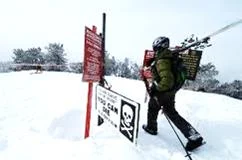
The distinction between a controlled ski resort environment and the uncontrolled wilderness of the American backcountry is often demarcated by nothing more than a single rope line or a swinging wooden gate. For many winter sports enthusiasts, these access points represent a gateway to pristine powder and "sidecountry" terrain—areas that are easily accessible from a lift but exist outside the formal boundaries of a ski resort. However, safety experts and avalanche professionals are increasingly concerned that the term "sidecountry" creates a lethal illusion of safety, leading unprepared skiers and snowboarders into "R-rated" terrain where the consequences of a mistake are often final.
While many premier ski destinations in the United States are situated on or adjacent to sprawling tracks of public land managed by the U.S. Forest Service, the management of these lands changes fundamentally the moment a rider crosses the boundary. Inside the resort, professional ski patrols work tirelessly to mitigate avalanche risks through the use of explosives, ski cutting, and terrain closures. Outside the boundary, even if only ten feet away, the terrain is unmanaged, unpatrolled, and entirely subject to the whims of nature. This transition from a supervised environment to a high-risk wilderness is the core focus of safety advocates who warn that the "sidecountry" is, in every functional sense, the backcountry.
The Illusion of Proximity and the Safety Gap
The primary danger associated with sidecountry skiing is the psychological phenomenon known as the "illusion of safety." Because these areas are accessed via chairlifts and are often visible from the lodge or the parking lot, riders frequently underestimate the objective hazards. The presence of other tracks in the snow further reinforces a false sense of security, leading individuals to believe the slope has been "vetted" by others.
In reality, the proximity to a resort does nothing to stabilize a snowpack. Avalanche professionals point out that the "sidecountry" moniker is a marketing-driven term that suggests a middle ground between the safety of a resort and the ruggedness of the deep wilderness. From a geomorphological and meteorological perspective, no such middle ground exists. Once a skier leaves the patrolled area, they enter a domain where rescue is not guaranteed and avalanche mitigation is non-existent.
This safety gap is particularly concerning regarding younger demographics. As noted by industry experts, parents often drop their children off at a ski area with the assumption that they are in a supervised environment. However, if those teenagers follow a group of peers through a boundary gate into R-rated terrain, they are no longer under the protection of the resort’s professional staff. In these scenarios, the responsibility for safety shifts entirely from the institution to the individual, often without the individual fully grasping the gravity of that shift.
Statistical Trends and Avalanche Fatalities
Data from the Colorado Avalanche Information Center (CAIC) and the American Avalanche Association highlight a sobering trend in winter sports fatalities. Over the last two decades, a significant percentage of avalanche-related deaths have occurred in areas categorized as "sidecountry." These incidents frequently involve riders who are equipped for a day at the resort—wearing standard alpine boots and carrying no rescue gear—rather than individuals prepared for a backcountry expedition.
According to national statistics, the United States averages approximately 25 to 30 avalanche fatalities per year. A recurring theme in these reports is the "out-of-bounds" factor. In many of these cases, the victims were found within a few hundred yards of a resort boundary. The data suggests that the ease of access provided by high-speed lifts allows skiers to reach high-consequence terrain with minimal physical effort, bypassing the "sweat equity" and time for observation that typically accompanies traditional backcountry touring.
Furthermore, the demographic profile of those involved in sidecountry accidents often leans toward experienced resort skiers who may lack formal avalanche education. While they possess the technical skills to ski steep, difficult terrain, they may lack the "mountain sense" required to evaluate snow stability, identify terrain traps, or perform a companion rescue with a transceiver, probe, and shovel.
The Chronology of the "Sidecountry" Crisis
The tension surrounding sidecountry access has evolved over several decades, paralleling the growth of the outdoor industry and advancements in equipment.
- The 1990s: The Open Boundary Movement: During this era, many U.S. ski resorts moved toward "open boundary" policies. This change was largely driven by the U.S. Forest Service’s stance that public lands should be accessible to the public. Resorts began installing gates rather than maintaining strict closures.
- The Early 2000s: The Rise of Freeriding: The popularization of "fat" skis and specialized backcountry gear made it easier for average skiers to navigate deep powder. Marketing campaigns began highlighting "sidecountry" as a perk of resort membership.
- 2012: The Tunnel Creek Incident: A watershed moment occurred at Stevens Pass, Washington, when a group of highly experienced skiers exited the resort boundary into an area known as Tunnel Creek. An avalanche killed three world-class skiers. This event brought national media attention to the dangers of sidecountry terrain and the "social proof" heuristic, where people follow others into danger.
- 2015-Present: The Education Pivot: Following a string of high-profile deaths, organizations like Avalanche.org and the National Ski Patrol began a concerted effort to retire the word "sidecountry." The current industry mantra is: "Backcountry is backcountry, no matter how you get there."
Jurisdictional Realities and the Role of Ski Patrol
A common misconception among resort guests is that the ski patrol is obligated to rescue them if they get into trouble outside the boundary. While ski patrols are composed of highly trained professionals who often assist in out-of-bounds rescues, their primary responsibility is to the paying guests within the permitted resort area.
When an accident occurs out-of-bounds, the jurisdiction typically shifts to the local Sheriff’s Office and volunteer Search and Rescue (SAR) teams. This transition can lead to significant delays in response times. Unlike a resort rescue, where a toboggan can reach an injured party in minutes, a wilderness rescue may require hours of mobilization, helicopter support, and dozens of volunteers.
Furthermore, the legal framework protects resorts from liability regarding out-of-bounds incidents. In most jurisdictions, once a skier passes a "You Are Leaving the Ski Area" sign, they assume all inherent risks of the wilderness. This includes not only avalanches but also unmarked cliffs, tree wells, and creek crossings that are not mitigated by the resort staff.
The Human Factor: Heuristics in the Sidecountry
Avalanche education increasingly focuses on the "human factor"—the psychological traps that lead people to make poor decisions in avalanche terrain. These traps are amplified in sidecountry environments:
- Familiarity: Skiers who have skied a particular out-of-bounds run dozens of times without incident develop a false sense of security, ignoring the fact that snowpack conditions change daily.
- Social Proof: Seeing a crowd of people heading through a gate leads individuals to assume the slope is safe.
- Scarcity (The "Powder Fever"): The desire to get "fresh tracks" before others can lead skiers to ignore obvious red flags, such as recent or active loading of snow.
- Expert Halo: Following a "leader" who appears confident but may not actually have the training to assess avalanche risk.
Experts argue that these R-rated terrains require an "X-rated" level of preparation. Without a partner, a plan, and the proper equipment, entering these areas is a gamble where the house—the mountain—always holds the advantage.
Industry Response and Future Implications
In response to the rising number of incidents, the National Ski Areas Association (NSAA) and various avalanche centers have intensified their educational campaigns. Many resorts now feature "Avalanche Awareness" beacons at boundary gates, allowing skiers to check if their transceivers are functioning before they exit.
There is also a growing movement to hold skiers more accountable for the costs associated with out-of-bounds rescues. In some states, if a skier knowingly enters a closed area or ignores posted warnings, they can be billed for the thousands of dollars spent on their rescue.
The broader implication for the ski industry is a shift in how terrain is marketed. The industry is moving away from the "sidecountry" label in favor of "unmanaged backcountry." By framing these areas as wilderness rather than an extension of the resort, safety advocates hope to discourage the casual, unprepared entry that has led to so many tragedies.
The message from professionals is clear: the gate is not just a doorway to better snow; it is a transition into a high-stakes environment where nature is the only authority. For those who choose to cross it, the requirement is not just skill on skis, but a profound respect for the volatility of the mountain and a commitment to the education required to survive it.
