

The winter of 1994/95 marked a different era for avalanche awareness and backcountry recreation in the United States. At that time, the landscape of avalanche forecasting was considerably less developed than it is today. Key figures like Knox Williams, Bruce Tremper, and Mark Moore led the prominent avalanche centers in Denver, Utah, and Seattle, respectively. Jim Kanzler managed the center in Jackson Hole, and Brad Ray directed operations at Mount Washington. A nascent avalanche center, initiated by the author in Bozeman, was only in its fifth year of operation. Notably, dedicated avalanche centers were yet to be established in critical mountain regions such as the Chugach, Tahoe, and Mount Shasta.
The equipment used by backcountry enthusiasts was also vastly different. The vast majority of backcountry skiers relied on telemark gear, with many, including the author, opting for traditional leather boots. Snowmobiles of that era were significantly less powerful, less mobile, and heavier than their modern counterparts. Ski resorts generally had strict closed boundaries, and the term "sidecountry," referring to terrain accessible from within ski resort boundaries but outside the marked trails, was not yet in common parlance and would take over a decade to gain widespread usage. Furthermore, the internet was in its infancy, with the first avalanche advisories only beginning to appear online towards the end of that particular winter season.
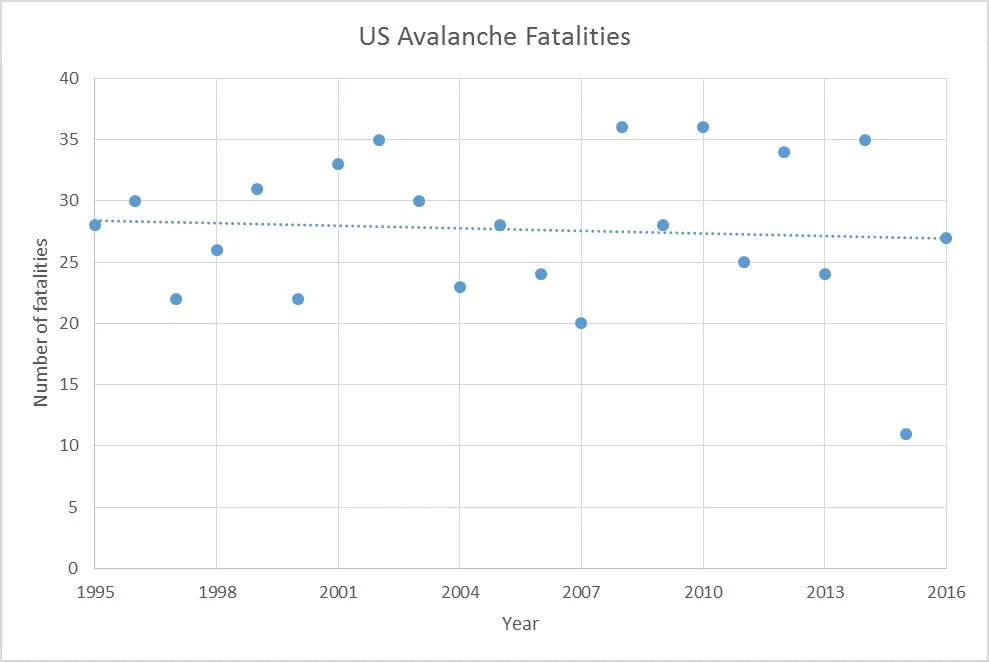
In light of these historical conditions and the dramatic evolution of backcountry recreation over the subsequent decades, a surprising statistical trend has emerged: the annual number of avalanche fatalities in the U.S. has not increased. For the past 22 seasons, despite significant technological advancements, a surge in backcountry participation, and the proliferation of information dissemination channels, the overall number of seasonal avalanche fatalities has remained remarkably stable. This stability is illustrated in Figure 1, which charts U.S. avalanche fatalities from the 1994/95 winter through the 2015/16 winter. The data reveals a slightly decreasing least squares trend line, which, crucially, is not statistically significant (p = 0.7). This lack of statistical significance indicates no discernible change in the number of avalanche fatalities over this extensive period.
A Look at the Data: Fatalities Across User Groups
Further analysis of the data reveals nuances within different user groups. While the overall trend is one of stability, examining specific categories of backcountry users provides a more granular understanding of the situation.
Snowmobile Avalanche Fatalities: A Consistent Picture
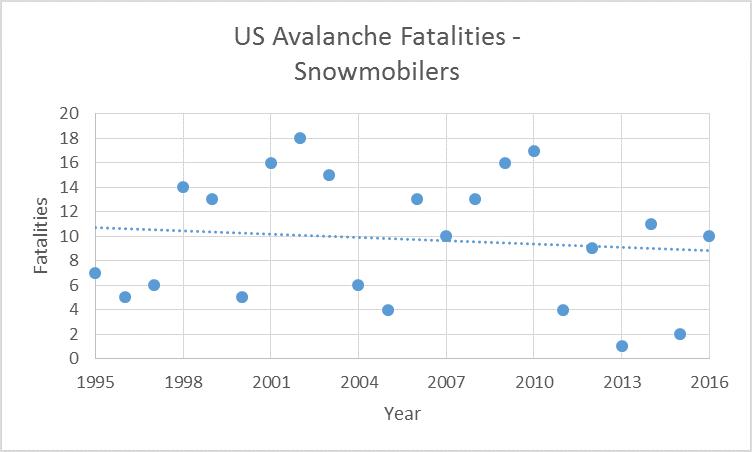
Figure 2, depicting the number of snowmobile avalanche fatalities over the same 22-season period, shows a trend mirroring the overall fatality rate. The number of fatalities among snowmobilers has also remained constant. Similar to the overall trend, the slightly decreasing trend line for snowmobile avalanche fatalities is not statistically significant (p = 0.6), reinforcing the observation of a steady safety record for this user group in avalanche incidents.
Skier and Snowboarder Fatalities: A Slight Uptick?
In contrast, Figure 3, which focuses on backcountry skier and snowboarder avalanche fatalities, presents a slightly different picture. While the numbers are also relatively flat, there is some statistical evidence (p = 0.07) suggesting a potential, albeit slight, increase in fatalities within this demographic over the observed timeframe. This finding warrants closer attention and may reflect shifts in participation patterns or risk-taking behaviors among skiers and snowboarders venturing into the backcountry.
The Unprecedented Boom in Backcountry Recreation
The remarkable stability in avalanche fatalities would be less noteworthy if backcountry use had remained stagnant. However, anecdotal evidence and available data strongly suggest the opposite. Anyone with experience in the backcountry over the past 22 years can attest to a dramatic, almost exponential, increase in the number of people venturing into snow-covered mountains.
While quantifying dispersed winter recreation is inherently challenging, avalanche advisory usage serves as a valuable, albeit imperfect, proxy for understanding this surge in popularity. The data from various regional avalanche centers paints a compelling picture of this growth:
- Utah Avalanche Center: Reported a staggering 12-fold increase in avalanche advisory usage over the past 22 seasons.
- Colorado Avalanche Information Center (CAIC): Experienced a remarkable 17-fold increase in advisory usage.
- Gallatin National Forest Avalanche Center: Saw an impressive 36-fold increase in engagement with their advisories.
- Northwest Avalanche Center: Documented an extraordinary 60-fold increase in advisory usage.
While a portion of these increases can undoubtedly be attributed to the enhanced accessibility and ease with which individuals can now obtain avalanche information—thanks to digital platforms and mobile technology—the magnitude of these figures undeniably points to a significantly larger number of people actively engaging in backcountry activities.
A Dramatic Decline in Fatality Rate
When this substantial increase in backcountry use is considered in conjunction with the stable number of avalanche fatalities, the implications for the fatality rate per backcountry user day are profound. Assuming a conservative estimate that backcountry use has increased by a factor of eight over the past two decades, and combining this with the observed flat fatality trend, the fatality rate has dropped dramatically. In fact, these figures suggest that the avalanche fatality rate has decreased by at least a factor of eight, and potentially more, over the last 22 years.
To contextualize this, if the fatality rate had remained constant while user numbers increased eightfold, the U.S. could have potentially seen over 200 avalanche fatalities per winter in recent years. This hypothetical scenario underscores the significant success of efforts to mitigate avalanche risks and improve safety in the backcountry.
A Collective Success Story: Acknowledging the Contributors
The consistent, low number of avalanche fatalities in the face of such substantial growth in backcountry participation represents a significant achievement for the entire avalanche community. This success is not attributable to a single factor but rather to a multifaceted and collaborative effort involving numerous individuals and organizations.
The author emphasizes that the community will continue to strive for zero fatalities, recognizing that every life lost is a tragedy. However, it is crucial to pause and acknowledge the profound positive implications of this sustained flat trend. This outcome is a testament to the dedication and effectiveness of:
- Avalanche Educators: Professionals and volunteers at all levels, from those providing comprehensive avalanche safety courses to those delivering vital "Know Before You Go" awareness presentations, have played a critical role in equipping individuals with the knowledge and skills to make informed decisions in avalanche terrain.
- Backcountry Guiding and Ski Area Operations: Guiding services and ski areas that prioritize client education and implement robust safety protocols contribute significantly to reducing risk for those under their care. Their commitment to responsible backcountry access and awareness is invaluable.
- Equipment Manufacturers: The innovation and development of advanced safety equipment have been pivotal. This includes significantly improved avalanche beacons, the integration of Avalungs for enhanced survival, lightweight and protective helmets, and the widespread adoption of avalanche airbag packs, which have demonstrably saved lives.
- Regional Avalanche Center Network: The network of regional avalanche centers across the country provides an indispensable public service. They deliver crucial avalanche education and disseminate current, reliable avalanche information, empowering individuals to make sound decisions based on real-time conditions.
Ultimately, this stable fatality trend, juxtaposed with an explosion in backcountry use, serves as powerful evidence that current safety initiatives and educational efforts are working. This collective success is a source of pride for everyone involved in promoting avalanche safety and responsible backcountry recreation.
Data Compilation and Acknowledgements
The data presented in this analysis was primarily provided by the Colorado Avalanche Information Center (CAIC). The author and the broader avalanche safety community express profound gratitude to the CAIC, its dedicated personnel who meticulously compile this vital data, and the many individuals who report and document avalanche accidents. Their efforts are instrumental in allowing the rest of the community to learn from past incidents and improve future safety measures. Constructive reviews and feedback from Simon Trautman, Doug Chabot, and Spencer Logan were also invaluable in shaping this analysis.
The evolution of avalanche safety in the U.S. over the past quarter-century is a compelling narrative of adaptation, innovation, and collective responsibility. As backcountry activities continue to grow in popularity, the ongoing commitment to education, technological advancement, and information dissemination will remain paramount in the pursuit of an even safer future in the mountains.
