

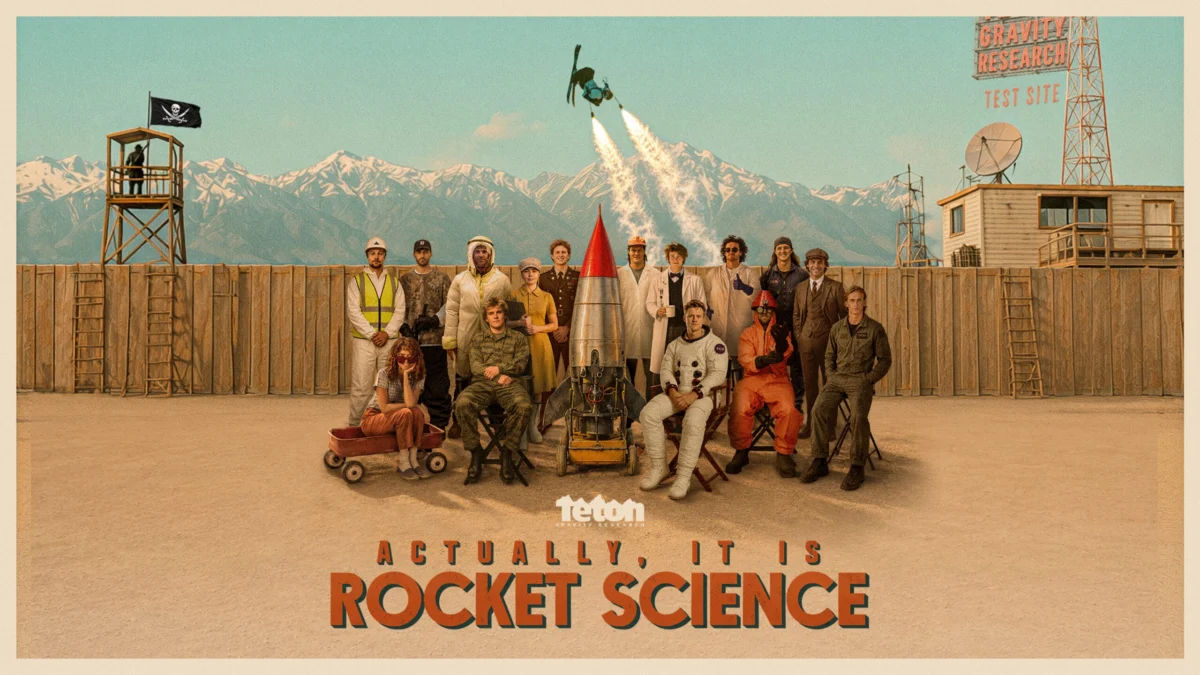
The seemingly intuitive art of navigating a treacherous couloir, executing a flawless cliff drop, or timing the perfect commitment to a daring line is, in fact, a deeply complex interplay of physics, physiology, and split-second decision-making. Teton Gravity Research (TGR) has meticulously explored this intricate relationship in their 31st annual ski film, "Actually, It Is Rocket Science." The documentary transforms the world’s most formidable mountain landscapes into a living laboratory, where elite skiers act as pioneering scientists, pushing the boundaries of speed, precision, creativity, and unwavering commitment across some of the planet’s most challenging terrains. The film delves into the critical calculations that precede each descent, the primal instincts that take over mid-air, and the razor-thin margin that separates a well-conceived plan from a successful, awe-inspiring run.
The genesis of this ambitious cinematic endeavor lies in the understanding that while there may not be a universally codified formula for extreme skiing, the principles governing it are as rigorous as any scientific discipline. These principles are not derived from textbooks but are forged in real-time, at speeds exceeding 60 miles per hour, amidst unpredictable weather patterns, and with the unforgiving terrain constantly unfolding beneath the skis. Each decision, each movement, is a data point in a live experiment, where the consequences of error are profound.
The Global Laboratory of Extreme Terrain
The pursuit of understanding these complex skiing dynamics has led TGR and its cadre of athletes across a geographically diverse and meteorologically varied canvas. The film’s narrative arc begins in Haines, Alaska, a region synonymous with some of the largest and most complex alpine terrain on Earth. Here, a meticulously established basecamp serves as the launching point for explorations into the Alaska Range, a formidable natural arena that demands the highest levels of skill and respect. The sheer scale and technical difficulty of these Alaskan mountains provide a critical testbed for the film’s central hypothesis.

From the rugged grandeur of Alaska, the expedition transitions to the volcanic peaks of Japan. This dramatically different landscape offers a unique set of challenges, primarily characterized by the transformative power of deep, abundant snowfall. The powdery conditions alter the very nature of the terrain, creating new lines and possibilities that require a distinct set of techniques and a heightened sense of adaptability. The interaction between the skiers’ expertise and the ephemeral nature of deep snow underscores the dynamic variables at play in their "experiments."
The film’s exploration continues through the granite walls of British Columbia, where the unforgiving nature of the rock formations necessitates an almost surgical precision in every turn. This environment highlights the importance of precise execution and the critical role of line choice when faced with sheer, unyielding surfaces. Further afield, the Arctic light of Finland reshapes the visual landscape, presenting unique challenges related to visibility and snow texture, demanding an even more refined sensory perception from the athletes. Andorra’s high alpine regions serve as another proving ground, where altitude and exposure amplify the inherent risks and the need for calculated bravery. Finally, the film touches upon the distinct challenges presented by a particularly deep and powder-stacked season at Jay Peak, Vermont, demonstrating that exceptional skiing isn’t confined to remote, exotic locales but can be found in more accessible, yet equally demanding, conditions.
Despite the stark differences in geography, climate, and geological makeup, a singular, unifying objective permeates each location: the relentless pursuit and execution of the perfect line. This consistent goal, pursued across such varied backdrops, allows for a comprehensive study of how different environmental factors influence the fundamental principles of extreme skiing. Ultimately, this global journey culminates back in Jackson Hole, Wyoming, a legendary mecca for skiers, where the season’s findings and the overarching narrative of the film come full circle.
Deconstructing the Descent: The Science Behind the Drop
The film posits that the decision to drop into a challenging line is far from impulsive. It is the culmination of a rigorous mental and physical preparation, akin to a scientific research process. This involves a meticulous assessment of numerous variables, including snowpack stability, avalanche risk, wind patterns, temperature fluctuations, and the topographical nuances of the chosen route. Athletes spend countless hours observing, analyzing, and strategizing before committing to a descent. This phase of the "experiment" is characterized by data gathering and hypothesis formation.

The "rocket science" analogy is particularly apt when considering the physics involved. The skiers are, in essence, navigating complex trajectories, calculating forces of gravity, friction, and air resistance. Each jump, each turn, each spray of snow is a demonstration of applied physics. The way a skier carves a turn to maintain momentum, the angle of approach to a jump to maximize airtime or control a landing, and the precise application of edge pressure all speak to an innate, yet highly developed, understanding of physical principles.
The film highlights how the world’s best skiers become their own instruments of measurement. They develop an extraordinary ability to "read" the snow – to discern subtle changes in texture, density, and depth that can significantly impact performance and safety. This sensory input is processed instantaneously, feeding into the decision-making algorithms that govern their actions. Their bodies become the sophisticated sensors, their skis the finely tuned instruments, and the mountain the dynamic testing ground.
The Instinctive Algorithm: When Data Meets Intuition
While preparation and scientific understanding are crucial, the element of instinct is equally vital. The film explores the fascinating threshold where calculated planning gives way to innate reaction. In the milliseconds that define a critical maneuver, years of experience and honed reflexes take over. This is where the "rocket science" becomes biology, where the trained mind and body operate as a single, cohesive unit, executing complex sequences with breathtaking speed and fluidity.
The question of how far one can push a line, how much can be precisely calculated before instinct takes over, and what transpires when a meticulously crafted plan collides with the unpredictable reality of the mountain are central themes. These questions are answered differently by each athlete featured in the film. Some discover their ultimate limits in the unforgiving high alpine environments, where exposure and technical demands are paramount. Others find their boundaries tested in the ethereal depths of powder snow, on impossibly steep faces, or through the split-second decisions that transform a mere idea into a breathtaking descent.

This inherent variety in approach and the diverse ways athletes confront and overcome challenges is precisely what makes the pursuit of extreme skiing so compelling to witness. "Actually, It Is Rocket Science" aims to capture this spectrum of human capability and the profound moments that arise when rigorous preparation meets the raw, untamed power of nature.
Broader Implications and The Future of the Sport
The implications of TGR’s exploration extend beyond the thrill of watching elite athletes perform extraordinary feats. The film serves as a testament to the human capacity for learning, adaptation, and pushing perceived limitations. By framing extreme skiing through the lens of scientific inquiry, TGR underscores the intellectual rigor and dedication required to excel in this discipline. This perspective can inspire a new generation of athletes and outdoor enthusiasts to approach their chosen activities with a deeper understanding of the underlying principles, fostering a culture of informed risk-taking and continuous improvement.
The film’s global tour, spanning over 200 stops, provides a platform for engaging with a wide audience, sparking conversations about environmental stewardship, the importance of understanding natural forces, and the profound connection between humans and the wild. The success of such films also contributes to the ongoing development and popularization of winter sports, potentially driving innovation in equipment, training methodologies, and safety protocols.
The very nature of extreme skiing is one of constant evolution. As athletes push boundaries and discover new techniques, the "science" behind their pursuits expands. TGR’s "Actually, It Is Rocket Science" not only documents this evolution but also provides a compelling framework for understanding the intricate blend of intellect, instinct, and courage that defines the pinnacle of the sport. The film’s premiere in Jackson Hole, followed by its extensive global tour, signifies a significant cultural event within the action sports community and beyond, offering a unique glimpse into the extraordinary world of those who dare to treat the mountain as their ultimate laboratory.
