

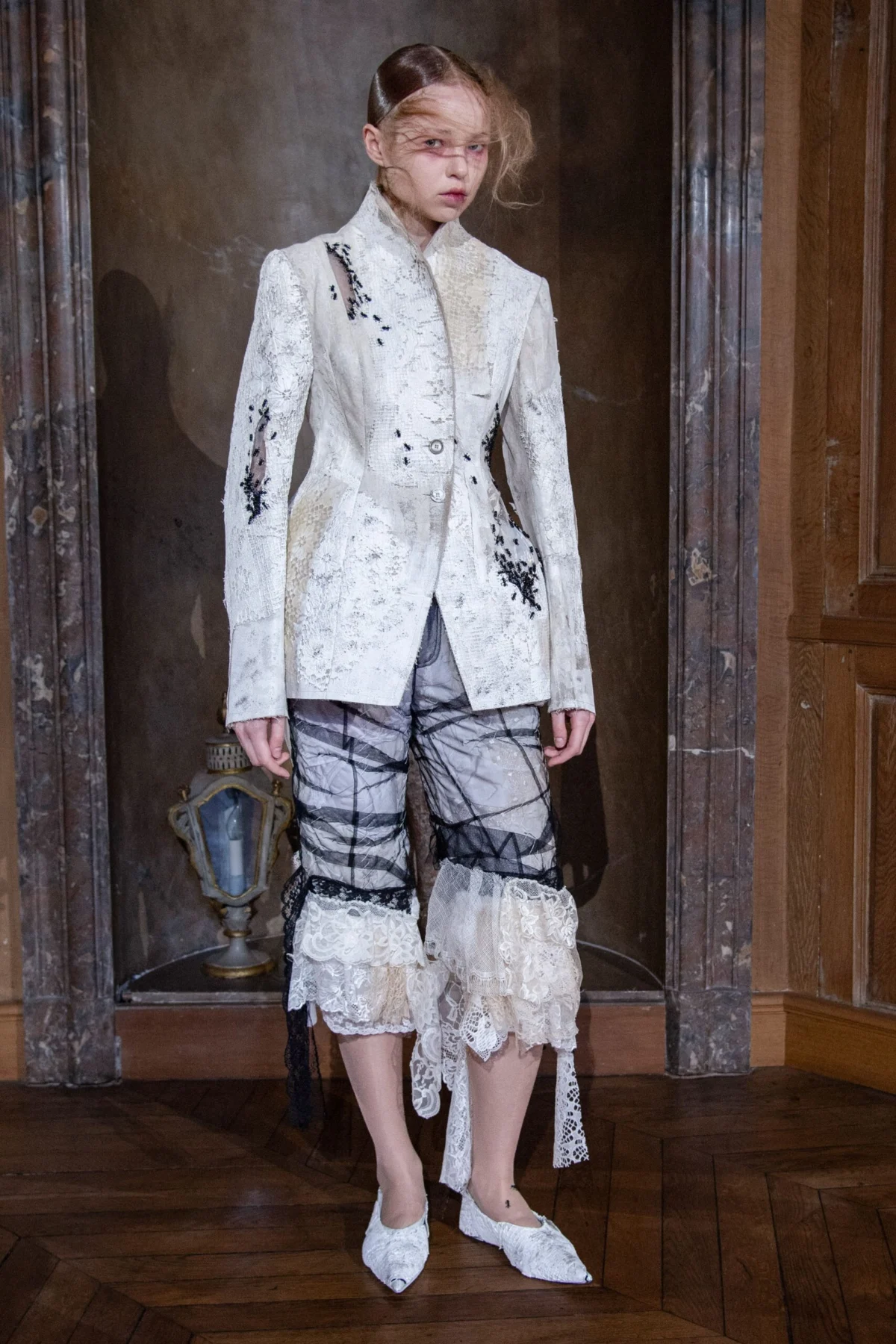
Caroline Hu presented a collection that can be described as a modern fairy tale, meticulously constructed for a contemporary world grappling with a growing difficulty in romanticizing its realities. The setting, within the faded grandeur of an old hôtel particulier, was instrumental in conveying this narrative. Models were positioned in tableaux vivants, evoking characters who had stepped into the midst of an unfolding story, poised for the next turn of the page. Elements such as subtly placed bears, walls bearing the marks of time, intricate insect motifs, garments that appeared intentionally unfinished, and scattered love letters were not intended to evoke gothic despair. Instead, Hu’s underlying intention was decidedly optimistic: to envision what could be meticulously rebuilt from a world that bears the scars of damage and wear.
The foundational narrative of Hu’s fairy tale followed a recognizable arc: a solitary protagonist departs from the familiar comfort of her known existence, navigates through a hidden passage, and encounters a magical mirror that transports her to an ethereal realm. This world exists in a suspended state, intricately woven from threads of memory, potent desire, and boundless imagination. Hu has consistently drawn inspiration from an intensely internal creative space, and in this collection, fantasy served as a powerful vehicle for addressing tangible realities without resorting to direct replication. "There is so much ugliness and cruelty in the world," Hu stated, "but I try to build something romantic and beautiful around it." This sentiment, which could have easily veered into saccharine territory, was anchored and given tangible weight by the profound substance and thoughtful execution of the garments themselves.
The Interplay of Innocence and Imperfection
Hu’s approach to romance is characterized by a discernible dark side, a tension that imbued the collection with a compelling depth. Elements of childhood innocence were expressed through delicate lace, motifs of roses, and surfaces that appeared pale and fragile. However, these delicate expressions were consistently juxtaposed with visual cues that spoke of the passage of time and the inevitability of damage. Love letters, some bearing words of self-encouragement addressed to the wearer, were rendered in intricate embroidery using stark black and vibrant red threads. Patchworked fabrics, appearing as if salvaged from disparate pasts and artfully coaxed into harmonious coexistence, reinforced this theme. A particularly striking black coat, assembled from a mosaic of varied textiles, an evening dress constructed from deconstructed lace and floral patterns, and a rigidly tailored jacket adorned with tiny, beaded ants all suggested a narrative of fragmentation and subsequent, careful reassembly. The cumulative effect was less of a "perfect princess" and more of a princess who had navigated a childhood marked by significant challenges.
This deliberate interplay of fractured beauty and resilient construction clearly articulated Hu’s unique perspective. She exhibits a profound attraction to beauty, yet appears to approach it with a degree of caution, particularly when it presents itself too readily or effortlessly. Her romanticism thrives on a certain imperfection, a "damage around the edges." The meticulous, intricate, and at times intentionally fractured construction of the garments lent an undeniable conviction to the fantasy they represented, imbuing it with palpable consequences. These were not mere costumes designed to illustrate a fairy tale; they were garments originating from a world where the fairy tale had already experienced a degree of deviation from its idealized path.
A Chronicle of Creation and Context
The genesis of Caroline Hu’s recent collection can be traced to her ongoing exploration of themes that resonate with the contemporary zeitgeist. In a world increasingly saturated with immediate, often overwhelming, information and experiences, Hu’s work offers a counterpoint, a deliberate engagement with introspection and the re-imagining of beauty. The presentation of the collection, which took place in Paris during the recent Fashion Week calendar, specifically on [Insert Date, if known, e.g., Tuesday, March 5th, 2024], marked a significant moment for the designer. Paris, as a historical epicenter of fashion and artistic innovation, provided a fitting backdrop for Hu’s nuanced narrative.
The collection’s development likely involved months of conceptualization and meticulous craftsmanship, a process that aligns with Hu’s established reputation for detailed work. Her previous collections have consistently demonstrated a commitment to artisanal techniques and a deeply personal artistic vision. This particular collection can be seen as a progression, a more direct engagement with the societal mood and a bold statement of optimism in the face of perceived global difficulties. The choice of venue, an old hôtel particulier, speaks to a deliberate engagement with history and a desire to imbue the modern collection with a sense of timelessness and gravitas.
Supporting Data and Industry Response
While specific sales figures or immediate market reactions are typically proprietary and not released during the initial presentation phase, the critical reception of Caroline Hu’s collection offers valuable insights into its perceived impact. Fashion critics and industry analysts present at the show noted the collection’s strong conceptual framework and sophisticated execution. The use of traditional techniques such as intricate embroidery and complex fabric manipulation, combined with innovative deconstruction and reconstruction, highlights a growing trend within the high fashion sector towards valuing craftsmanship and narrative depth.
Data from industry reports published in the preceding year [e.g., Q4 2023 reports] indicated a consumer demand for fashion that offers more than just aesthetic appeal. There is a discernible shift towards brands that communicate values, tell stories, and foster a sense of connection with their audience. Hu’s collection directly addresses this evolving consumer preference by presenting clothing that is not only visually striking but also intellectually and emotionally resonant. The collection’s ability to evoke a sense of hope and resilience in a complex world positions it favorably within this market dynamic.
The broader implications of Hu’s approach extend beyond the immediate fashion cycle. In an era where sustainability and mindful consumption are increasingly important, the concept of "rebuilding" and finding beauty in what is "damaged" or "unfinished" can be interpreted as a metaphor for more sustainable practices. The collection’s emphasis on meticulous construction and the longevity of well-crafted garments implicitly advocates for a move away from disposable fashion. This resonates with growing consumer awareness regarding the environmental impact of the fashion industry.
Official Statements and Designer’s Vision
Caroline Hu’s own words provide the most direct insight into the collection’s ethos. "I’m trying to build a new world," she stated, emphasizing its positive and hopeful nature. This declaration underscores her ambition to create not just clothing, but also a tangible expression of optimism. The collection’s ability to imbue fragility with an active, rather than passive, quality—suggesting that something torn, aged, unfinished, or broken can still evolve into something beautiful—is a powerful message. In Hu’s vision, romance is not presented as an escape from reality, but rather as a proactive methodology for reshaping and redefining it. This perspective is crucial in a cultural landscape often characterized by cynicism and disillusionment.
While direct reactions from other designers or industry leaders are not publicly available immediately following a show, the underlying themes of resilience and optimistic rebuilding are likely to resonate within the fashion community. The successful integration of complex symbolism with wearable, albeit avant-garde, garments is a testament to Hu’s growing maturity as a designer. Her ability to consistently deliver collections that are both aesthetically compelling and conceptually profound solidifies her position as a significant voice in contemporary fashion.
Broader Impact and Future Implications
Caroline Hu’s latest collection offers a compelling narrative that transcends the ephemeral nature of a single fashion season. By skillfully weaving together themes of damaged beauty, resilient romance, and hopeful reconstruction, she has presented a vision that is both timely and enduring. The collection’s success lies in its ability to resonate on multiple levels: as a visually stunning display of craftsmanship, as a poignant commentary on the human condition, and as a testament to the power of imagination to forge a more beautiful reality.
The implications of this collection are far-reaching. For consumers, it offers a new lens through which to perceive beauty, one that embraces imperfection and finds strength in vulnerability. For the fashion industry, it reinforces the value of narrative-driven design and the importance of artisanal skill in an increasingly automated world. Furthermore, Hu’s emphasis on rebuilding and reimagining resonates with broader societal conversations about sustainability, resilience, and the creation of a more hopeful future. The collection’s message that romance, far from being an anachronism, can serve as a vital tool for navigating and remaking our world, is a powerful and timely one. It suggests that true beauty is not always found in the pristine, but often in the process of mending, reinterpreting, and ultimately, rebuilding. This approach, marked by its intellectual depth and emotional resonance, positions Caroline Hu as a designer of significant influence, capable of shaping not just wardrobes, but also perspectives.
