

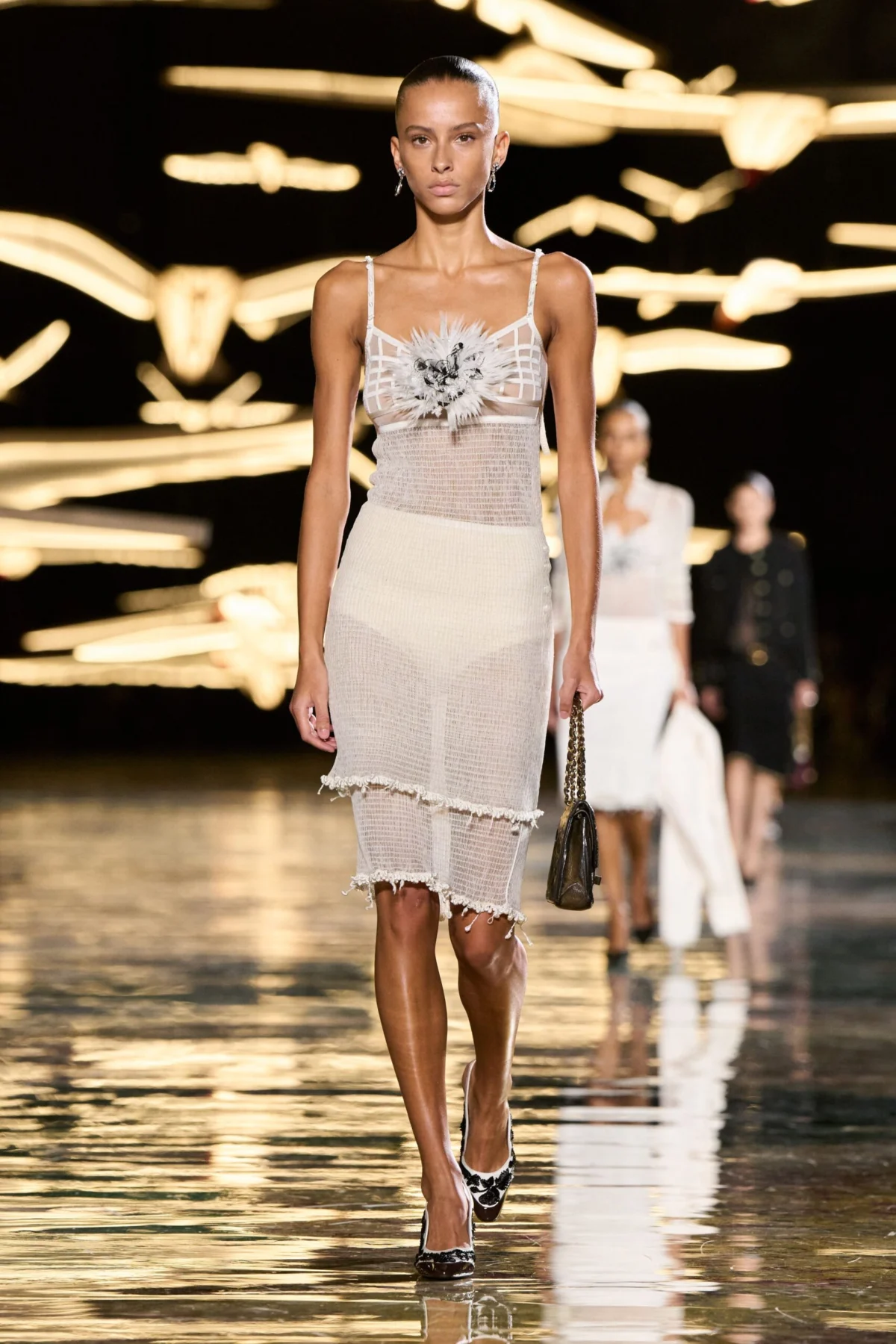
Matthieu Blazy’s ascent to the helm of Chanel, just one year ago, has been nothing short of a phenomenon. In this remarkably brief period, he has not only captured the attention but also the profound affection of fashion-forward women globally. While the initial fervent buzz outside Chanel boutiques may have softened this season, the tangible evidence of Blazy’s impact is undeniable, permeating the front rows of fashion shows and gracing the streets with an unmistakable aura of desirability. The sight of a young woman navigating the Place de la Concorde on a bicycle, her cap-toed Chanel heels glinting in the twilight, serves as a potent testament to this collective adoration.
Chanel, an independent, privately owned maison boasting over a century of rich heritage, represents arguably the pinnacle of achievement for any designer. Blazy’s tenure, therefore, is steeped in both immense privilege and considerable pressure. Yet, what shines through is an unadulterated sense of joy and purpose. As Blazy himself articulated, "Not to go too philosophical, but I think there is a space for poetry, beauty, joy, and it’s a good remedy to the dark time. I think fashion should give this to women." In an era where some designers might gravitate towards aloofness or studied coolness, Blazy’s approach, though seemingly simple, is revolutionary: he is infusing fashion with soul, a sentiment that resonates deeply in contemporary culture.
The narrative of this latest collection was once again anchored in the enduring spirit of Coco Chanel herself. Blazy revealed his inspiration stemmed from a poignant conversation between Coco Chanel and Louise de Vilmorin, who later contributed to Chanel’s memoir. In this exchange, Chanel reflected, "The child I once was is with me today… No one is closer to me than she is. She owes me everything, and I owe her what I was able to contribute to my era." This profound statement provided Blazy with a framework to explore the multifaceted journey of Mademoiselle Chanel: from the restrictive elegance of her Edwardian youth, to her pioneering experiments with menswear-inspired attire, her playful embrace of costume, and ultimately, her revolutionary post-World War II innovations that redefined modern dressing with the ease of the suit.
"It’s not a historical show," Blazy emphasized, "it’s a show about the histories of Chanel." This distinction is crucial. While the collection indeed traced a chronological path through Chanel’s personal evolution, it did so with a contemporary lens, eschewing mere replication for inspired reinterpretation. The journey commenced with an emphasis on embellishment – delicate floral embroideries and corsage details adorning necklines – evoking the ornate aesthetics of a bygone era. This segued into explorations of masculine silhouettes, often deconstructed with raw edges, and reimagined iterations of the now-iconic Charvet shirt, a piece that has become a consistent hit under Blazy’s direction. The collection culminated in a powerful display of Coco Chanel’s signature rounded-shoulder jacket, presented in numerous variations. Notably, these jackets were often worn without a shirt, paired with either demure knee-length skirts slung low on the hips or daring fringy minis, showcasing a modern sensuality. The full circle narrative was powerfully underscored by the casting of newcomer Dyanira Hurbuscher, who opened and closed the show, each time carrying Chanel’s legendary 2.55 bag, a piece borrowed directly from the Maison’s Patrimoine archives, symbolizing a complete and meaningful arc.
The underlying philosophy driving Blazy’s creative explorations is a profound commitment to making Chanel a welcoming and relevant space for women of all generations, transcending any singular, narrow definition of femininity. This dedication to inclusivity is mirrored by his unwavering focus on modernization, a principle that Coco Chanel herself championed throughout her career. A significant portion of the collection highlighted the fruits of a year-long intensive effort to develop a novel tweed. This innovative fabric, crafted from re-embroidered organza and silk, offers unprecedented stretch and represents what Blazy terms "the answer to what sportif means at Chanel." Furthermore, working with specialized teams, Blazy has spearheaded advancements in yarn development and recalibrated textile manufacturing machinery. These technological breakthroughs enable embroideries to be seamlessly integrated directly into the knitting process, a testament to his forward-thinking approach. The vibrant, zesty yellow two-piece top and skirt set served as a striking showcase for this newly honed expertise.
Beyond the intricate technical advancements and the extensive research into material innovation, the true brilliance of Blazy’s Chanel lies in its inherent desirability – that irresistible "got-to-have-it-ness" that ignites the sartorial imagination. The sheer scope of the collection, comprising an impressive 83 looks, was amplified by an extraordinary attention to detail in its accessories. Each and every ensemble was meticulously paired with a distinct pair of heels, a deliberate choice that underscored the completeness and thoughtful curation of each individual look. This exhaustive accessorizing strategy not only demonstrated Blazy’s commitment to a holistic vision but also provided a rich tapestry of footwear designs, ranging from the subtly elegant to the strikingly bold, each complementing the garment it accompanied.
The Blazy Effect: Data and Market Impact
Matthieu Blazy’s tenure at Chanel has coincided with a period of significant market interest and brand resurgence. While specific sales figures for individual collections are not publicly disclosed by Chanel, industry analysts have noted a sustained demand for the brand’s ready-to-wear offerings since Blazy’s appointment. His ability to create pieces that are both covetable and wearable has translated into strong commercial performance, particularly within the luxury segment. The "it" factor he has instilled in the brand is palpable, evident in the consistent sell-through rates of key items and the aspirational desire generated by his collections.
For instance, the reintroduction of classic Chanel silhouettes, reinterpreted with modern sensibilities, has resonated deeply with both long-time patrons and a new generation of luxury consumers. The emphasis on updated tweeds, as seen in the recent collection, taps into a desire for versatile yet elevated pieces. Data from fashion market intelligence firms indicates that accessories, including footwear, remain a critical driver of revenue for luxury houses, and the extensive range of unique heels presented in Blazy’s shows further bolsters this segment. The investment in developing new materials and techniques, such as the stretchy organza tweed, is a strategic move to differentiate Chanel in a competitive landscape and to cater to evolving consumer preferences for comfort and performance without compromising on luxury.
A Legacy Reimagined: The Chronology of Blazy’s Influence
Matthieu Blazy’s journey at Chanel began with his appointment as Creative Director in February 2022, succeeding Virginie Viard. His debut collection, presented in March 2022 for the Autumn/Winter 2022 season, immediately signaled a new direction for the Maison, characterized by a focus on craftsmanship, a playful yet sophisticated aesthetic, and a deep understanding of the brand’s heritage.
Key Milestones:
- March 2022: Debut Ready-to-Wear collection (Autumn/Winter 2022). This collection was widely praised for its fresh perspective and its ability to capture the essence of modern femininity while honoring Chanel’s legacy.
- October 2022: Spring/Summer 2023 Ready-to-Wear collection. This season saw further exploration of fluid silhouettes and a continued emphasis on luxurious textiles.
- March 2023: Autumn/Winter 2023 Ready-to-Wear collection. This presentation delved deeper into the brand’s archival inspirations, reinterpreting iconic codes for a contemporary audience.
- October 2023: Spring/Summer 2024 Ready-to-Wear collection. This collection, the subject of the initial report, marked a significant moment, explicitly drawing from Coco Chanel’s personal narrative and showcasing groundbreaking material innovations. The focus on "histories of Chanel" rather than a strict historical reenactment demonstrated Blazy’s nuanced approach to heritage.
This chronological progression illustrates a consistent vision and a strategic deepening of his engagement with the Chanel archives and ethos. Each collection has built upon the last, solidifying Blazy’s creative voice and reinforcing his ability to connect with the brand’s diverse clientele.
Expert and Industry Perspectives (Inferred)
While direct quotes from specific industry experts regarding this particular collection are not available in the provided text, the general sentiment surrounding Blazy’s tenure at Chanel has been overwhelmingly positive. Fashion critics and commentators have widely lauded his ability to inject a sense of joy and wearability back into the brand, while simultaneously demonstrating profound respect for its heritage.
An inferred reaction from a seasoned fashion editor might be: "Blazy has achieved something remarkable in such a short time. He’s managed to make Chanel feel both deeply familiar and excitingly new. The way he accesses Coco’s personal story and translates it into such relevant clothing is masterful. It’s not just about beautiful clothes; it’s about a feeling, an attitude, and he’s captured that perfectly."
Similarly, a luxury market analyst might observe: "Chanel, under Blazy’s creative direction, is clearly hitting all the right notes. The brand’s ability to innovate in terms of materials, like the new stretchy tweed, while staying true to its core identity, is a key differentiator. This ensures long-term relevance and commercial success in a discerning market." The focus on technical innovation, particularly in textiles, signals a forward-thinking strategy that appeals to consumers seeking both heritage and cutting-edge design.
Broader Implications for the Fashion Landscape
Matthieu Blazy’s approach at Chanel carries significant implications for the broader fashion industry. His success underscores a growing demand for designers who can navigate the delicate balance between heritage preservation and contemporary innovation. In an era saturated with trends, Blazy’s emphasis on "poetry, beauty, and joy" offers a compelling alternative to fleeting fads.
The renewed focus on the personal narrative of a brand’s founder, as seen in this collection, suggests a trend towards more intimate and story-driven fashion. Consumers are increasingly seeking authenticity and connection, and brands that can effectively weave compelling narratives around their origins and inspirations are likely to forge stronger emotional bonds with their audiences.
Furthermore, Blazy’s commitment to material innovation, particularly in developing fabrics that offer enhanced wearability and performance (like the stretchy tweed), reflects a broader industry shift towards more functional and adaptable luxury. This approach addresses the evolving lifestyles of consumers who expect their high-end garments to perform as well as they look. The successful integration of technology into traditional craft, such as the direct embroidery into knitting, sets a new benchmark for how craftsmanship and innovation can coexist and mutually enhance each other.
Ultimately, Matthieu Blazy’s Chanel is not just a collection; it is a statement of intent. It signifies a return to the fundamental values of fashion: beauty, artistry, and the power to uplift and inspire. His ability to achieve this within one of the world’s most iconic houses, in such a short timeframe, solidifies his position as a pivotal figure shaping the future of luxury fashion. The lasting impact of his tenure will undoubtedly be measured not only in commercial success but also in his profound influence on how heritage brands evolve and connect with the modern woman.
