

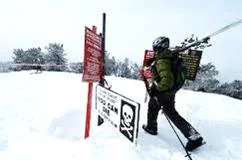
The accessibility of the American backcountry has reached an unprecedented level, as many premier ski resorts in the United States now operate on or adjacent to vast tracts of public land. While this proximity provides a recreational windfall for winter sports enthusiasts, it has simultaneously created a dangerous ambiguity regarding safety and responsibility. These areas, frequently referred to in marketing and colloquial terms as "sidecountry," represent a significant challenge for land managers, ski patrols, and local law enforcement. Despite their proximity to chairlifts and groomed runs, these regions are entirely uncontrolled and unpatrolled, functioning as wild backcountry terrain where the standard safety nets of a commercial ski resort do not exist.
The term "sidecountry" itself has become a point of contention among snow safety experts. Many professionals argue that the word suggests a middle ground between the controlled environment of a resort and the raw wilderness of the backcountry. In reality, no such middle ground exists. Once a skier or snowboarder passes through a boundary gate or crosses a rope line, they have entered an environment where avalanche mitigation is nonexistent and rescue services are not guaranteed. This transition from a managed environment to a high-risk wilderness area is the focal point of a growing movement to re-educate the public on the inherent dangers of "Rated R" terrain.
The Jurisdictional Divide: Public Land vs. Resort Management
Most major ski resorts in the Western United States, including those in the Rocky Mountains, the Cascades, and the Sierra Nevada, operate under special-use permits issued by the U.S. Forest Service. This arrangement allows resorts to manage specific acreage for commercial recreation, which includes grooming trails, operating lifts, and performing active avalanche control—usually through the use of explosives and "ski cutting" to trigger slides before the public arrives.
However, the land immediately adjacent to these permitted boundaries remains general public land. Under federal law, the public generally has the right to access these areas. To accommodate this, many resorts have moved away from "closed boundary" policies toward "open boundary" policies, where designated gates allow skiers to exit the resort and enter the backcountry. The critical distinction, often misunderstood by the casual tourist, is that the resort’s legal and operational responsibility ends exactly at that boundary line.
Inside the resort, the ski patrol acts as a first-response agency, providing medical aid and evacuation. Outside the boundary, the responsibility for search and rescue (SAR) typically falls to the local county sheriff’s department and volunteer SAR teams. This shift in jurisdiction often leads to significant delays in response times, as volunteer teams must be mobilized from off-site, and helicopters may be required for extraction in rugged terrain.
The Evolution of Boundary Access: A Chronology of Risk
The current state of sidecountry access is the result of a multi-decade shift in both equipment technology and resort management philosophy.
In the 1970s and 1980s, most U.S. ski areas maintained strict "closed boundary" policies. Leaving the resort through the woods or under a rope was often met with the permanent revocation of skiing privileges or even criminal trespassing charges. During this era, the backcountry was the domain of a small group of dedicated mountaineers using specialized gear.
By the late 1990s and early 2000s, a "freeride" movement emerged, fueled by advancements in ski and snowboard technology. Wider skis and splitboards made it easier for intermediate athletes to navigate deep, untracked powder. Recognizing the demand for "extreme" terrain, many resorts began working with the U.S. Forest Service to install access gates. This was intended to provide a safer, centralized exit point for those who chose to leave the resort.
However, this increased ease of access coincided with a rise in accidents. The mid-2010s saw a spike in avalanche fatalities involving skiers who had exited resort boundaries. This period marked the beginning of a concerted effort by avalanche centers to dispel the "sidecountry" myth. Experts began to emphasize that the proximity of a chairlift does not stabilize the snowpack. A slope 50 feet outside a resort boundary is just as likely to slide as a peak ten miles into the wilderness.
Statistical Realities and the Human Factor
Data from the Colorado Avalanche Information Center (CAIC) and the Utah Avalanche Center (UAC) highlight a concerning trend: a significant percentage of avalanche fatalities occur in the "near-country" or "sidecountry" areas. Over the last decade, approximately 25 to 30 people have died in avalanches annually across the United States. A notable portion of these incidents involves individuals who were equipped for a day of resort skiing—wearing light clothing and lacking essential rescue gear—rather than a day of backcountry travel.
The "human factor," a term used by behavioral psychologists and avalanche researchers, plays a primary role in these statistics. Several "heuristic traps" contribute to poor decision-making in sidecountry terrain:
- The Social Proof Trap: Seeing tracks in the snow leads skiers to believe a slope is safe. In reality, tracks only prove that someone else did not trigger a slide at that specific moment; they do not indicate stability.
- The Familiarity Trap: Because the terrain is near a familiar resort, skiers often underestimate the danger, treating the backcountry as an extension of the "home" mountain.
- The Scarcity Trap: The desire to get "fresh tracks" before others can lead individuals to ignore obvious warning signs, such as recent heavy snowfall or high winds.
Furthermore, demographic data suggests that the "Rated R" nature of these areas is particularly dangerous for younger skiers. Adolescents and young adults, often driven by peer pressure and a higher tolerance for risk, are frequently the ones venturing past the gates without proper training or equipment.
The "Rated R" Warning: Parental and Social Responsibility
The phrase "Sidecountry: Rated R" serves as a stark metaphor for the maturity and preparation required to navigate these areas. Doug Abromeit, a prominent figure in the avalanche safety community and former director of the U.S. Forest Service National Avalanche Center, has frequently raised concerns regarding parental awareness. The core issue is whether parents, who may be enjoying the amenities of the resort lodge or groomed runs, realize that their children may be venturing into uncontrolled wilderness.
"After a parent waves goodbye in the ski area parking lot, do they know what the kids are doing?" Abromeit asks. "Are they leaving the ski area for R-rated terrain?"
This concern is backed by the reality of rescue operations. When a teenager or young adult is caught in a slide or becomes lost out-of-bounds, the emotional and financial toll on the family is immense. Unlike in-bounds accidents, where the resort’s insurance and medical staff handle the immediate aftermath, out-of-bounds rescues can result in bills totaling tens of thousands of dollars if private flight-for-life services or extensive technical rescue teams are required.
Official Responses and Safety Initiatives
In response to the rising number of out-of-bounds incidents, the ski industry and avalanche centers have launched several high-profile educational campaigns. The "Know Before You Go" (KBYG) program is perhaps the most successful, providing a free, introductory curriculum aimed at high school and middle school students. The program emphasizes five key pillars:
- Get the Gear: Always carry a transceiver, probe, and shovel.
- Get the Training: Take an American Institute for Avalanche Research and Education (AIARE) course.
- Get the Forecast: Check daily avalanche bulletins before heading out.
- Get the Picture: Observe weather and snow conditions in real-time.
- Get Out of Harm’s Way: Travel one at a time and stay out of the path of others.
Resorts have also improved their signage. Many boundary gates now feature large, red warning signs stating: "YOU ARE LEAVING THE SKI AREA. YOU CAN DIE. THIS IS YOUR DECISION." Some resorts have even installed "beacon checkers" at gates—electronic sensors that beep if a skier is wearing a functioning avalanche transceiver, serving as a final reminder of the gear required for survival.
Broader Impact and the Future of Mountain Safety
The ongoing debate over sidecountry access has broader implications for land use and legal liability. While the "Ski Area Safety Act" in many states protects resorts from liability regarding the inherent risks of skiing, those protections are often tested when accidents occur near the boundary. As a result, some resorts are reconsidering their open-boundary policies, weighing the recreational benefits against the potential for tragedy and the strain on local rescue resources.
Climate change is also a factor in the changing landscape of sidecountry safety. Increasingly erratic weather patterns, characterized by "atmospheric rivers" followed by long periods of drought, create complex and unstable snowpacks. These conditions make "persistent weak layers" more common, where a buried layer of faceted snow can remain unstable for months, waiting for the weight of a single skier to trigger a catastrophic collapse.
The "Rated R" nature of the sidecountry is not an exaggeration but a necessary warning for an era of unprecedented mountain access. As the boundary between the managed resort and the wild backcountry continues to blur, the responsibility for safety shifts from the institution to the individual. For those who choose to pass through the gate, the price of entry is not a lift ticket, but the knowledge, gear, and sobriety to handle an environment that offers no forgiveness for error.
