

The landscape of winter recreation in the United States has undergone a profound transformation over the last three decades, evolving from a niche pursuit into a mainstream industry. In the mid-1990s, the backcountry was the domain of a dedicated few, equipped with rudimentary gear and limited access to real-time safety data. Today, the mountains are more accessible than ever, populated by enthusiasts utilizing high-performance equipment and guided by sophisticated digital forecasting. However, a comprehensive analysis of historical data reveals a counterintuitive trend: despite a massive surge in the number of people venturing into avalanche-prone terrain, the annual number of avalanche-related fatalities in the United States has remained remarkably steady for over 20 years.
This statistical anomaly suggests a significant decline in the individual risk rate for backcountry travelers. According to data compiled by the Colorado Avalanche Information Center (CAIC) and analyzed by avalanche scientist Karl Birkeland, the "flat line" of fatalities represents a major success for the safety infrastructure, education initiatives, and technological advancements that have grown alongside the sport.
A Historical Perspective: The Winter of 1994/95
To understand the current state of avalanche safety, one must look back at the winter of 1994/95, a pivotal era for the industry. During this period, the institutional framework for avalanche forecasting was still in its formative stages. Prominent figures like Knox Williams in Denver, Bruce Tremper in Utah, and Mark Moore in Seattle led the primary avalanche centers. Other regions, such as Jackson Hole, were managed by veterans like Jim Kanzler, while the Mount Washington center was under the leadership of Brad Ray.
At that time, the geographic coverage of avalanche centers was significantly smaller than it is today. Critical regions such as the Chugach Mountains in Alaska, the Lake Tahoe area in California, and Mt. Shasta lacked dedicated forecasting centers. The tools available to the public were similarly limited. The internet was in its infancy; it was only at the end of the 1994/95 season that the first avalanche advisories were posted to the web. Before this digital shift, skiers and snowmobilers often relied on recorded telephone hotlines or physical bulletin boards for updates.
The equipment used during this era also stood in stark contrast to modern gear. Telemark skiing was the dominant method for backcountry travel, with many users still utilizing leather boots that offered minimal support. Snowmobiles were significantly heavier and less powerful, lacking the mobility required to access the steep, high-elevation terrain that modern machines can navigate with ease. Furthermore, the concept of the "sidecountry"—resort-adjacent backcountry accessed via chairlifts—was not yet a recognized term, as most ski areas maintained strictly closed boundaries.
Analyzing the Fatality Trends
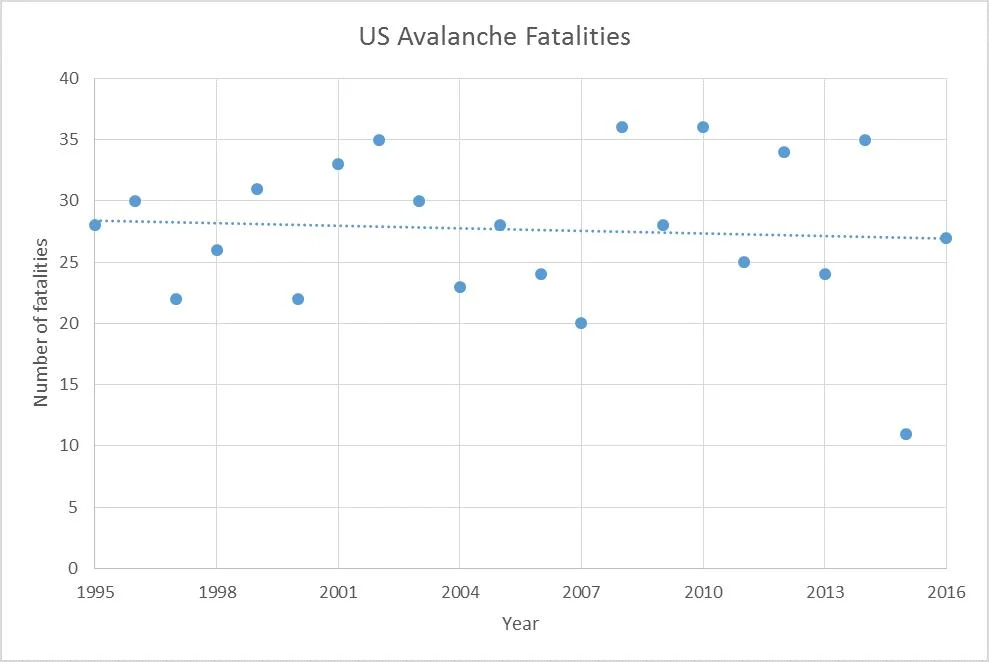
Despite the technological and demographic shifts that have occurred since 1995, the raw number of avalanche fatalities has not followed the upward trajectory of participation. Data spanning 22 seasons from 1994/95 through 2015/16 shows that the annual death toll has remained relatively constant.
Statistical analysis using the least squares trend line method indicates that the overall number of U.S. avalanche fatalities shows no statistically significant change. With a p-value of 0.7, the slight decrease observed in the trend line is considered statistically insignificant, confirming a "flat" trend.
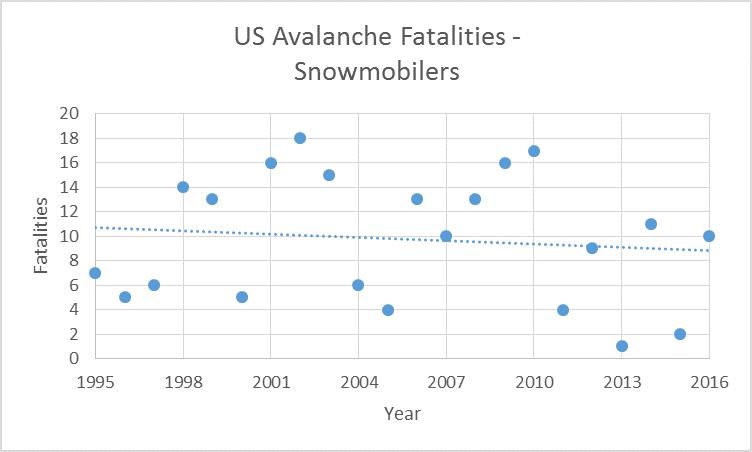
When the data is disaggregated by user group, similar patterns emerge:
- Snowmobilers: Despite the development of more powerful "mountain sleds" that allow riders to reach more dangerous slopes, the number of snowmobile-related fatalities has remained flat over the 22-year period (p = 0.6).
- Skiers and Snowboarders: This group shows a slightly different profile. While the trend is also relatively flat, there is some statistical evidence (p = 0.07) suggesting a marginal increase in fatalities. However, this increase is negligible when compared to the massive influx of new participants in these disciplines.
Measuring the Explosion in Backcountry Usage
The stability of fatality numbers becomes even more significant when contrasted with the estimated growth in backcountry recreation. Because winter recreation is often dispersed and unmonitored, obtaining exact participation numbers is challenging. However, avalanche experts use "advisory usage"—the number of times people access daily avalanche forecasts—as a proxy for participation.
The growth in advisory access over the 22-season study period is staggering:
- Utah Avalanche Center: 12-fold increase in usage.
- Colorado Avalanche Information Center: 17-fold increase.
- Gallatin National Forest Avalanche Center: 36-fold increase.
- Northwest Avalanche Center (Seattle): 60-fold increase.
While some of this growth can be attributed to the transition from phone hotlines to mobile apps and websites, the sheer magnitude of the increase points to a dramatic rise in the number of individuals entering the backcountry. If one assumes a conservative estimate that backcountry usage has increased by a factor of eight, and compares that to the flat fatality rate, the implication is clear: the fatality rate per individual user day has dropped by at least 800%.
Experts suggest that if the fatality rate had remained the same as it was in the mid-1990s, the United States could be seeing upwards of 200 avalanche deaths per winter, rather than the current average which typically fluctuates between 20 and 30.
Factors Driving the Decline in Risk
The significant reduction in the individual risk of dying in an avalanche is attributed to a multi-faceted approach involving education, technology, and professional forecasting.
The Evolution of Education
The "Know Before You Go" (KBYG) program has become a cornerstone of avalanche awareness, reaching tens of thousands of young and novice users annually. Beyond basic awareness, the professionalization of avalanche education—led by organizations like the American Institute for Avalanche Research and Education (AIARE)—has standardized the curriculum for Level 1 and Level 2 courses. These programs have shifted focus from purely snow science to human factors and decision-making, helping users recognize the psychological traps that lead to accidents.
Technological Advancements
The gear available to the modern backcountry traveler is lighter, more reliable, and more effective than that of the 1990s.
- Avalanche Transceivers: The transition from analog to digital multi-antenna beacons has simplified the search process, significantly reducing the time required to locate a buried victim.
- Airbag Packs: The widespread adoption of avalanche airbags has provided a critical tool for staying on the surface of a slide, which is often the difference between life and death.
- Communication and Navigation: Smartphones equipped with GPS and offline mapping tools like Gaia GPS or OnX Backcountry allow users to navigate more precisely and avoid known hazard zones.
Professional Forecasting and Guiding
The regional avalanche center network has expanded its reach and improved the precision of its forecasts. Forecasters now utilize a mix of field observations, remote weather stations, and sophisticated snowpack modeling to provide daily "bottom-line" danger ratings. Additionally, the growth of the professional guiding industry has provided a safer entry point for novices, ensuring that more people are entering the mountains under the supervision of trained experts.
Institutional Responses and Industry Impact
The findings of this data analysis have been met with a mix of pride and caution within the avalanche safety community. While the "flat line" is celebrated as a major achievement, officials at the CAIC and the National Avalanche Center emphasize that there is no room for complacency.
"This trend shows that what we are doing works," noted Karl Birkeland in his assessment of the data. The sentiment is shared by many in the industry who view the data as a validation of the funding and effort poured into public safety over the last two decades. The Colorado Avalanche Information Center, which provided the data for the study, continues to lead the way in documenting accidents and near-misses, providing a feedback loop that informs future educational efforts.
The impact of this safety trend extends to the outdoor industry at large. Manufacturers of Alpine Touring (AT) gear and mountain snowmobiles have seen record sales, a trend bolstered by the perception that the backcountry can be managed safely with the right tools and knowledge. This, in turn, has led to increased investment in safety technology, creating a virtuous cycle of innovation and risk reduction.
Future Challenges and Implications
Despite the positive trends, new challenges are emerging. The rise of "sidecountry" skiing—where resort patrons pass through gates into unmanaged terrain—brings a demographic that may be less prepared than traditional backcountry tourers. Furthermore, as the "low-hanging fruit" of easy-to-access terrain becomes crowded, more users are pushing into remote and complex areas where the margin for error is slimmer.
Climate change also presents a shifting variable. Unpredictable weather patterns, including atmospheric rivers followed by deep freezes, can create complex snowpack structures that challenge even seasoned forecasters.
The goal for the next decade remains the same: to push the number of fatalities toward zero. However, the data from 1994 to 2016 provides a powerful testament to the efficacy of the current safety ecosystem. In an era where outdoor participation is at an all-time high, the fact that avalanche fatalities have not increased is not merely a statistical quirk—it is a landmark success for public safety and the result of a coordinated, decades-long effort by educators, forecasters, and the recreating public.
