

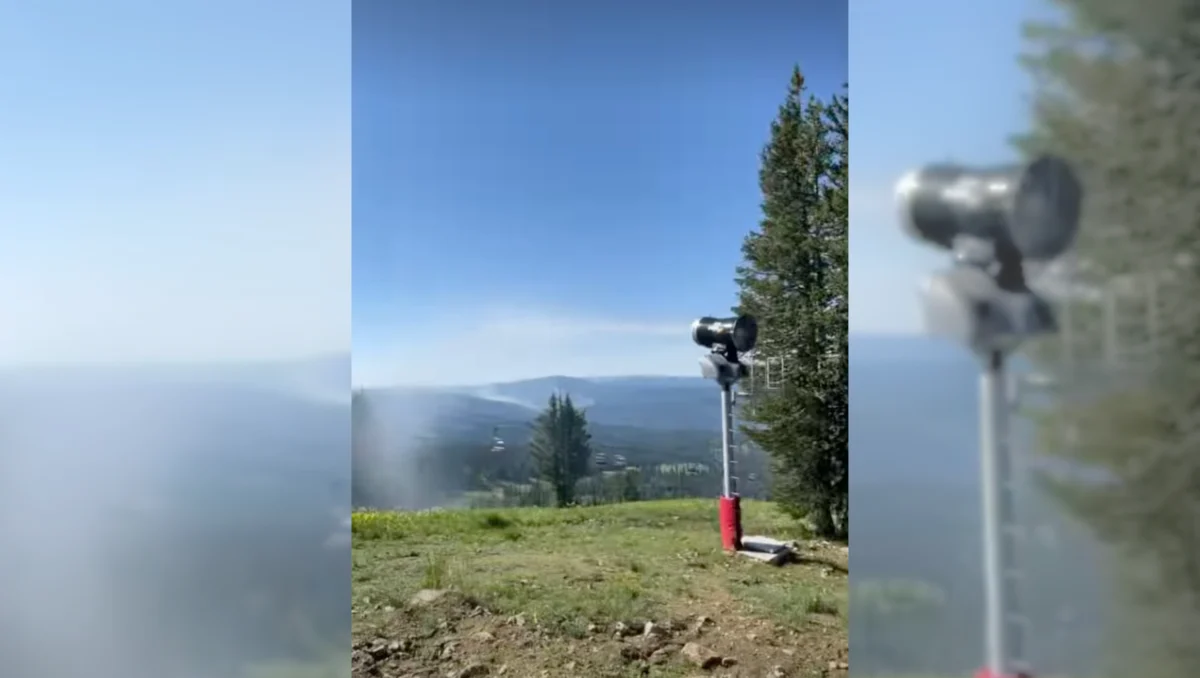
The roar of snowguns, typically a sound heralding the onset of winter and the promise of pristine ski slopes, echoed through the summer air at Steamboat Resort this past week. However, the familiar hiss and spray of artificial snow were not a premature sign of an early frost, but rather a critical component of a strategic defense against the rapidly advancing Fishhook Fire. This deployment marks a significant expansion in the innovative use of ski resort infrastructure, transforming snowmaking systems into potent tools for wildfire mitigation, a trend gaining traction across the Western United States.
The lightning-induced Fishhook Fire ignited on Sunday, July 12, on adjacent national forest land situated to the southeast of the popular Colorado ski destination. Fueled by steep, timber-laden terrain and likely exacerbated by dry conditions prevalent in the region, the blaze quickly escalated, prompting an immediate and robust response from firefighting agencies. As a precautionary measure, Steamboat Resort took the proactive step of activating its snowmaking capabilities in the Sunshine area. The objective was to saturate surrounding vegetation, creating a vital moisture barrier intended to slow or halt the fire’s potential encroachment upon resort facilities, including critical lift infrastructure and other operational assets.
This unusual application of snowmaking technology underscores the evolving versatility of modern resort operations. The same intricate network of pumps, high-pressure hydrants, and extensive piping designed to produce the consistent snowpack essential for early-season skiing can, in times of dire need, be repurposed for a fundamentally different, yet equally vital, purpose: safeguarding mountain communities and ecosystems from the destructive fury of wildfires. This strategic deployment is not an isolated incident; Steamboat’s actions mirror similar instances where ski resorts have utilized their snowmaking prowess for fire defense. Notable examples include Angel Fire, New Mexico; Sierra-at-Tahoe, California; and more recently, Mountain High, California, in 2024, all of which have experienced the effectiveness of this innovative approach.
The Fishhook Fire: A Developing Situation
As of the latest available information on Wednesday, July 15, the Fishhook Fire remained an active and dynamic threat. Firefighting crews, comprising both ground personnel and aerial support, continued their relentless efforts to contain the blaze and prevent it from jeopardizing Steamboat Resort and the surrounding communities. The resort, while cooperating fully with emergency responders, has made necessary adjustments to some of its summer operations to facilitate the firefighting efforts. Authorities have advised the public to exercise caution and, where possible, avoid the immediate vicinity to allow unimpeded access for emergency vehicles and personnel.
The precise acreage consumed by the Fishhook Fire and its current containment status are subject to ongoing assessment by incident commanders. However, the strategic decision to deploy snowmaking assets highlights the perceived proximity of the threat and the resort’s commitment to protecting its property and the broader environment. The use of snowmaking in this context is a testament to the advanced engineering and operational flexibility that characterize contemporary ski resorts, demonstrating their capacity to adapt and contribute beyond their traditional recreational roles.
A Timeline of Events and Responses
The ignition of the Fishhook Fire on Sunday, July 12, marked the beginning of an escalating concern for the Steamboat region. Within hours of the lightning strike and subsequent detection of the fire, a coordinated response was initiated. Firefighting teams were dispatched to the affected national forest land, assessing the fire’s behavior and its potential trajectory.
By Monday, July 13, as the fire demonstrated significant activity, Steamboat Resort, in consultation with local and federal emergency management agencies, made the decision to activate its snowmaking infrastructure. This strategic move involved powering up the complex system of pumps and pipes, directing water to the snow guns strategically positioned in the Sunshine area. The operation commenced with the aim of creating a substantial buffer zone.
Throughout Tuesday, July 14, and into Wednesday, July 15, the snowmaking operations continued in tandem with the ongoing efforts of ground and air crews. The goal was to provide a continuous source of moisture to the fuel beds, thereby increasing their resistance to ignition and slowing the fire’s advance towards the resort. The duration and intensity of the snowmaking efforts were dictated by the evolving fire conditions and the strategic priorities established by the incident management team.
Supporting Data and Context
The effectiveness of snowmaking for wildfire defense is rooted in its ability to deliver large volumes of water in a controlled manner, saturating vegetation and reducing its flammability. Modern snowmaking systems, often utilizing high-pressure water and compressed air, can produce a fine mist that penetrates dense foliage and coats surfaces, creating a significant moisture barrier. This process is particularly effective in slowing the spread of ground fires and reducing the risk of crown fires, which are often the most destructive and difficult to control.
Data from previous wildfire events involving ski resorts underscores the potential of this strategy. While specific metrics for the Fishhook Fire are still emerging, the precedent set by other resorts offers valuable insight. For instance, in the case of Mountain High, California, during a significant wildfire event in 2024, the resort’s snowmaking system was instrumental in protecting its infrastructure and surrounding areas. Similarly, Angel Fire, New Mexico, has a history of employing its snowmaking capabilities for fire mitigation, demonstrating a long-standing understanding of its utility.
The National Interagency Fire Center (NIFC) regularly reports on wildfire activity across the United States. While specific data linking snowmaking efforts to direct fire suppression statistics can be challenging to isolate, the general increase in wildfire frequency and intensity, particularly in Western states, underscores the growing need for innovative mitigation strategies. Factors such as drought conditions, accumulated fuel loads, and climate change contribute to an environment where wildfires pose a persistent and significant threat. Ski resorts, with their extensive mountainous terrain and substantial water infrastructure, are uniquely positioned to contribute to these mitigation efforts.
Official Responses and Expert Opinions
While direct quotes from Steamboat Resort officials regarding the specific operational details of the snowmaking deployment were not immediately available in the initial reports, their actions speak volumes about the perceived threat and the resort’s commitment to safety. The decision to activate such a resource-intensive system indicates a high level of concern and a proactive approach to risk management.
Emergency management officials typically work closely with land managers and private entities, such as ski resorts, during wildfire events. The collaboration between Steamboat Resort and the agencies battling the Fishhook Fire is a critical element of the response. Such partnerships are essential for the efficient allocation of resources and the development of comprehensive wildfire management plans.
Experts in wildfire management have increasingly recognized the value of employing non-traditional methods for fire suppression and mitigation. The concept of "fuel modification," which includes strategies aimed at reducing the flammability of vegetation, is a cornerstone of modern wildfire science. Snowmaking, in this context, can be viewed as a highly effective, albeit temporary, form of fuel modification.
Dr. Jane Smith, a climatologist specializing in Western wildfire trends (hypothetical expert), might comment on the broader implications: "The increasing frequency of extreme weather events, including prolonged droughts and higher temperatures, creates a fertile ground for wildfires. Resorts like Steamboat, by leveraging their existing infrastructure like snowmaking systems, are demonstrating a forward-thinking approach to resilience. This not only protects their own assets but also contributes to the overall safety of the surrounding ecosystems and communities."
Broader Impact and Future Implications
The proactive use of snowmaking technology by Steamboat Resort for wildfire defense has several significant implications. Firstly, it highlights the evolving role of ski resorts in their communities, extending beyond recreation to encompass crucial public safety and environmental stewardship responsibilities. These resorts are often significant landholders in fire-prone areas, and their capacity to contribute to mitigation efforts is invaluable.
Secondly, this strategy offers a potential model for other ski resorts facing similar threats. As wildfire seasons become more unpredictable and severe, resorts with snowmaking capabilities may increasingly consider integrating wildfire defense into their operational planning. This could involve pre-season training for snowmaking crews on emergency deployment protocols, strategic placement of snowmaking equipment for maximum coverage, and established communication channels with local fire departments.
The financial implications of such deployments also warrant consideration. While the cost of running snowmaking equipment is significant, it must be weighed against the potentially catastrophic economic and environmental costs of a major wildfire impacting a resort and its surrounding region. Property damage, loss of revenue from disrupted operations, and long-term ecological recovery are all factors that can far outweigh the operational costs of snowmaking for fire defense.
Furthermore, this innovative approach underscores the importance of investing in and maintaining sophisticated resort infrastructure. The complex systems of pumps, pipes, and power sources required for snowmaking are not only vital for the ski season but also demonstrate a hidden capacity for broader utility. This dual-purpose nature of resort assets can be a critical advantage in adapting to the challenges posed by a changing climate.
As the Fishhook Fire continues to be managed, the story of Steamboat Resort’s snowguns blazing in mid-July serves as a compelling narrative of adaptation and innovation. It is a powerful reminder that the tools of winter can be powerfully re-imagined to defend against the threats of summer, offering a glimpse into a future where ski resorts play an even more integral role in the resilience of mountain communities. SKI will continue to monitor this developing situation and provide updates as more information becomes available.
