

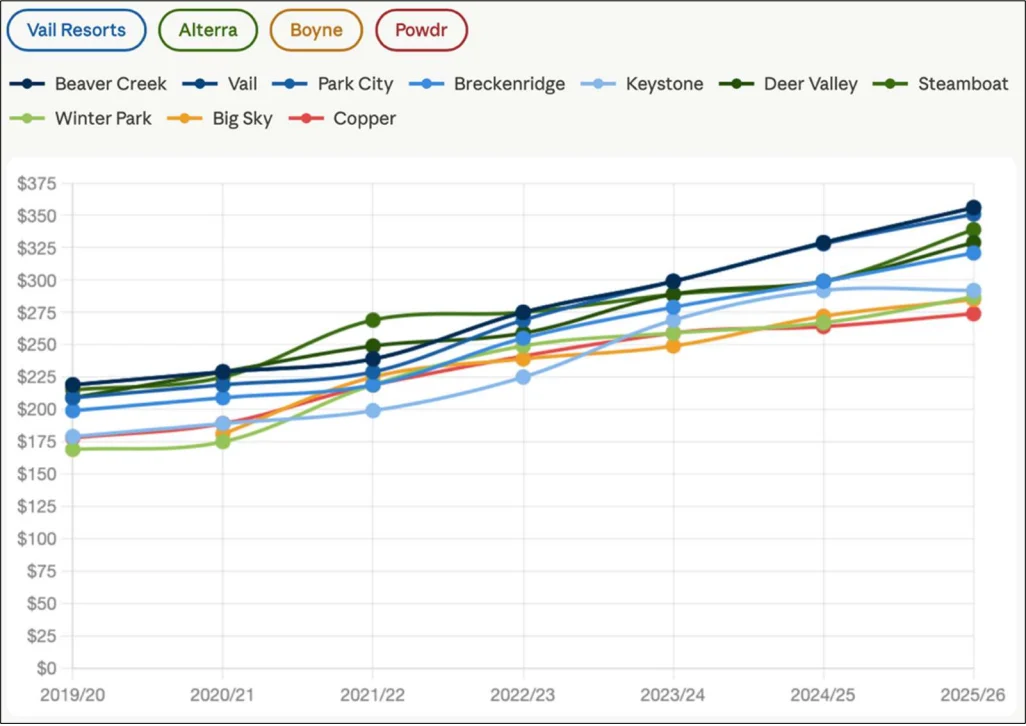
The winter sports community, long accustomed to the steady climb of lift ticket and season pass prices, is now confronted with a federal class-action lawsuit that alleges these escalating costs are not merely the byproduct of natural market forces, but rather the deliberate outcome of an orchestrated scheme involving the nation’s largest ski resort operators. Filed in federal court, the suit seeks substantial damages for individuals who purchased lift tickets or season passes from the implicated companies since 2020, asserting direct violations of U.S. antitrust law designed to protect fair competition and consumers. This legal challenge casts a critical spotlight on the concentrated power within the ski industry and the practices that have allegedly led to what many skiers perceive as an increasingly inaccessible and devalued experience.
The lawsuit names a formidable roster of defendants, including the titans of the ski world: Vail Resorts, Alterra Mountain Company, Boyne Resorts, and POWDR Corp. These entities collectively own and operate a significant majority of the most popular and commercially vital ski destinations across the United States. Beyond the resort operators themselves, the complaint also implicates the National Ski Areas Association (NSAA), a prominent trade organization, and RRC Associates, a research firm, alleging their roles in facilitating the purported anti-competitive conduct. According to the plaintiffs, these companies did not compete fairly but instead collaborated to fix prices, exchange sensitive proprietary data, and systematically eliminate genuine market competition. It is crucial to note that, as of this reporting, the defendants have not been found liable, and all allegations remain unproven in a court of law.
The Allegations: A Web of Information Exchanges and Parallel Price Hikes
At the core of the plaintiffs’ complaint is the assertion that these ostensibly rival resort operators ceased engaging in meaningful price competition. Instead, the legal filing contends that beginning in early 2020, these powerful corporations leveraged trade association gatherings and their relationship with data partner RRC Associates to systematically exchange confidential operational metrics. This alleged data sharing included granular resort-level information regarding revenue streams, yield management strategies, operational capacity, and even rental numbers, all funneled into centralized databases accessible to competitors.
The lawsuit posits that by sharing such detailed and sensitive business intelligence, these mega-resorts gained an unprecedented and unfair insight into each other’s strategic planning and financial health. Far from fostering healthy competition that would typically drive prices down or offer greater value, the plaintiffs allege that this information exchange was used to coordinate pricing decisions. The filing explicitly claims that the resorts shared pricing data and, crucially, recommendations to jointly raise both season pass and day-ticket prices in unison, thereby circumventing the competitive pressures that would otherwise exist in a truly free market. This alleged coordinated behavior directly impacted millions of skiers and snowboarders, who faced steadily increasing costs for access to their preferred slopes.
Evidence cited in the court documents highlights a stark increase in consumer costs during the alleged class period. Peak single-day lift tickets at many of the nation’s premier resorts have reportedly surged by more than 55% since 2020. Concurrently, flagship pass products like Vail’s Epic Pass and Alterra’s Ikon Pass, which dominate the multi-resort pass market, have seen consistent year-over-year price increases. These rising costs have been a significant point of contention among the skiing public, who often voice frustrations not only about affordability but also about the perceived decline in the on-mountain experience, including increased crowding and strain on existing infrastructure, even as prices continue to climb.
A Decade of Consolidation: Reshaping the Ski Landscape
To fully grasp the context surrounding these allegations, it is essential to examine the profound wave of consolidation that has swept through the ski industry over the past decade. The lawsuit meticulously traces this trend, arguing that the defendant companies actively pursued what it terms "stealth acquisitions." This strategy involved the methodical acquisition of both prominent destination mountains and smaller, regional "feeder hills" that traditionally served local populations. This aggressive expansion, particularly by Vail Resorts and Alterra Mountain Company, created vast networks of interconnected resorts under single corporate umbrellas.

Vail Resorts, for instance, pioneered the multi-resort pass model with its Epic Pass, dramatically expanding its portfolio through strategic acquisitions of iconic resorts like Whistler Blackcomb, Park City, and numerous others across North America and beyond. Not to be outdone, Alterra Mountain Company emerged as a significant competitor, consolidating its own impressive collection of resorts under the Ikon Pass, including destinations like Squaw Valley Alpine Meadows, Aspen Snowmass, and Jackson Hole. Boyne Resorts and POWDR Corp also engaged in their own growth strategies, albeit on a slightly smaller scale, further contributing to the market concentration.
The cumulative effect of these acquisitions, the complaint argues, was the systematic elimination of independent alternatives for consumers. Where skiers once had a diverse array of independent resorts offering distinct experiences and competitive pricing, they are now often left with choices largely dominated by a handful of mega-corporations. This reduced competition, the plaintiffs assert, created an environment ripe for the alleged price-fixing scheme, as the market became less responsive to traditional competitive pressures. The consolidation effectively narrowed the field of viable competitors, making coordinated actions more feasible and impactful.
Economic Pressures and Alleged Collaboration: The Pandemic and Climate Factors
The period during which the alleged antitrust violations took place, commencing in early 2020, coincided with unprecedented economic and environmental challenges for the ski industry. The COVID-19 pandemic introduced immense financial chaos, forcing resorts to adapt to rapidly changing public health guidelines, capacity restrictions, and significant operational uncertainties. Simultaneously, the escalating threat of climate change continued to exert pressure on resort bottom lines, manifesting as shorter ski seasons, reduced natural snowfall, and increased reliance on costly snowmaking operations.
The lawsuit contends that instead of responding to these formidable challenges by engaging in robust competition—perhaps by offering better value, innovative services, or more competitive pricing to attract and retain customers—the corporate leaders of the defendant companies allegedly chose a path of collaboration. The complaint suggests that in the face of these external pressures, the companies opted to raise pass prices and day-ticket rates collectively, rather than competing to offer skiers a more attractive proposition. This strategy, the plaintiffs argue, allowed them to maintain or increase profit margins even while, paradoxically, cutting back on operational aspects and overall guest experience.
For the everyday skier and rider, the consequences of this alleged collaboration have become painfully familiar and frustratingly consistent. Increasing trip costs have become a norm, often accompanied by longer lift lines, overcrowded parking lots, and visibly fatigued or under-maintained mountain infrastructure. Numerous voices within the skiing community have echoed these sentiments, expressing deep dissatisfaction with what they perceive as a diminishing on-mountain experience despite paying significantly more for access. The narrative among many passionate skiers is one of being squeezed by corporate interests, with the soul of the sport gradually eroding under the weight of commercialization and alleged anti-competitive practices.
The Defendants’ Stance and the Legal Process Ahead
It is imperative to reiterate that the allegations brought forth in this federal lawsuit are serious and remain unproven. Under the American legal system, the defendants – Vail Resorts, Alterra Mountain Company, Boyne Resorts, POWDR Corp, the National Ski Areas Association, and RRC Associates – are presumed innocent until proven otherwise. While specific official statements from the defendants regarding this particular lawsuit have not been widely disseminated at the time of this article’s writing, it is highly anticipated that they will vigorously deny all allegations of antitrust violations.
In their defense, the implicated companies are likely to assert that their pricing strategies are the result of legitimate competitive forces, market demand, and the substantial operational costs associated with running world-class ski resorts. They would likely point to significant investments in infrastructure, snowmaking capabilities, high-speed lifts, and guest services as justifications for price adjustments. Furthermore, they may argue that the data exchanges facilitated by entities like NSAA and RRC Associates are standard industry practices designed to improve efficiency, share non-competitive benchmarks, and foster overall industry growth, rather than to collude on pricing. They may also contend that the multi-resort pass model actually offers consumers greater value and flexibility than traditional single-resort passes, despite the higher headline prices.

Antitrust litigation, particularly class-action lawsuits of this magnitude, is notoriously complex and often protracted. These cases typically involve extensive discovery processes, including the review of millions of documents and numerous depositions, followed by potentially lengthy trial proceedings or out-of-court settlements. The burden of proof lies with the plaintiffs to demonstrate, with compelling evidence, that the defendants engaged in a coordinated effort to fix prices and reduce competition, rather than simply responding to market conditions independently.
Broader Implications for the Sport and Its Future
Beyond the immediate legal ramifications for the defendant companies, this lawsuit has ignited a crucial conversation about the broader trajectory of the ski industry and its impact on the very culture of snow sports. As the business side of skiing becomes increasingly consolidated and financially driven, concerns are mounting about the rising "barrier to entry" for the next generation of enthusiasts. Aspiring groms, dedicated core riders, and budget-conscious road-tripping soul skiers face ever-higher hurdles to participate in a sport that has historically celebrated freedom, accessibility, and a deep connection to the outdoors.
The lawsuit implicitly questions the long-term sustainability of a model where access to mountains becomes increasingly exclusive. If skiing becomes a luxury sport only accessible to the affluent, what does this mean for its cultural vibrancy, its grassroots development, and its ability to attract diverse participants? The potential for reduced participation rates could have ripple effects throughout the industry, impacting equipment manufacturers, local businesses in ski towns, and even the future talent pool for professional athletes.
This legal challenge also brings into sharp focus the role of regulatory bodies and antitrust enforcement in rapidly consolidating industries. A successful outcome for the plaintiffs could set a significant precedent, potentially leading to increased scrutiny of pricing practices and mergers in other recreational and leisure sectors. It could also empower consumer advocacy groups to push for greater transparency and accountability from large corporations. The lawsuit forces a critical examination of the balance between corporate growth and shareholder value versus consumer welfare and the long-term health of a beloved sport.
Looking Ahead: The Road to Resolution
The path to resolution for Nicholas Green et al. v. Vail Resorts Inc. et al will undoubtedly be a long and arduous one. Whether the lawsuit ultimately succeeds in proving its allegations of a coordinated price-fixing scheme remains to be seen. However, its very existence has already achieved a significant objective: it has shone a powerful spotlight on questions that countless skiers and snowboarders have been asking for years. Why have prices climbed so precipitously? Why does the on-mountain experience often feel increasingly crowded and less personal? And what are the true consequences when a mere handful of powerful companies exert such extensive control over the vast majority of the sport’s infrastructure and access points?
The outcome of this case could reshape how the ski industry operates, potentially forcing changes in pricing strategies, data-sharing practices, and even future acquisition plans. It represents a pivotal moment for a sport grappling with its commercial identity, its environmental responsibilities, and its commitment to fostering an inclusive and accessible passion for generations to come. The resolution, whatever it may be, will undoubtedly influence the future landscape of skiing and snowboarding, impacting everyone from the casual day-tripper to the most dedicated freeride enthusiast.
