

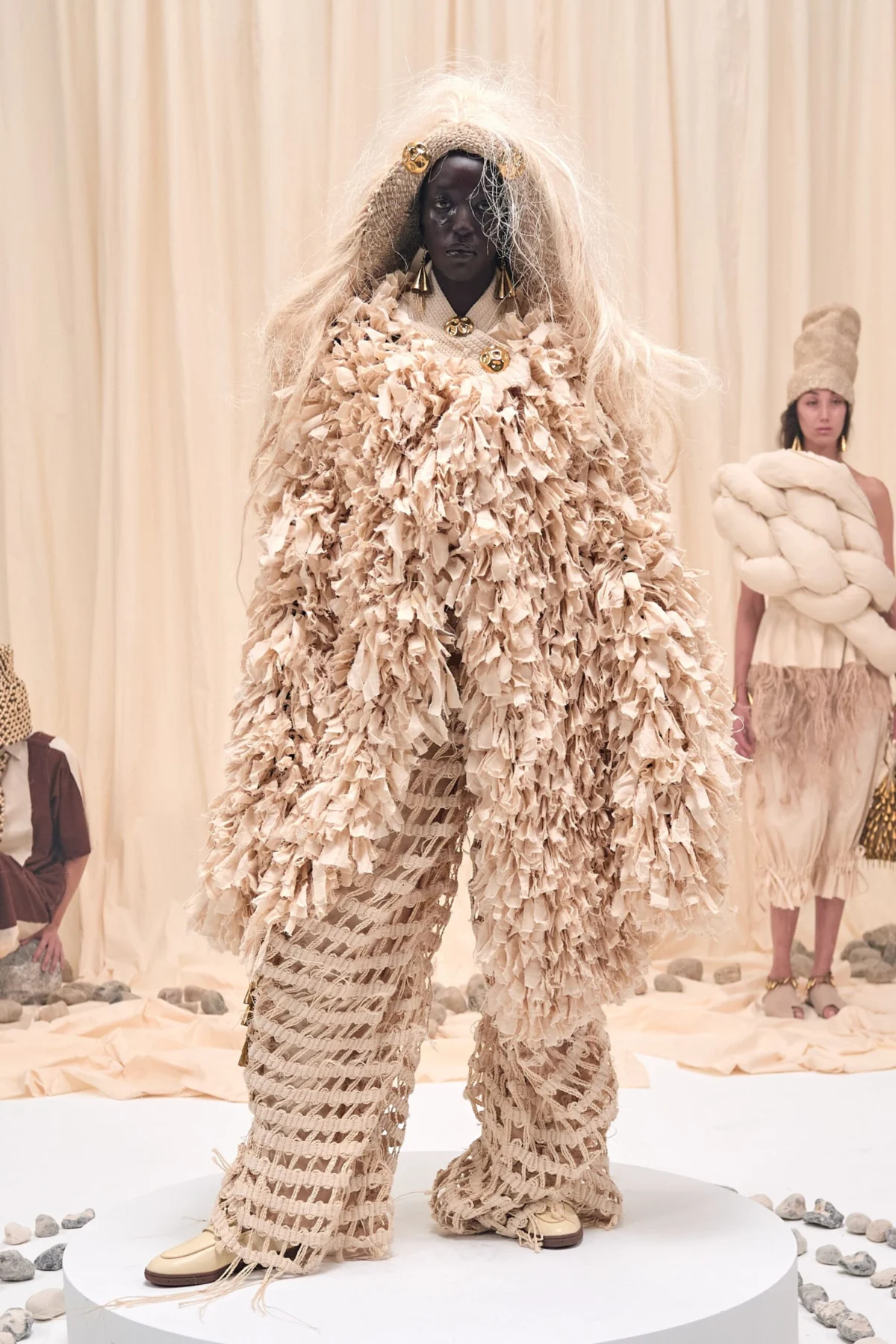
The hallowed halls of fashion history are often constructed from fleeting trends and ephemeral aesthetics, yet the most enduring legacies are built on foundations of deep-rooted cultural narratives. This season at Copenhagen Fashion Week, Nigerian designer Bubu Ogisi, the visionary force behind IAMISIGO, has presented a collection that transcends the ephemeral, delving into the profound concept of memory and its tangible manifestations. Ogisi’s latest offering is a powerful dialogue between the past and the present, a testament to the enduring strength of African traditions and a bold exploration of sustainable practices within the global fashion landscape.
At the heart of Ogisi’s inspiration lies the lukasa, a remarkable memory board meticulously crafted by the Luba people of the 19th century. These carved wooden artifacts, adorned with beads and shells, served as sophisticated mnemonic devices, functioning as both conceptual maps and intricate historical chronicles. Complementing this, Ogisi was captivated by the regal headdresses worn by the nsɛneɛfoɔ, the royal heralds of the Asante kingdom in present-day Ghana. These ornate creations, fashioned from the hides of colobus monkeys and embellished with beaten gold repoussé plaques and silver chains, are not mere adornments but living embodiments of history and status. Ogisi eloquently articulated the profound connection, stating, "The first is an object that holds knowledge. The second is a human who carries it." This duality, the object that stores and the being that embodies, became the central thesis for her collection.
Presented within a thoughtfully curated, albeit industrial, space in Copenhagen, the IAMISIGO collection sought to bridge these two powerful symbols of memory. High hats and exaggerated silhouettes directly evoked the grandeur of African royalty, a lineage historically believed to possess a profound connection to the spiritual realm. These imposing headpieces, a direct nod to the nsɛneɛfoɔ, commanded attention, signaling a reassertion of cultural heritage on the global stage. The collection’s trousers, characterized by their voluminous cut and intricate embroidery, served as a visual lexicon of the earth’s memory. Their color palettes, reminiscent of verdant mountain ranges, sweeping sandy dunes, and the deepest ocean blues, spoke to the environment’s capacity to absorb and retain the passage of time.
Further weaving the narrative of memory into the fabric of the collection, elongated ties crafted from IAMISIGO’s signature beaded textile were adorned with three-dimensional snake motifs. The snake, an animal steeped in symbolism across numerous African mythologies, is frequently associated with memory, wisdom, and ancient knowledge. "Snakes are one of the oldest animals. They have seen what the earth has seen," Ogisi explained, underscoring their primordial connection to the planet’s history. "In African mythology, the snake is revered and respected. The patterns on its skin function like memory boards." This poetic analogy highlights the intricate beauty of natural patterns and their inherent ability to carry and transmit information, much like the lukasa.
Copenhagen Fashion Week’s unwavering commitment to sustainability, evidenced by its stringent minimum standards, has fostered a collective vision for a more responsible fashion industry. Ogisi, a recipient of the prestigious Zalando Visionary Award at Copenhagen Fashion Week last summer, returns with a mission to broaden this vision and demonstrate that sustainability is not a monolithic concept but a multifaceted approach that adapts to diverse contexts. For IAMISIGO, sustainability is intrinsically linked to the preservation of indigenous African traditions. It involves revitalizing heritage crafts, reintroducing them to contemporary consumers, and championing the innovative use of natural materials. This endeavor is far from simplistic, often requiring extensive research and development. For instance, the brand began harvesting Ugandan bark cloth in November of the previous year, dedicating considerable time to experimenting with subterranean dyeing techniques to achieve the perfect clay-like hue. Furthermore, the artisans with whom IAMISIGO collaborates have undergone a learning curve, adapting their skills to work with less conventional materials such as banana and pineapple fibers.
"I love seeing our artisans get excited about new materials and ideas," Ogisi expressed, her voice reflecting genuine satisfaction. "That’s the most fulfilling thing for me." This sentiment underscores the collaborative spirit that drives IAMISIGO, where innovation is a shared journey and the empowerment of local craftspeople is paramount.
The Genesis of a Collection: From Luba to Asante
The conceptual groundwork for Ogisi’s collection was laid during her extensive research into African cultural heritage. The lukasa memory boards, originating from the Luba people of the Democratic Republic of Congo, represent a sophisticated system of mnemonic recording that predates widespread literacy. These objects, often crafted from wood, bone, or ivory, are intricately incised with patterns and studded with beads or shells, each element holding specific semantic meaning. Their purpose was to aid storytellers, historians, and spiritual leaders in recalling complex narratives, genealogies, and historical events with remarkable accuracy. The Luba Kingdom, which flourished in the 17th to 19th centuries, was renowned for its complex political structures and rich artistic traditions, with the lukasa serving as a vital tool in maintaining social order and cultural continuity.
In parallel, the nsɛneɛfoɔ of the Asante people, a powerful kingdom in present-day Ghana that reached its zenith in the 18th and 19th centuries, embodied a living tradition of oral history and ceremonial protocol. The Asante Kingdom, known for its sophisticated governance, elaborate courtly life, and significant wealth derived from gold and trade, placed immense importance on its royal heralds. The nsɛneɛfoɔ, adorned in their distinctive headdresses made from the luxurious fur of the colobus monkey and embellished with precious metals, were not merely ceremonial figures. They were living conduits of royal pronouncements, keepers of lineage, and active participants in the preservation of Asante history and identity. The use of beaten gold repoussé, a technique involving hammering thin sheets of gold from the reverse side to create a raised design, and intricately crafted silver chains speaks to the immense value and artistry associated with these royal accoutrements.
Ogisi’s synthesis of these two distinct yet complementary cultural artifacts—the inanimate object that stores knowledge and the human who embodies it—provides a powerful framework for her contemporary fashion narrative. The collection, therefore, becomes an exploration of how history is not only recorded but also transmitted, lived, and embodied.
Sustainability as Cultural Preservation: IAMISIGO’s Approach
Copenhagen Fashion Week’s commitment to sustainability is a significant driver for designers seeking to align their creative output with environmental and ethical responsibility. Launched in 2020, the Danish Fashion Institute’s (now Copenhagen Fashion Summit) ambitious sustainability requirements mandate that participating brands meet stringent criteria related to materials, waste reduction, and ethical production. This has positioned Copenhagen as a leading platform for showcasing fashion that prioritizes planetary health and social equity.
IAMISIGO’s participation, particularly following its recognition with the Zalando Visionary Award, highlights a crucial dimension of sustainable fashion: the preservation and elevation of traditional craft and indigenous knowledge. For Ogisi, sustainability is not solely about sourcing recycled materials or reducing carbon footprints; it is fundamentally about valuing and perpetuating the skills and cultural heritage of African artisans. This approach offers a powerful counter-narrative to the often-homogenized aesthetics of global fashion, celebrating diversity and the intrinsic value of handcrafted goods.
The brand’s exploration of materials like Ugandan bark cloth exemplifies this commitment. Bark cloth, derived from the fig tree, is one of the oldest textiles known to humankind and holds deep cultural significance in several African regions, including Uganda. The process of harvesting and transforming bark into fabric is labor-intensive and requires intimate knowledge of the natural environment and traditional techniques. IAMISIGO’s dedication to refining these processes, as evidenced by their experiments with underground dyeing, showcases a profound respect for the material and the ancestral knowledge associated with it.
Similarly, the integration of banana and pineapple fibers into their collections represents a forward-thinking approach to utilizing readily available agricultural byproducts. These natural fibers are biodegradable, renewable, and offer unique textural qualities. The challenge and reward lie in educating and empowering artisans to embrace these new materials, fostering a culture of innovation rooted in tradition. This process of adaptation and skill development is a testament to IAMISIGO’s commitment to not just using sustainable materials, but to building a sustainable ecosystem for craft and creativity.
Broader Implications and Industry Impact
Bubu Ogisi’s work at IAMISIGO, particularly her latest collection, carries significant implications for the broader fashion industry. Firstly, it underscores the growing demand for authentic cultural narratives and the increasing recognition of African design on the global stage. As consumers become more discerning, they seek fashion that offers more than just aesthetic appeal; they desire pieces that tell a story, connect them to heritage, and embody values of craftsmanship and cultural respect. IAMISIGO’s collections consistently deliver on this front, positioning the brand as a leader in the burgeoning field of Afro-futurism and culturally rooted design.
Secondly, the brand’s approach to sustainability offers a compelling model for other designers and fashion houses. By integrating traditional crafts and natural materials into a contemporary context, IAMISIGO demonstrates that ethical and environmentally conscious fashion does not necessitate a compromise on creativity or luxury. Their commitment to working directly with artisans, investing in their development, and valuing their expertise serves as a blueprint for more equitable and sustainable supply chains. This challenges the prevailing industry model, which has often been criticized for its exploitative practices and reliance on mass production.
The success of IAMISIGO at Copenhagen Fashion Week also contributes to a broader discourse on decolonizing fashion. By centering African aesthetics, narratives, and production methods, Ogisi is actively reshaping the global fashion landscape, challenging Western-centric notions of beauty and design. This shift is not merely symbolic; it represents a tangible redistribution of influence and a greater appreciation for the richness and diversity of global creative traditions. The brand’s ability to translate complex cultural concepts into wearable art that resonates with an international audience is a testament to its powerful vision and innovative execution.
As the fashion industry continues to grapple with the urgent need for systemic change, designers like Bubu Ogisi are at the forefront of driving this transformation. Their work serves as an inspiration, demonstrating that fashion can be a powerful force for cultural preservation, economic empowerment, and environmental stewardship, all while creating exceptionally beautiful and meaningful garments. The memory boards of the Luba and the headdresses of the Asante, once confined to museums and historical records, are now re-emerging through the vision of IAMISIGO, reminding us that the past holds vital lessons for shaping a more conscious and vibrant future.
