

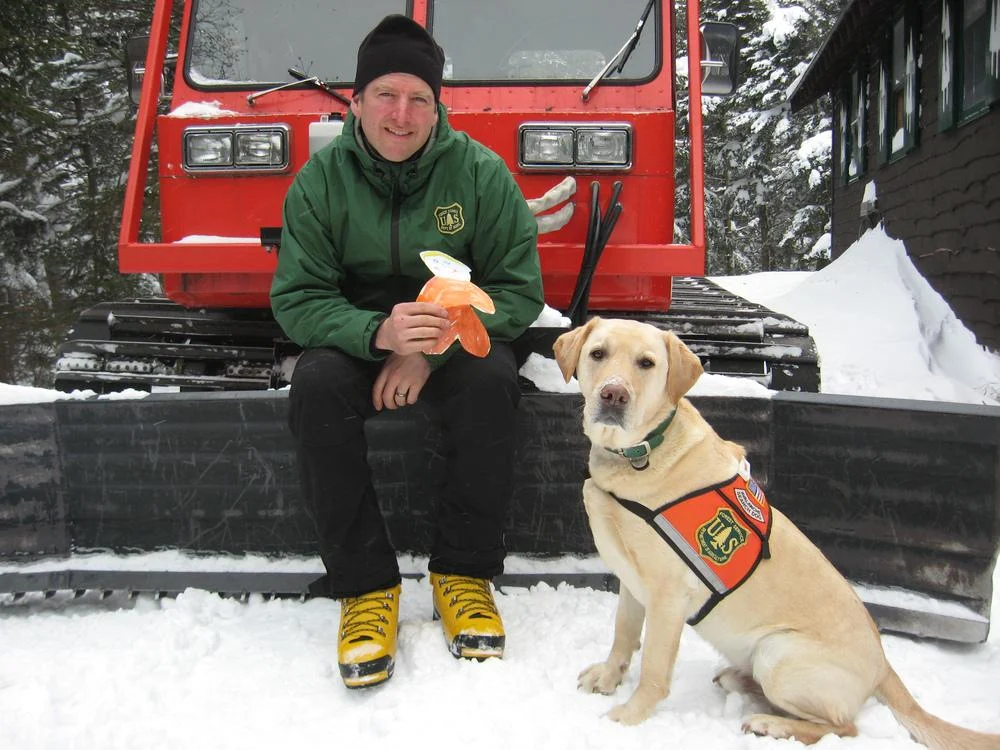
The Mount Washington Avalanche Center and the broader New England mountaineering community are mourning the loss of Cutler, a dedicated avalanche rescue dog who served the White Mountain National Forest for over a decade. Cutler, who passed away at the age of 14, spent 11 years—nearly 80 percent of his life—working alongside the Mount Washington Snow Rangers to ensure the safety of the thousands of backcountry skiers, climbers, and hikers who visit the Presidential Range annually. Partnered with Mount Washington Avalanche Center (MWAC) Director Chris Joosen, Cutler was a fixture of the Tuckerman Ravine and Huntington Ravine areas, where his presence served as both a critical safety asset and a powerful tool for public education.
A Career Defined by Service and Safety
Cutler’s tenure at Mount Washington began during a period of increasing popularity for backcountry winter sports in the Northeast. As a working dog for the U.S. Forest Service, his primary responsibility was to provide rapid response capabilities in the event of an avalanche burial. In the high-stakes environment of Mount Washington—a peak known for having some of the "world’s worst weather"—the speed of a trained canine can mean the difference between life and death.
Throughout his 11-year career, Cutler was a constant presence in the "Bowl" of Tuckerman Ravine, one of the most trafficked backcountry skiing destinations in North America. His service spanned from the mid-2000s through 2015, a decade characterized by significant technological advancements in avalanche safety and a surge in public interest in high-alpine recreation. Cutler’s role was dual-purpose: while he was trained for the grim reality of recovery and rescue, he was perhaps most effective as a preventative force, acting as a bridge between the stern warnings of the Snow Rangers and the visiting public.
The Mount Washington Environment: A Unique Challenge
To understand the magnitude of Cutler’s service, one must consider the unique and often treacherous environment of the White Mountain National Forest. Mount Washington, standing at 6,288 feet, is the highest peak in the Northeastern United States. Despite its modest elevation compared to the Rocky Mountains, its geographical position at the confluence of several major storm tracks results in extreme conditions.
The mountain famously held the world record for surface wind speed (231 mph) for many decades, and it regularly experiences hurricane-force winds and temperatures well below zero. These conditions create a volatile snowpack in the mountain’s glacial cirques, particularly Tuckerman and Huntington Ravines. According to data from the MWAC, these areas are prone to frequent avalanches due to heavy snowfall and significant wind-loading, where snow is blown from the 50-acre Alpine Garden onto the steep slopes below.
In this environment, Cutler had to be more than just a search dog; he had to be an elite athlete capable of navigating ice, deep powder, and gale-force winds. His presence allowed the Snow Rangers to maintain a mobile, responsive search-and-rescue unit that could be deployed faster than traditional human-led probe lines.
The Chronology of a Rescue Dog’s Life
Cutler was born approximately in 2001 and began his specialized training in his early years. By 2004, he had become an integral part of the Mount Washington Avalanche Center’s operations. His life and career followed a timeline of rigorous training and public service:
- 2001–2003: Early Training and Socialization. Like most search-and-rescue (SAR) dogs, Cutler would have undergone intense socialization and foundational obedience training before specializing in scent detection.
- 2004: Certification and Deployment. Cutler joined Chris Joosen at the MWAC, beginning his official duties as an avalanche dog. This involved learning to identify the scent of human beings buried under several feet of compressed snow.
- 2004–2015: Active Service. For over a decade, Cutler patrolled the ravines. His daily routine often involved traveling by snowcat or on foot to the Hermit Lake Shelters and then up into the steep terrain of the ravines.
- Public Relations Milestones: Throughout his career, Cutler became the "face" of the Snow Rangers. He was featured in numerous educational programs, safety videos, and community outreach events designed to teach the "Know Before You Go" principles of avalanche safety.
- 2015: Passing and Legacy. Cutler passed away at the age of 14, leaving behind a legacy of enhanced safety protocols and a more informed public.
Supporting Data: The Efficiency of Canine Search and Rescue
The reliance on dogs like Cutler is supported by decades of search-and-rescue data. In the event of an avalanche, the "Golden Hour" is a critical window. Statistics show that victims recovered within 15 minutes have an approximately 90% survival rate, but this drops to around 30% after 35 minutes.
A single trained avalanche dog can search a one-hectare area (approximately 2.5 acres) in about 30 minutes. In contrast, it would take a human search team of 20 people approximately four hours to probe the same area with the same level of thoroughness. In the rugged terrain of Tuckerman Ravine, where weather can deteriorate in minutes, the efficiency of a dog like Cutler was an indispensable component of the U.S. Forest Service’s safety strategy.
Furthermore, Cutler’s presence contributed to the statistical decline in fatalities relative to the number of visitors. While the number of backcountry users on Mount Washington has grown significantly over the last 20 years, the implementation of better forecasting, educational outreach, and the visible presence of the Snow Ranger team (including Cutler) has helped manage the inherent risks of the terrain.
Professional Impact and Public Relations
While his primary function was operational, Cutler’s impact on public relations was equally significant. Mount Washington Avalanche Center Director Chris Joosen noted that Cutler had a unique ability to engage the public. Many hikers and skiers who might have been intimidated by a uniformed ranger felt comfortable approaching Cutler.
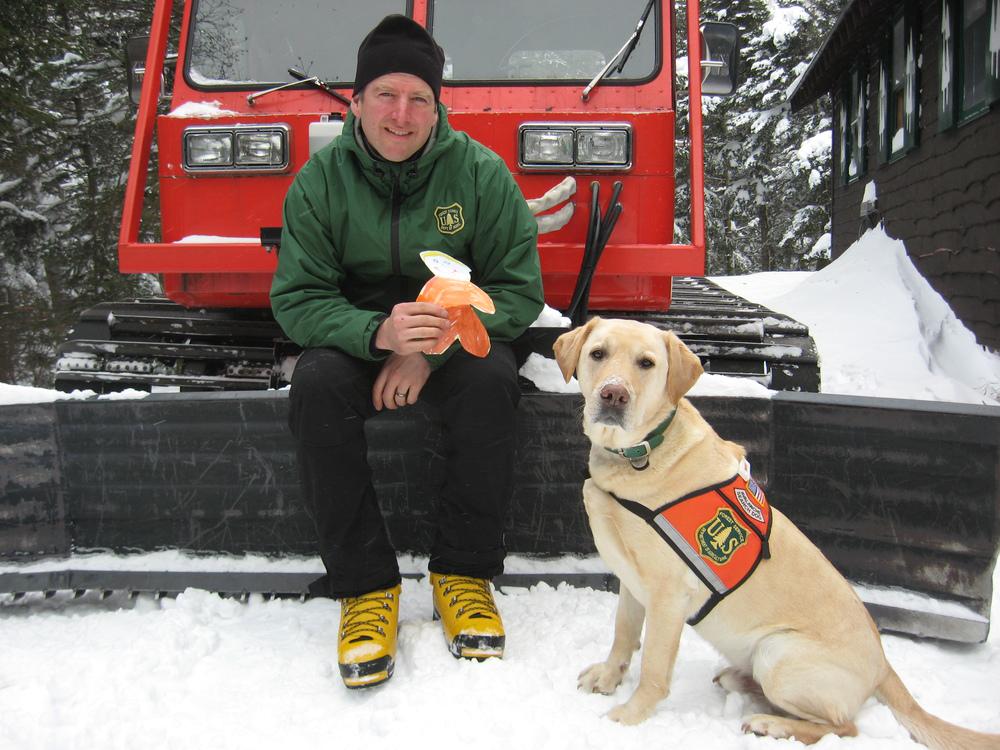
This interaction provided a "teachable moment." While visitors petted Cutler, rangers could discuss the day’s avalanche advisory, check if the visitors were carrying beacons, probes, and shovels, and offer advice on safe travel routes. This "soft" approach to enforcement and education is credited with fostering a more collaborative relationship between the Forest Service and the backcountry community.
Joosen, who shared a deep bond with Cutler both on and off the mountain, highlighted in a commemorative blog post that Cutler excelled at these interactions. The dog’s ability to transition from a high-drive search animal to a calm, friendly ambassador was a testament to his temperament and training.
Official Responses and Community Reaction
The passing of Cutler has prompted a wave of tributes from the outdoor community. Former colleagues and visitors to the White Mountains have shared stories of encountering Cutler at the HoJo’s (Hermit Lake) ranger station or seeing him navigate the steep headwalls of the ravines with ease.
The Mount Washington Avalanche Center released a statement acknowledging Cutler’s contributions, stating that he spent the vast majority of his life working to make the National Forest a safer place. The center emphasized that his work in education and public relations allowed the Snow Rangers to reach a demographic of mountain users that might otherwise have ignored traditional safety warnings.
The U.S. Forest Service has long recognized the value of canine programs in mountainous regions. Cutler’s career serves as a benchmark for future SAR dog programs in the Northeast, proving that these animals are just as vital in the icy, maritime snowpack of New Hampshire as they are in the deep powder of the Western United States.
Analysis of Implications for Future SAR Operations
The loss of a veteran dog like Cutler highlights the ongoing need for robust canine programs within the National Forest System. As backcountry use continues to hit record highs—driven in part by advancements in alpine touring gear and the "Instagram effect" on outdoor recreation—the demand for rapid-response rescue assets is greater than ever.
Cutler’s career also underscores the evolution of the Snow Ranger role. Modern rangers are no longer just enforcement officers; they are educators, forecasters, and community leaders. The success of Cutler’s "public relations" work suggests that future SAR programs should continue to integrate animals not just for their noses, but for their ability to humanize the authorities and facilitate better communication with the public.
Furthermore, Cutler’s longevity in the field—serving until the age of 11—demonstrates the high level of care and professional handling provided by the MWAC staff. Managing a working dog in sub-arctic conditions requires meticulous attention to the animal’s health, gear, and psychological well-being. The lessons learned during Cutler’s 11 years of service will undoubtedly inform the training and care of the next generation of avalanche dogs.
Conclusion: A Lasting Legacy on the Mountain
Cutler’s life was a testament to the partnership between humans and animals in the pursuit of safety. From the wind-swept ridges of the Presidential Range to the crowded floor of Tuckerman Ravine, he was a silent guardian who asked for nothing more than a job to do and the companionship of his handler.
As the Mount Washington Avalanche Center moves forward, the memory of Cutler will remain a part of the mountain’s history. He was more than just a search-and-rescue asset; he was a symbol of the dedication required to manage one of the most dangerous recreational areas in the country. For the thousands of skiers who safely navigated the ravines during his tenure, Cutler’s legacy is the safety they enjoyed and the education they received, often without even realizing it was being delivered by a four-legged ranger with a wagging tail.
The "buddy" who gave 14 great years to the mountain has completed his final patrol, but the impact of his 11 years of service will be felt for many winters to come as the MWAC continues its mission of "Safety through Education."
