

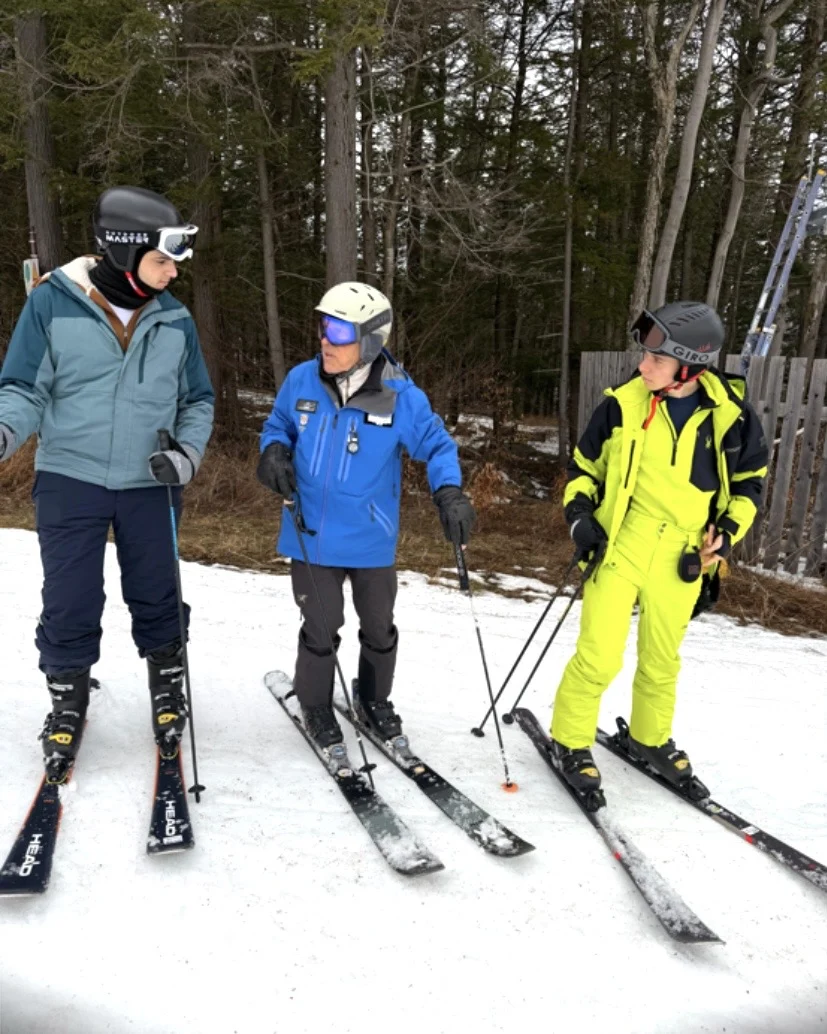
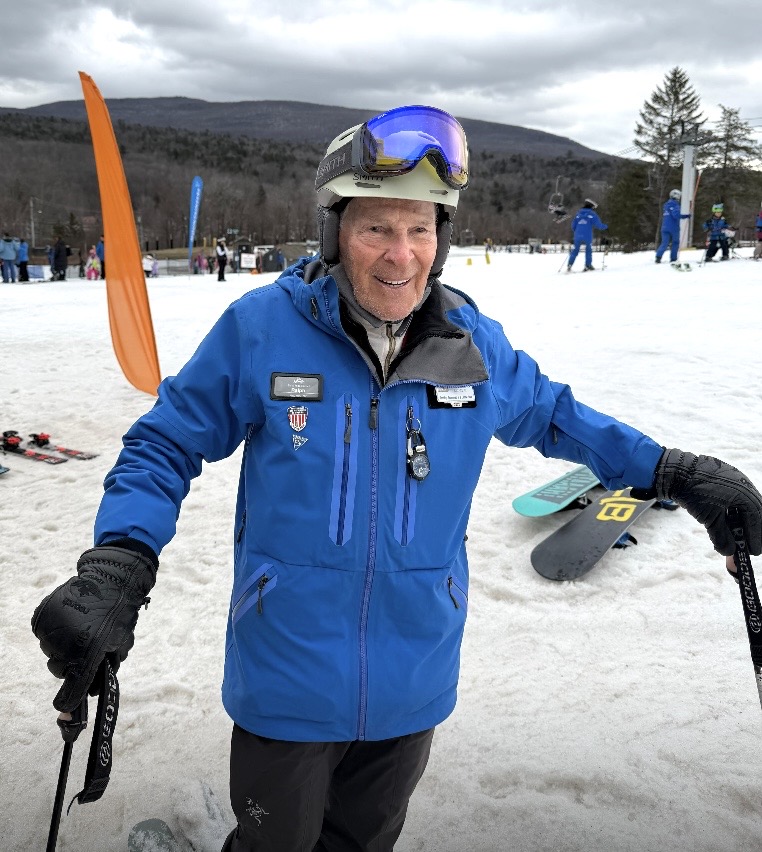
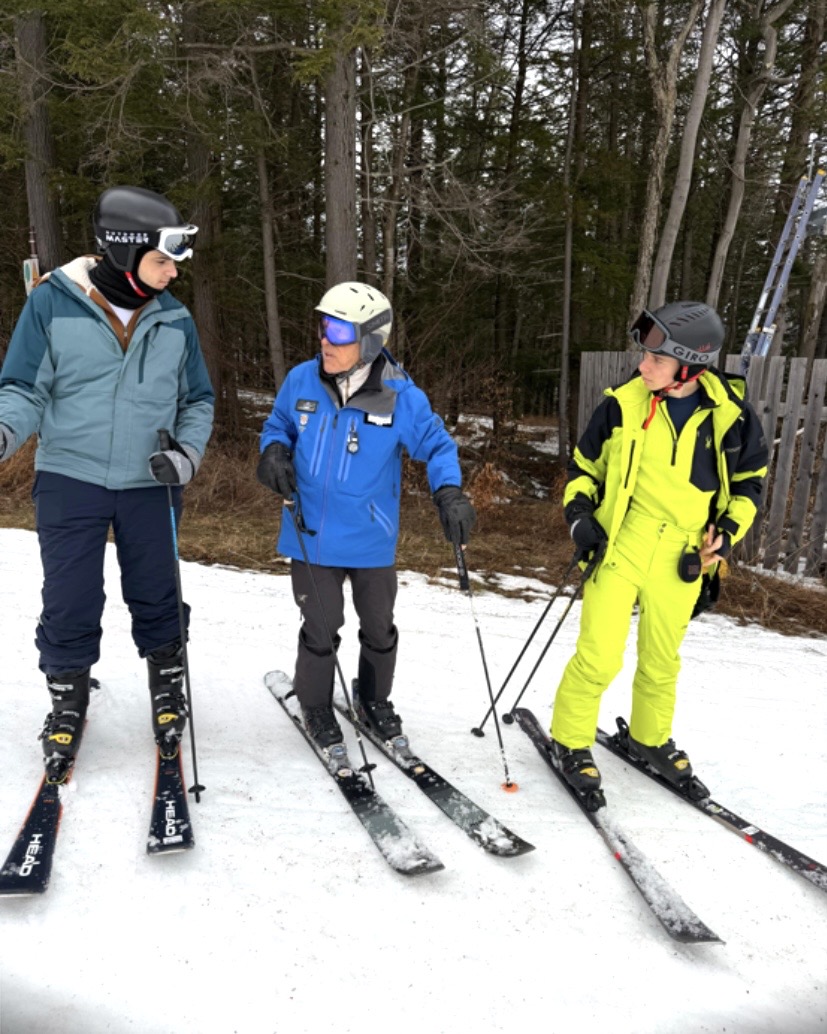
The biting cold of a New York winter morning, with temperatures plummeting to -5°F and a wind chill that made it feel like a punishing -30°F, did little to deter Ralph Perlberger as he celebrated his 95th birthday on the slopes of Hunter Mountain. As the Otis Quad chairlift crested its unloading ramp, sending a piercing shot of wind swirling snow around him, Perlberger, a Professional Ski Instructors of America (PSIA) Level II Alpine instructor, was preparing for another run, surrounded by his wife, Carol, and two fellow ski instructors, David Raindorf and Steve Cohen. This remarkable scene, witnessed by Leslie Surprenant, an Alpine Level II and Children’s Specialist 1 at Hunter Mountain, and later documented in the Spring 2026 issue of the SnowPro, the official publication of the PSIA Eastern/Education Foundation, underscored a life defined by extraordinary resilience, an unyielding love for skiing, and an inspiring dedication to teaching.
A Nonagenarian’s Indomitable Spirit on the Slopes
On that frigid morning, while most guests sought refuge in the warmth of the lodge, jockeying for a coveted spot near the fireplace, Ralph Perlberger stood ready, his skis squeaking on the cold, dry snow. His presence, particularly on his 95th birthday and in such extreme conditions, was a powerful testament to his philosophy of embracing every snow condition and weather challenge. Leslie Surprenant, who was coaching a weekly women’s clinic, introduced Perlberger to her group, highlighting his unwavering grit. The muffled rendition of "Happy Birthday" through frozen face masks was a small tribute to a man who embodies the spirit of perseverance and active living.
The significance of Perlberger’s commitment resonates deeply within the Hunter Mountain community. Victoria Mercado, Senior Manager of Hunter Mountain’s Ski and Ride School, articulated this sentiment: "Ralph is an inspiration. He’s not only skiing, but teaching! Skiing and riding keep you young. When I watch Ralph ski, I can’t believe he’s 95. His energy, skill, and passion on the mountain defy his age. It’s an absolute pleasure to work alongside him." Her statement reflects the broader appreciation for Perlberger’s dedication and the positive impact he has on both his colleagues and students. His fellow instructors echo this admiration. David Raindorf, a close friend and colleague, once remarked, "When I grow up, I want to be Ralph," while Steve Cohen added, "Ralph is my idol." These sentiments underscore Perlberger’s profound influence, not just as a skilled instructor, but as a living example of how to live a life full of passion and purpose, regardless of age.
Hunter Mountain, located in the Catskill Mountains of New York, is a prominent ski resort renowned for its diverse terrain and vibrant ski culture, attracting thousands of visitors annually. For over two decades, Perlberger has been an integral part of this community, contributing significantly to its reputation for quality instruction and fostering a love for the sport among countless students. His continued presence on the mountain, especially in challenging conditions, serves as a powerful symbol of the transformative and life-affirming power of outdoor sports and a testament to the benefits of an active lifestyle.
A Life Forged in Adversity: From Holocaust Survivor to Skiing Icon
Ralph Perlberger’s remarkable journey began in Amsterdam, Netherlands, a city that in the 1930s was a vibrant cultural hub, yet increasingly overshadowed by the rising tide of Nazism across its eastern border. In 1940, as the political climate grew dire, Ralph’s father, foreseeing the imminent danger, embarked on a desperate mission to New York City to secure immigration for his family. Tragically, he arrived on May 10, the very day Nazi forces launched their brutal invasion of the Netherlands, effectively trapping his family within the occupied territory. This swift and devastating occupation immediately plunged the Dutch Jewish community into an unimaginable nightmare, initiating a period of systematic persecution and unimaginable hardship.
The Perlberger family’s ordeal intensified in 1941. Nine-year-old Ralph, his mother, and two older brothers were forcibly removed from their home in Amsterdam. They were first imprisoned in Westerbork transit camp in the Netherlands. Westerbork, initially a refugee camp for Jews fleeing Germany, was repurposed by the Nazis into a central transit camp, serving as a chilling waystation where over 100,000 Dutch Jews were processed before being deported to extermination camps like Auschwitz and Sobibor. Conditions were harsh, characterized by extreme overcrowding, meager rations, forced labor, and the constant psychological torment of the weekly transports that would take prisoners to their ultimate doom.
In February 1944, the Perlbergers were subjected to one such transport, crammed into railroad cattle cars bound for the Bergen-Belsen concentration camp in Germany. Bergen-Belsen, while not initially an extermination camp, became infamous for its horrific conditions, particularly in the war’s final months. Overcrowding, deliberate starvation, complete lack of sanitation, and rampant diseases like typhus and typhoid fever led to the deaths of tens of thousands of prisoners, including Anne Frank. Ralph himself contracted both typhus and typhoid fever, yet against all odds, he held onto a profound sense of hope and an unwavering belief that he and his family would survive. He credits his parents for instilling in him this remarkable confidence and security, even in the face of unimaginable suffering. He even harbored the innocent, youthful thought that he would one day have an incredible story to share with friends once the war concluded, a testament to the resilience of the human spirit in the darkest of times.
During these harrowing years, Ralph’s father in New York City lived in agonizing uncertainty, completely unaware if his family had survived the Nazi atrocities. Relief finally came at war’s end when he learned they were alive, located in the Russian-occupied village of Tröbitz, Germany. Their survival was due to a series of extraordinary and desperate circumstances involving the "Lost Transport." This was one of three trains, carrying approximately 7,500 Jewish prisoners from Bergen-Belsen, intended by the Nazis to be exchanged for German prisoners held by the Allies. The exchange never materialized, a final act of Nazi deception.
The "Lost Transport" embarked on a two-week odyssey across a war-torn landscape, a torturous journey marked by constant stops and rerouting due to destroyed tracks and the collapsing German war machine. It never reached its intended destination, instead becoming a symbol of the chaos and cruelty of the final days of the war. On April 23, 1945, the train finally halted on a destroyed bridge over the Elster River, just outside the village of Tröbitz. It was there that Russian troops, advancing through Germany, discovered and liberated the remaining prisoners. The journey had been catastrophic; hundreds had succumbed to typhus and starvation en route, a grim reflection of the conditions in the cattle cars. The survivors, including the Perlberger family, were emaciated and critically ill, their liberation a bittersweet moment of relief and profound physical and emotional exhaustion.
In the five months that followed, while their visa applications for immigration to the United States were pending, Ralph’s father, now aware of their survival, tirelessly sent Red Cross packages filled with desperately needed food and hygiene products. These provisions were crucial for their recovery and sustenance in the devastated aftermath of the war. Finally, in February 1946, Ralph, his mother, and his two brothers immigrated to the United States, making their new home in New York City. The process of reunification was fraught with the challenges of healing from trauma and rebuilding lives in a new country. Ralph, demonstrating remarkable adaptability and an inherent drive, quickly learned English and excelled in school, embarking on a new chapter of his life in a land of freedom and opportunity, allowing his father the profound privilege of getting to know his family again after years of agonizing separation and uncertainty.
From Academic Pursuits to Alpine Adventures
Ralph Perlberger’s deep-seated love for skiing blossomed during his collegiate years. While pursuing economics at Stanford University, a pivotal winter break saw his father send him and his two older brothers to the famed Sun Valley, Idaho. This iconic resort, established in 1936 as America’s first destination ski resort, offered a luxurious and exhilarating introduction to the sport. With its pioneering chairlifts and meticulously groomed slopes, Sun Valley provided an unparalleled experience that captivated young Ralph, sparking a lifelong passion. He was "hooked," as he recounts, and from that moment on, he seized every opportunity to ski.
This passion continued unabated, even as he embarked on the rigorous academic path of earning his law degree at Harvard University. Balancing demanding legal studies, a testament to his intellectual prowess, with the pursuit of alpine adventures speaks volumes about his dedication and ability to integrate personal passions with professional aspirations. His early experiences laid the foundation for decades of recreational skiing across diverse and challenging terrains, from the renowned slopes of Taos in New Mexico, celebrated for its steep and challenging runs, to various prestigious resorts throughout Europe, and eventually, the familiar trails of Hunter Mountain. Each destination contributed to his extensive knowledge of ski technique and mountain conditions, honing his skills long before he ever considered becoming an instructor. This continuous engagement with the sport, across different geographies and conditions, reflects a profound and enduring connection to skiing.
Embracing the Role of an Educator on Skis
The transition from passionate recreational skier to certified ski instructor for Ralph Perlberger was a deliberate and impactful choice made in 2002, demonstrating his commitment to giving back to the sport he loved. It began when an advertisement caught his eye: for a modest $85, he could participate in a weekend of instructor training and candidate selection at Hunter Mountain. This accessible pathway allowed experienced skiers to explore a career in ski education without a prohibitive initial investment. Perlberger was among those chosen to become instructor candidates, a selection that, despite his decades of experience on skis, revealed a new dimension to the sport. He quickly realized that becoming an effective teacher required a different skill set—a deeper understanding of biomechanics, a nuanced approach to communication, and the ability to diagnose and correct technical flaws in others.
His dedication led him to achieve PSIA Level II Alpine instructor certification. The Professional Ski Instructors of America (PSIA) sets the national standards for ski and snowboard instruction in the United States, representing a vast community of snow sports professionals. A Level II certification signifies a high level of proficiency in personal skiing technique, a comprehensive understanding of teaching methodology, and the ability to effectively analyze and correct student movements across a range of skill levels. The certification process is rigorous, involving practical on-snow exams, written tests covering theoretical knowledge, and demonstrations of teaching scenarios, all designed to ensure instructors can safely and effectively guide students of varying abilities. This accomplishment, particularly for someone who began their instructing career later in life, speaks volumes about Perlberger’s commitment to continuous learning and mastery, showcasing his intellectual curiosity and physical prowess.
Throughout his instructional career, Perlberger has been open to learning from his peers, embodying a spirit of humility and collaborative improvement. He credits fellow ski instructor and PSIA Alpine examiner Charlie Knopp with providing some of the most impactful advice he ever received: "Lift your inside hip!" This seemingly simple cue is a fundamental principle in advanced ski technique, essential for initiating turns, maintaining balance, and achieving efficient edge control and angulation. It speaks to the precision and subtle body movements that distinguish expert skiing and underscores Perlberger’s humility and ongoing quest for refinement, even as a seasoned and highly respected instructor.
A Master Educator’s Approach to Skiing Fundamentals
Within the Hunter Mountain ski and ride school community, Ralph Perlberger is not just an instructor; he is a revered figure, known for his wisdom and gentle demeanor. Luca Arrigoni, a member of the Eastern Alpine Development Team, shared a particularly poignant reflection: "Ralph has a special place in my heart. I shadowed him as a new instructor and was inspired by his patient, gentle, and knowledgeable way with beginners. He still proudly wears the Hunter uniform, which shows his love for, and dedication to, the sport and teaching." This sentiment is widely shared, highlighting his nurturing approach and unwavering commitment to his craft. His consistent presence in the distinctive Hunter Mountain uniform is a familiar and comforting sight on the slopes.
Perlberger specializes in helping adult intermediate skiers, a demographic
