

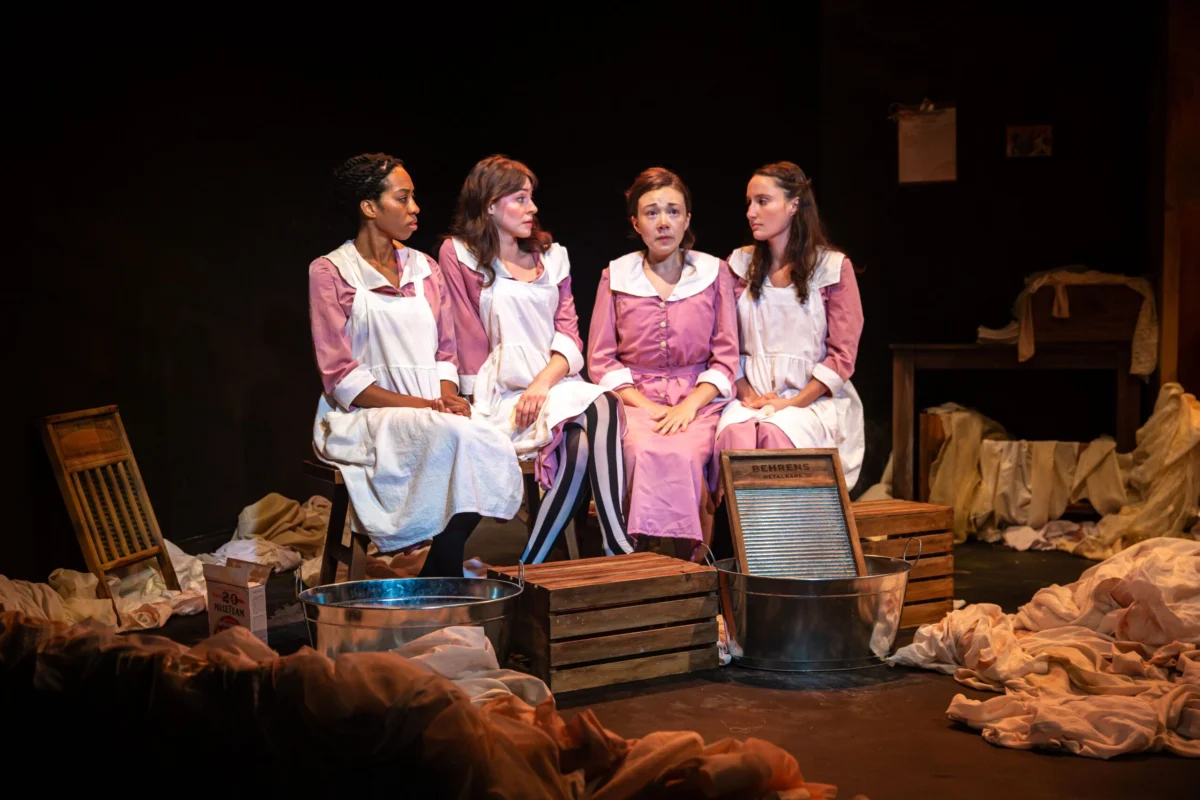
Benevolent, the latest theatrical offering from acclaimed playwright Sophie McIntosh, plunges audiences into the grim realities of 1917 New York, specifically within the confines of Inwood’s Benevolent Home, a reformatory institution designed for "fallen and friendless girls." This powerful new work, directed by McIntosh’s long-standing collaborator Nina Goodheart, offers a searing examination of societal judgment, female resilience, and the enduring struggle for agency amidst oppressive circumstances. The play’s stark setting—a perpetually damp and labor-intensive basement laundry room—serves as a potent metaphor for the Sisyphean tasks these young women face, both literally with the endless stream of soiled linens and figuratively with their societal and personal burdens.
The narrative centers on four distinct young women, each confined to the Benevolent Home for reasons that illuminate the complex social strata and moral anxieties of the early 20th century. Livvy Marcus portrays Abby, a 17-year-old whose spoiled upbringing has landed her in this institution, highlighting the often arbitrary nature of "fallen" status. Mia Fowler embodies Emma, a Black sex worker whose maturity and pragmatism contrast sharply with her youthful appearance, offering a nuanced perspective on survival in a deeply prejudiced society. Chani Reese delivers a compelling performance as Margaret, a white woman whose involvement in more lucrative brothels positions her with a different kind of social leverage, yet still ensnared by the system. Completing the quartet is Rachel Ravel as Sarah, the seemingly most buoyant of the group, whose panhandling on the Coney Island Boardwalk—dubbed "Sodom by the Sea" by Abby’s father—underscores the desperation that can drive individuals to the margins. Through their interactions, the play meticulously peels back layers of their individual histories, revealing shared vulnerabilities and fostering a sense of solidarity that transcends their disparate backgrounds and ages.
The Genesis of Benevolent: Historical Roots and Thematic Exploration
Playwright Sophie McIntosh, known for her incisive work like Macbitches, revealed in a recent interview that the genesis of Benevolent can be traced back to the fall of 2024, when it began as her thesis project. The initial spark for the play came from local historian Cole Thompson, whose passionate research into Inwood’s past uncovered the existence of institutions like the Magdalen Benevolent Society, later known as Inwood House, and the House of Mercy. These reformatories, operational from the late 1800s through the 1910s, served as a focal point for the era’s fervent, often misguided, attempts at social reform.
"I was really fascinated and it was so specific to this progressive era," McIntosh explained. "Reform was the zeitgeist and everybody was trying to fix every single social ill through a scientific process. They were categorizing these women using sociological data and surveys to be like, ‘Okay, this proves scientifically that you are a bad person,’ even though the methodology that they were using wasn’t actually very effective at all." This historical context is crucial to understanding the play’s critique of institutional power and the often pseudoscientific basis for judging and attempting to "correct" marginalized individuals. The inherent irony of these reformatories is highlighted by the fact that many residents, lacking viable alternatives, would often return to their previous circumstances due to a lack of genuine interest in or opportunity for reform. The play subtly questions the efficacy of a system that sought to "teach women how to do laundry so they don’t have to be prostitutes" when the underlying economic and social factors driving sex work remained unaddressed.
Evolution of the Narrative: From Spectacle to Grounded Human Drama
.jpg)
McIntosh’s initial draft, presented in a round-table reading during her graduate studies under the guidance of acclaimed playwright David Henry Hwang, was a significantly different beast. The early version featured twice the number of characters and incorporated a complex subplot involving spiritualism and séances, reflecting concurrent religious movements that gained traction in the wake of the Civil War, a period marked by immense loss and a yearning for connection with the departed.
"The original draft of this play had an abortion and a séance and they are two very different kinds of, for lack of a better word, spectacles," McIntosh reflected. "But I sort of wanted the play to live in the more grounded, human plane. And I wanted them to be doing manual labor for the whole play to reinforce the drudgery that is their lives." This conscious decision to pare down the narrative and focus on the visceral reality of the women’s daily labor was a pivotal moment in the play’s development. By stripping away supernatural elements, McIntosh aimed to amplify the stark, tangible struggles of the characters, making their plight more immediate and relatable.
The subsequent reading at Theater Row last spring proved to be another crucial stage in refining the play. A significant development from this period was the decision to explicitly incorporate race into the character dynamics. McIntosh admitted to initial trepidation: "I did not specify race in the first draft. I knew that I didn’t want to have an all-white cast but I was scared to go there." However, with the establishment of Good Apples Collective, a theater incubator co-founded by McIntosh and Goodheart that champions stories from queer and gender-marginalized voices, the commitment to authentic representation became paramount. The casting of Mia Fowler, a company member, as Emma solidified the intention to address the intersection of race, class, and gender. "I had this feeling watching it that by getting so specific about class and gender but not talking about race at all, we were undermining the play itself and cheapening the story," McIntosh stated.
Confronting Race and Power Dynamics
The inclusion of race as a central element of the narrative is not merely observational but integral to the play’s unfolding conflicts. In a poignant and unsettling moment, a racial slur is hurled at Emma in the first act, a stark reminder of the pervasive racism of the era and its immediate impact on the characters’ relationships. McIntosh emphasized the importance of this deliberate inclusion: "When you don’t touch on race, especially in a period piece where it is so pronounced, and has such a strong impact on the dynamics, it just results in a flattening of everyone’s character and circumstances."
The collaborative process to integrate this sensitive aspect of the story was meticulously handled. McIntosh, alongside Mia Fowler, the play’s dramaturg, and associate director, worked to ensure that racial dynamics were woven into the fabric of the four-way relationship between the characters. Recognizing the inherent power imbalances in a theater setting, especially within a company led by white women, McIntosh and Goodheart took deliberate steps to ensure a supportive and informed environment. "We wanted to make sure that at any point in rehearsal, nobody was the only person representing their identity. So we were very intentional about hiring a Black dramaturg and a Black stage manager so that we had a room of people who could have those conversations. And I am really grateful for Mia because she never let me off the hook, in a really useful way. That can be a challenging thing when you are an actor, given the power dynamic." This commitment to diverse creative teams and open dialogue underscores Good Apples Collective’s ethos: "Even more than that, I think the most defining feature is the idea that you can make high-quality art without treating people badly," McIntosh explained. "We are really just trying to make art with people we love in a way that is mutually supportive and sustainable."
Researching the Past: Language, Lives, and Locations
.jpg.jpg)
Delving into the early 20th century required McIntosh to immerse herself in the language, customs, and social realities of the period. As a playwright not previously accustomed to period pieces, she embraced the challenge, noting the distinct differences between eras where video documentation exists and those where only audio recordings and written accounts are available. "They had just started inventing recording equipment [when Benevolent is set], so it was a challenge," she recalled.
Her research methodology was comprehensive and multifaceted. She extensively studied court record transcripts of women arrested for prostitution, larceny, and other offenses, gaining direct insight into the legal and social pressures they faced. Newspaper clippings and interviews from the time provided further anecdotal evidence and contemporary perspectives. A particularly valuable resource was a book from the Columbia library detailing the history of Inwood House, although McIntosh noted its heavily propagandistic nature, offering a fascinating glimpse into the institution’s self-serving narrative.
The physical landscape of Inwood also played a significant role in her creative process. While writing the play, McIntosh resided in Washington Heights and frequently walked through the area, often stopping to stand on the grounds of the former Inwood House and gaze out at the Hudson River. "It’s very woo-woo, but it was very helpful for me," she admitted, highlighting the immersive quality of her research that extended beyond textual analysis to a deep connection with the historical environment. This blend of academic rigor and sensory engagement allowed her to craft a world that felt both historically authentic and emotionally resonant.
The Political Resonance of Benevolent
A striking element of Benevolent is its unflinching portrayal of a medical abortion performed onstage, a scene that carries significant weight given the historical context and contemporary relevance of reproductive rights. McIntosh acknowledged the play’s visual and thematic parallels to Ruby Rae Spiegel’s Dry Land, a play that also explores abortion with frankness.
When questioned about whether she views her work as political, McIntosh offered a nuanced perspective. "I think that as long as we in the American theater system are beholden to ticket buyers in order to create art and are stuck in that capitalistic system, I don’t think that any art can truly be political," she stated, referencing the constant pressure to "pander to fill the seats." However, she firmly believes that Benevolent possesses a distinct political dimension: "With that said, I do think this play is more political than some, and that is something I was very aware of going in. I knew it wouldn’t be pleasant or easy and we are very careful to make sure that we have clear content warnings on the website."
The discussion around content warnings has become a significant point of debate in contemporary theater. McIntosh advocates for their continued use, emphasizing the importance of audience autonomy: "I feel like it’s important to give people the option to look for them if they want them." Good Apples Collective employs a tiered system on their website, allowing individuals to choose the level of detail they wish to engage with regarding potential triggers, thereby empowering audiences to make informed decisions about their theatergoing experience.
.jpg)
Navigating the Commercial Landscape and Societal Challenges
The tension between artistic integrity and commercial viability is a constant challenge for theater makers, particularly when tackling difficult subject matter. McIntosh expressed gratitude for the current run of Benevolent in the downtown indie theater scene, which she considers her "bread and butter." The positive reception and the potential for the play to find a wider audience are encouraging, though she acknowledged the inherent financial considerations. "And the math of that is definitely different than if [the play] had slightly different subject matter. This downtown indie theater scene is my bread and butter and is something that I love. But I would also love to have better health insurance and get my partner on my health insurance."
The play’s raw depiction of abortion resonated deeply in the current socio-political climate. McIntosh recalled the profound impact of the Roe v. Wade decision’s overturning, which coincided with her COVID-19 isolation: "I was trapped in my room, watching it happen on my phone screen while everybody I knew was out in the streets screaming about it. I think I am still trying to get my hollering out all these years later." The proximity of the IATI Theater to the shuttered Manhattan Planned Parenthood and the Sheen Center, an institution that, due to its Catholic ownership, would not stage plays addressing abortion, further underscores the charged environment in which Benevolent is being presented. The play, therefore, stands not only as a historical exploration but as a potent contemporary statement, a testament to the enduring power of theater to confront uncomfortable truths and spark necessary dialogue.
Benevolent is currently running at the IATI Theater in the East Village through September 5.
