

Published August 28, 2026 08:57 AM
As the crisp mountain air begins to beckon and the first snowflakes grace the highest peaks, skiers worldwide anticipate the approaching winter season. For many, the goal of simply navigating the slopes with a sense of accomplishment has evolved. Intermediate skiers, comfortable on groomed runs and capable of linking turns, often find themselves at a crossroads, ready to transcend mere descent and embrace true skiing mastery. This transition, marked by a desire to ski with greater confidence and fluidity, doesn’t necessarily hinge on adopting aggressive techniques or increasing risk. Instead, experts suggest that subtle yet fundamental adjustments to existing habits can unlock a new level of performance and enjoyment on the mountain.
The pursuit of confidence on skis is intrinsically linked to maximizing the joy of the sport. When skiers feel more in control, more connected to their equipment and the snow, the experience becomes exponentially more rewarding. This season, skiers looking to move beyond the intermediate plateau can focus on seven key areas, each designed to refine technique, enhance feel, and ultimately foster a more assured presence on the slopes. These adjustments, while seemingly minor, can have a profound impact on a skier’s ability to handle varied terrain, changing snow conditions, and unexpected challenges with grace and control.
Initiating Turns from the Ground Up: The Power of Feet and Ankles
A common pitfall for intermediate skiers involves initiating turns with an overreliance on upper body movement. Modern shaped skis are forgiving, making it easy to simply tilt the shoulders and lean the body, prompting the skis to carve a turn. However, this approach severs the crucial connection between the skier and the snow, diminishing the ability to react proactively to subtle shifts in terrain or snow consistency.
The foundational principle for more connected skiing lies in initiating the turn from the feet and ankles. As a new turn begins, the focus should shift to gently rolling the feet and ankles onto their edges. This subtle action creates a palpable pressure along the big-toe side of the outside ski and the little-toe side of the inside ski. This initiated movement then propagates upward, naturally guiding the knees, allowing the hips to flow into the turn, and maintaining a relaxed, balanced upper body. The mantra here is "feet first, body follows." This doesn’t imply a rigidly frozen torso, but rather a deliberate cessation of unnecessary upper body exertion. By allowing the feet to lead, skiers gain a more nuanced feel for the snow’s texture and grip, providing invaluable time to adapt to any incoming changes. This subtle shift in initiation can dramatically improve control, especially when encountering unpredictable patches of ice or uneven surfaces, common challenges that test intermediate skiers.
Engaging the Front of the Skis for Optimal Grip on Hardpack
Slick conditions, such as ice or firm, compacted snow, are unforgiving and quickly expose any sloppiness in technique. Many intermediate skiers, when faced with these challenging surfaces, exacerbate the problem by leaning too far back or attempting to force the entire ski onto its edge simultaneously. A more effective approach involves actively engaging the front of the skis, or the ski tips, to gain purchase.
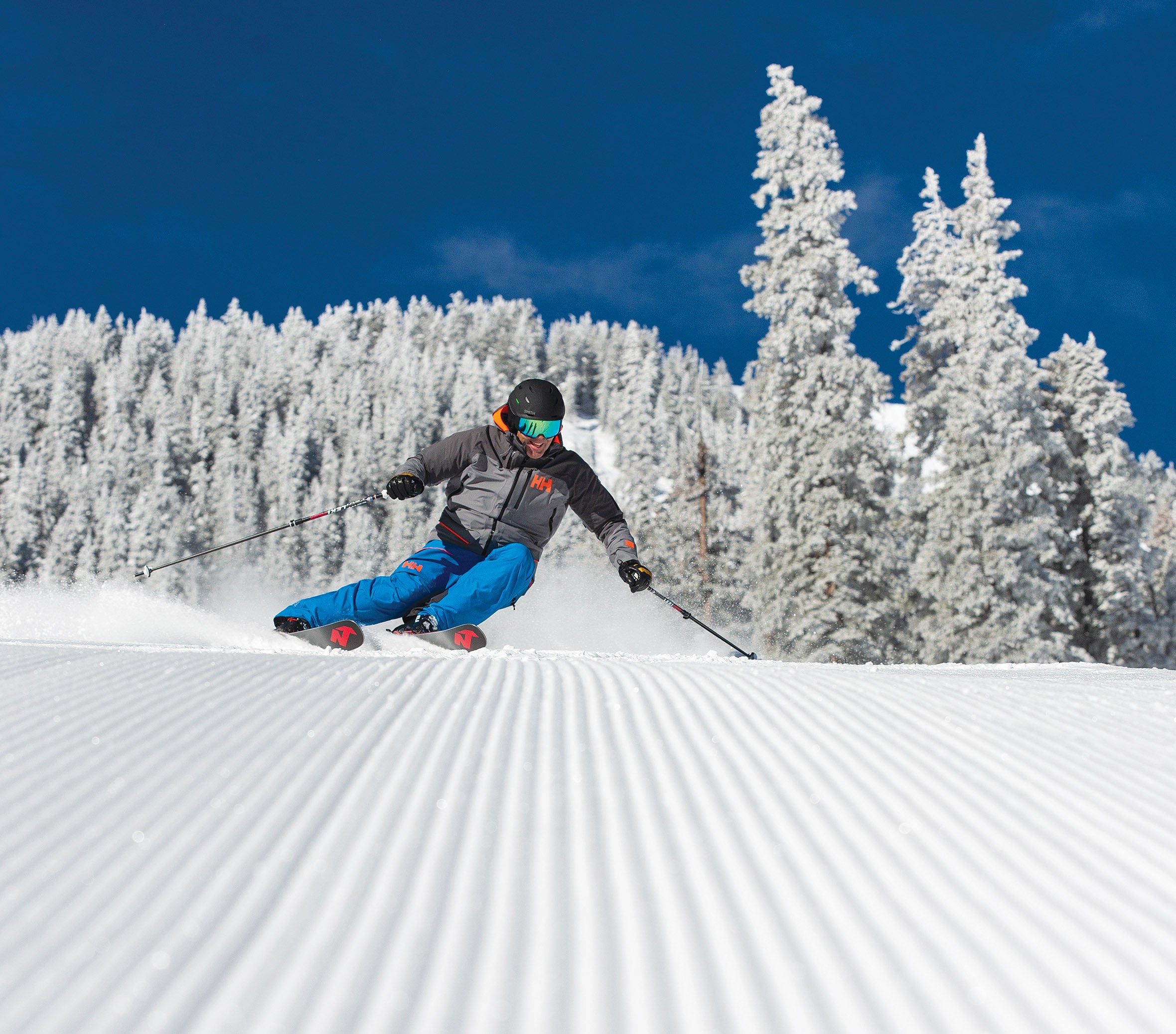
Achieving this requires an open stance that provides ample room for leg movement. By maintaining pressure against the front of the boot cuffs through ankle flexion, skiers can then initiate a turn by gently tipping both ski tips onto their new edges. This early engagement is paramount; it encourages the skis to bite into the snow rather than merely skidding across it. As the turn progresses, it is natural for more pressure to build on the outside ski, particularly in the latter half of the arc. However, the critical element is to avoid delaying edge engagement until deep into the turn. A practical exercise for skiers is to consciously focus on feeling the edges engage near the ski tips on a firm groomer before the rest of the ski arcs around. This proactive engagement on hardpack can prevent uncontrolled skidding and significantly improve the skier’s ability to maintain a controlled line, a skill vital for navigating crowded slopes or steeper, icy pitches where grip is paramount.
The Art of Finishing Turns: Controlling Speed Through Arc Shape
For skiers who find speed to be a persistent challenge, the issue may not be an inability to turn, but rather an inclination to prematurely abandon their turns. A fundamental principle in skiing dictates that the shape of a turn directly influences speed. Directing skis more downhill leads to acceleration, while shaping the turn further across the fall line, and even slightly uphill, effectively decelerates the skier.
Many intermediate skiers believe they are completing their turns when, in reality, they are exiting them shortly after crossing the fall line. While this may suffice on gentler slopes, it can quickly lead to a loss of control on steeper gradients. The solution is not necessarily to execute sharper turns or to rely on braking maneuvers. Instead, skiers should focus on allowing their skis to continue their trajectory across the hill, completing a more rounded arc. The guiding principle is that steeper slopes often necessitate utilizing more of the mountain’s width to manage speed. Mastering the ability to adjust turn shape is a significant stride toward confident skiing on varied terrain. It’s important to understand that long turns are not inherently faster, nor are short turns inherently slower; the outcome is dictated by where and how the turn is finished. This understanding is particularly relevant as resorts increasingly open more challenging, off-piste terrain, where controlled speed management is crucial for safety and enjoyment.
Developing Versatility: Moving Beyond the Signature Turn
Every skier develops a preferred turn shape, whether it’s the sweeping, high-speed arc on a freshly groomed blue run or the rapid, short-radius turns that mimic mogul skiing. While this signature turn can be a source of comfort and enjoyment, it can become a limitation when the mountain demands a different approach. Expert skiers, in contrast, possess a diverse repertoire of turn shapes, capable of executing large, medium, and small arcs with equal proficiency, adapting their technique to suit the terrain.
The key to developing this versatility lies in learning to "change gears" fluidly. Skiers are encouraged to experiment on familiar runs, consciously varying their turn shapes. This might involve linking several wide, sweeping arcs, followed by a series of tighter turns, and then stretching out the subsequent arc. By observing how each shape influences speed, rhythm, and position on the hill, skiers can begin to internalize the mechanics of adapting their technique. Learning to ski each run in accordance with the terrain’s demands is a rapid path to skill enhancement. This adaptability is invaluable, especially as skiers venture into more challenging environments where conditions can change rapidly, requiring a flexible and responsive skiing style.
The Unseen Anchor: Calming the Hands for Enhanced Stability
The hands often serve as an unconscious barometer of a skier’s control. When a skier feels out of sync, their arms tend to flail, with movements like reaching behind or throwing hands downhill in a desperate, often ineffective, attempt to regain balance. Conversely, calm and steady hands provide a stable platform for the upper body, allowing the legs to perform their primary role in steering and control.
Maintaining hands forward and roughly level, with elbows comfortably positioned in front of the chest, is essential. A helpful mental image is to envision a horizontal line connecting the hands, aiming to keep this line relatively level throughout the turn, rather than allowing the downhill hand to drop towards the knee. This does not advocate for rigid, robotic arm movements. Hands should remain relaxed and prepared, particularly when using ski poles. However, gratuitous arm movements can disrupt balance precisely when stability is most needed. A simple self-assessment involves asking: If filmed from the front, do the hands appear to be passively along for the ride, or are they actively trying to steer? The former is the desired state, allowing the skis to execute the turns. This principle is particularly relevant when skiing in variable conditions, such as choppy snow or through trees, where a stable upper body allows for more precise ski control.
Pre-emptive Planning: Skiing the Run Before You Ski It
The optimal moment for strategic decision-making regarding a challenging slope is rarely when one is already midway down it. Before committing to terrain that pushes comfort zones, taking a moment to stop and formulate a plan is crucial. This involves observing the slope from vantage points such as the ski lift or the very top.
The objective is to identify key features: where does the pitch change? Are there obvious terrain variations? Where might the snow be scraped off, or where does the run narrow? Pinpointing areas where speed control might be necessary is also important. Once these observations are made, the run can be mentally segmented into manageable sections. This is not about memorizing every inch of the slope like a competitive racer, but rather about creating a mental roadmap. For instance, a skier might plan to traverse to a specific knoll, execute a few controlled turns through a steeper section, and then open up their speed below a cluster of trees. This visualization process transforms an intimidating run from a singular, overwhelming problem into a series of achievable objectives. The emphasis is on "thinking small" and focusing on executing the immediate section well, rather than solely fixating on reaching the bottom. Crucially, this plan should allow for flexibility, acknowledging that conditions can change, and other skiers may behave unpredictably. The plan should foster confidence, not rigidly dictate a course of action that may become inappropriate as circumstances evolve. This pre-emptive strategy is a cornerstone of safe and confident skiing in avalanche-prone areas or on complex, multi-faceted slopes.
Expanding Vision: Looking Ahead for Proactive Control
The appearance of effortless skiing often stems from the ability of proficient skiers to anticipate. The farther ahead a skier looks, the earlier they can perceive what lies ahead, granting them more time to react. Conversely, fixating on the tips of one’s skis turns every bump, ice patch, and gradient change into an unexpected surprise.
The practice of maintaining forward vision, akin to how a driver observes the road ahead, is essential. Skiers should direct their gaze towards the next section of terrain, rather than focusing solely on the immediate few feet. As confidence grows, this extends to actively "reading" the slope: identifying areas where the snow is likely to be softer, where the pitch steepens, and where the optimal location for finishing the next turn might be. This broader perspective integrates many of the previously discussed skills. When the feet are guiding the turns, the upper body remains calm, and there is a clear understanding of where one is heading, skiing transforms from a reactive process to a proactive one. The skier is no longer merely responding to the mountain; they are actively engaging with and skiing it. This forward-looking approach is fundamental to navigating challenging conditions, such as whiteouts or areas with hidden obstacles, where the ability to perceive and react in advance can be critical.
The collective implementation of these seven subtle shifts offers a pathway for intermediate skiers to transcend their current abilities and embrace a more confident, enjoyable, and capable skiing experience. As the winter season unfolds, these refined techniques promise not only improved performance but also a deeper connection with the exhilarating sport of skiing.
