

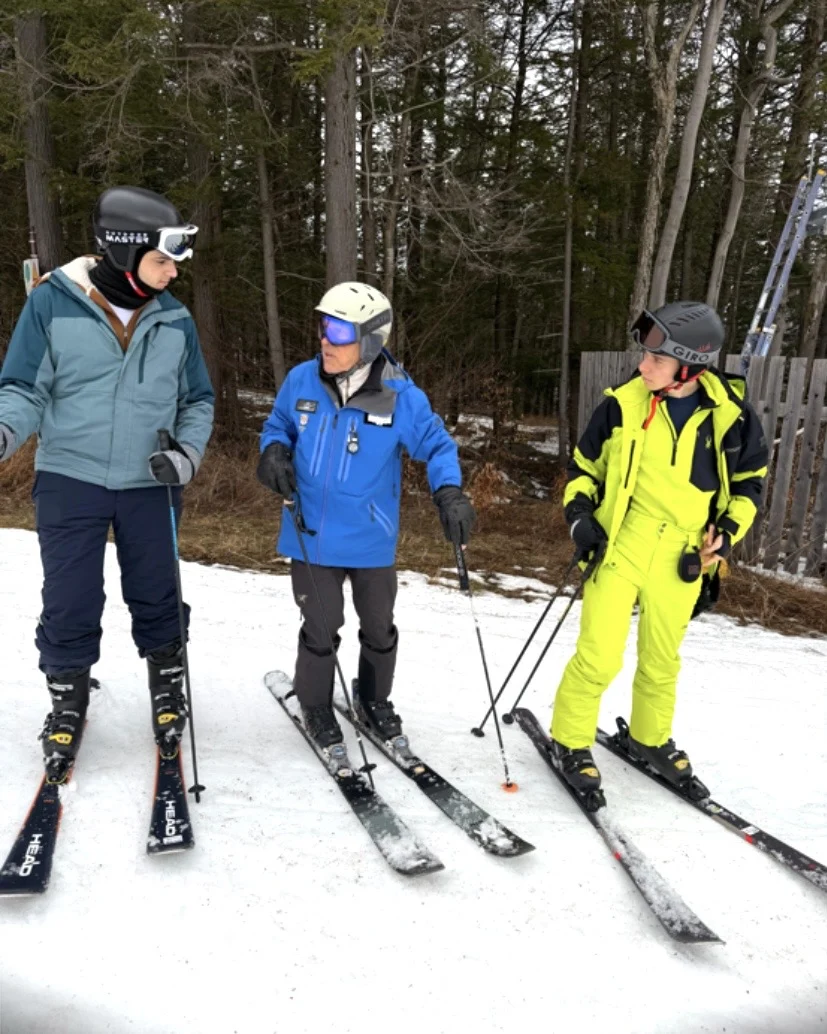
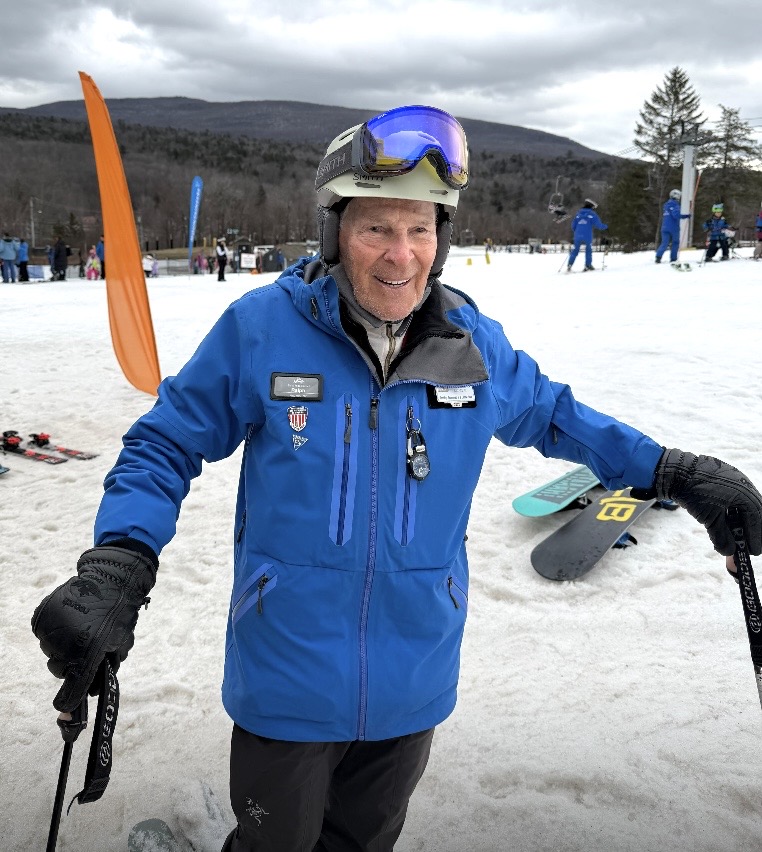
In the biting cold of a late winter morning at New York’s Hunter Mountain, a piercing shot of wind swirled snow across the Otis Quad’s unloading ramp. The jacket thermometer registered a formidable -5°F, with the wind chill plummeting the perceived temperature to a frigid -30°F. While many sought refuge in the warmth of the lodge, jostling for a coveted spot near the fireplace, ninety-five-year-old Ralph Perlberger stood ready for his descent, skis squeaking on the dry, cold snow. Accompanied by his wife, Carol, and two fellow ski instructors, David Raindorf and Steve Cohen, Perlberger was poised to celebrate his 95th birthday on the slopes, a testament to his philosophy of skiing in all conditions and weather. This extraordinary display of vigor and dedication prompted Leslie Surprenant, an Alpine Level II and Children’s Specialist 1 instructor at Hunter Mountain, to introduce Perlberger to the women from her weekly clinic, highlighting his inspiring grit.
The scene unfolded as Perlberger, a PSIA Level II Alpine instructor, prepared for a run down West Side Glide, an intermediate trail weaving through a canopy of pines and hemlocks. His grin, visible through a frozen face mask, broadened as the group sang "Happy Birthday," their voices muffled by the cold. This moment underscored a remarkable career spanning 24 seasons as an instructor, a journey marked not just by longevity but by a profound commitment to the sport and his students. Victoria Mercado, Senior Manager of Hunter Mountain’s Ski and Ride School, articulated the sentiment shared by many: "Ralph is an inspiration. He’s not only skiing, but teaching! Skiing and riding keep you young. When I watch Ralph ski, I can’t believe he’s 95. His energy, skill, and passion on the mountain defy his age. It’s an absolute pleasure to work alongside him." His colleagues, like David Raindorf, who once remarked, "When I grow up, I want to be Ralph," and Steve Cohen, who calls Perlberger his "idol," echo this admiration, recognizing a figure whose life story is as compelling as his turns on the snow.
A Chronology of Survival and Resilience
Ralph Perlberger’s journey to becoming a revered figure on the slopes of Hunter Mountain is rooted in a harrowing past, a narrative of survival against unimaginable odds during World War II. Born in 1931, his early childhood in Amsterdam, Netherlands, was irrevocably altered by the encroaching shadow of Nazi Germany. In 1940, as the Nazi forces launched their devastating invasion of the Netherlands on May 10th, Ralph’s father had already departed for New York City, meticulously arranging for his family’s immigration to the United States. This desperate attempt to secure their safety was tragically interrupted by the swift advance of the German war machine.
The Holocaust: Westerbork and Bergen-Belsen
The following year, in 1941, nine-year-old Ralph, his mother, and his two older brothers were forcibly removed from their home in Amsterdam. Their first destination was Westerbork transit camp in the Netherlands. Established in 1939 as a refugee camp for Jews who had fled Nazi Germany, Westerbork was transformed by the Nazi occupation into a transit point for the systematic deportation of Jews from the Netherlands to extermination camps in Eastern Europe. Conditions were harsh, but it served primarily as a collection and departure center.
In February 1944, the Perlberger family’s ordeal intensified as they were transferred by railroad cattle car to the Bergen-Belsen concentration camp in Germany. Bergen-Belsen, initially established as a prisoner of war camp, evolved into a concentration camp where prisoners were starved, subjected to forced labor, and died in vast numbers from disease and maltreatment. While it did not feature gas chambers like Auschwitz, its conditions were horrific, particularly in the later stages of the war. Ralph endured the camp’s brutal realities, suffering through both typhus and typhoid fever, illnesses that claimed countless lives. Despite the omnipresent despair and death, Ralph maintained an extraordinary sense of confidence, security, and hope, a testament to the resilience instilled by his parents. He later recalled even believing he would have "quite a story to share with friends, once the war ended," a remarkable outlook for a child facing such atrocities.
The "Lost Transport" and Liberation
During these agonizing years, Ralph’s father in New York City had no knowledge of his family’s fate, agonizing over their survival. As World War II drew to a close, the Perlberger family found themselves part of one of the most desperate and chaotic episodes of the Holocaust’s final days: the "Lost Transport." This refers to one of three trains on which the Nazis, in a desperate and cynical ploy, sent approximately 7,500 Jewish prisoners, including Ralph and his family, from Bergen-Belsen. The intention was to exchange these prisoners for German prisoners held by the Allies, a scheme that ultimately failed.
The "Lost Transport" train embarked on a two-week odyssey, traveling aimlessly across war-torn Germany. Its journey was fraught with constant stops and rerouting due to widespread destruction of railway tracks by Allied bombing. The prisoners, already emaciated and weakened by years of starvation and disease, endured unimaginable suffering. Hundreds perished from typhus and hunger en route. The train, never reaching its intended destination for the prisoner exchange, finally came to a halt on a destroyed bridge over the Elster River, just outside the Russian-occupied village of Tröbitz, Germany. It was there, on April 23, 1945, that Russian troops liberated the remaining prisoners. This liberation marked the end of their captivity, but the struggle for survival continued for many, including the Perlbergers, who were severely weakened by their ordeal.
Rebuilding a Life in America
News eventually reached Ralph’s father that his family had survived and were in Tröbitz. While their visa applications were processed, a period that lasted five months, his father tirelessly sent Red Cross packages filled with food and hygiene products, providing crucial aid for their recovery. In February 1946, Ralph, his two brothers, and his mother finally immigrated to the United States, making their new home in New York City. The transition was profound. Ralph quickly learned English, excelled in school, and his family began the long process of healing and rebuilding their lives, allowing his father to reconnect with the family he had fought so hard to save. This period of assimilation and academic achievement laid the foundation for a future far removed from the horrors of his past.
The Call of the Slopes: From Student to Master Instructor
Ralph Perlberger’s introduction to skiing came much later in life, a stark contrast to the trauma of his youth, and quickly blossomed into a lifelong passion. While studying economics at Stanford University, his father, perhaps recognizing the importance of new experiences and joy after their collective trauma, sent Ralph and his two older brothers to Sun Valley, Idaho, for a winter break. It was there that Ralph was "hooked," falling in love with the sport that would define much of his later life. He pursued skiing at every opportunity, even while earning his law degree at Harvard University, demonstrating an early commitment to balancing rigorous academic pursuits with his burgeoning passion for the outdoors.
For decades, Perlberger honed his skills on various slopes, from the challenging terrains of Taos and the grand peaks of Europe to the familiar runs of Hunter Mountain. His love for skiing was unwavering, but it wasn’t until 2002, at the remarkable age of 71, that a new chapter began. An advertisement caught his eye: for $85, he could attend a weekend of instructor training and candidate selection at Hunter. If selected, a second weekend of training and final selection would be free. Driven by a desire to deepen his engagement with the sport, he enrolled. He was among those chosen, embarking on a path that revealed a continuous journey of learning, even for an experienced skier.
The Professional Ski Instructors of America (PSIA) and AASI
Perlberger’s achievement as a PSIA Level II Alpine instructor is significant. The Professional Ski Instructors of America and American Association of Snowboard Instructors (PSIA-AASI) is the world’s largest education association for professional snowsports instructors. Its certification system involves rigorous testing across three levels, assessing skiing or snowboarding proficiency, teaching methodology, and technical knowledge. A Level I certification focuses on teaching beginners and intermediates. Level II, which Perlberger holds, signifies an instructor’s ability to teach a wider range of terrain and skill levels, demonstrating advanced skiing skills and a comprehensive understanding of teaching theory. Level III is the highest certification, denoting expert-level skiing and teaching abilities across all conditions and terrain. Perlberger’s attainment of Level II underscores his commitment to continuous improvement and his expertise in conveying complex skiing concepts effectively.
His dedication to mastering the craft of instruction is evident in his ongoing pursuit of knowledge. He credits fellow ski instructor and PSIA Alpine examiner Charlie Knopp for some of the best advice he ever received: "Lift your inside hip!" This seemingly simple instruction encapsulates the nuanced biomechanics of effective ski turning, a detail Perlberger now imparts to his own students.
A Guiding Light on the Mountain
Ralph Perlberger has become a beloved and essential figure within the Hunter Mountain ski and ride school community. His colleagues consistently express awe and appreciation for his presence and contributions. Luca Arrigoni, a member of the Eastern Alpine Development Team, shared a poignant reflection: "Ralph has a special place in my heart. I shadowed him as a new instructor and was inspired by his patient, gentle, and knowledgeable way with beginners. He still proudly wears the Hunter uniform, which shows his love for, and dedication to, the sport and teaching." This sentiment highlights Perlberger’s role not just as an instructor, but as a mentor and an embodiment of the ski school’s values.
Perlberger’s Teaching Philosophy
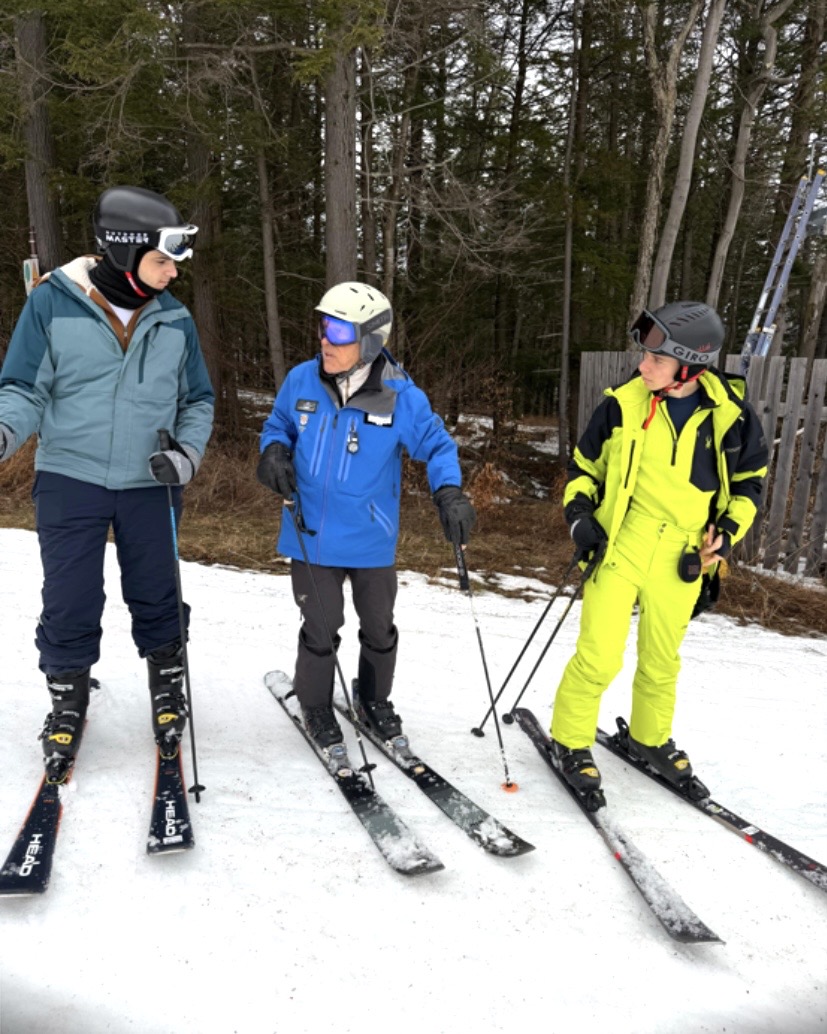
Perlberger particularly enjoys helping adult intermediate skiers, a demographic often struggling with fundamental techniques. His approach is rooted in observation and guided discovery. He begins by asking students how they believe they make their skis turn. The common response – "I don’t know; I just turn" – reveals a lack of conscious awareness of their body mechanics. Perlberger observes that many intermediates rely on leg rotation on flat skis, neglecting crucial elements of proper technique.
His instruction focuses on re-establishing core fundamentals:
- Maintaining Center of Mass (CM) over Base of Support (Stance): This ensures balance and efficient power transfer.
- Directing Pressure to their Outside Skis: Essential for effective edging and turn initiation.
- Controlling Edge Angles: Key to carving and managing speed on varying terrain.
He employs a kinesthetic approach, coaching skiers to feel their shins against the tongue of their boots throughout all turn phases. This tactile feedback helps students understand and correct their body position. When he notices skiers leaning back, a common issue leading to fatigue and loss of control, he prompts them to stop and articulate how their quads feel. The typical responses – "tired" or "burning" – become teachable moments, allowing him to direct their attention to their body’s relationship with their feet and reinforce the importance of maintaining forward shin contact with the boot. Through this patient, analytical, and encouraging methodology, Perlberger consistently ensures that "every student improves, has fun, and thanks him." His ability to simplify complex movements and connect with students on a personal level is a hallmark of his enduring success.
Broader Implications: Active Aging and Lasting Legacy
Ralph Perlberger’s story extends beyond the ski slopes, offering profound implications for understanding active aging, the human spirit’s resilience, and the ski industry itself.
A Paradigm for Active Aging
At 95, Perlberger is a living testament to the benefits of an active lifestyle and a positive mindset. His continued ability to ski and teach at a high level defies conventional expectations of aging. Research consistently shows that engaging in regular physical activity, especially sports like skiing that demand balance, coordination, strength, and cognitive engagement, can significantly slow down the aging process. Studies by organizations such as the National Institute on Aging highlight that physical activity improves cardiovascular health, maintains muscle mass and bone density, enhances cognitive function, and boosts mood, contributing to a higher quality of life in older adults. Perlberger’s example serves as a powerful inspiration, demonstrating that age is merely a number when passion and purpose remain vibrant. His commitment to skiing in "all conditions and all weather" underscores a philosophy that embraces challenges and rejects limitations, a mindset that undoubtedly contributes to his remarkable vitality.
The Power of Holocaust Remembrance
Perlberger’s survival of the Holocaust adds an extraordinary layer to his narrative. His ability to not only overcome such immense trauma but to thrive and dedicate his later life to helping others learn and enjoy a sport is a powerful message of hope and resilience. His story serves as a vital reminder of the atrocities of the Holocaust and the enduring strength of the human spirit. In an era where Holocaust remembrance and education are more critical than ever, Perlberger’s life stands as a testament to the importance of bearing witness and ensuring that such history is never forgotten. His presence on the mountain, teaching with joy, is a quiet but profound act of defiance against the darkness he endured.
Impact on the Ski Industry and Community
Within the ski industry, Perlberger represents the invaluable contribution of experienced instructors. His longevity and dedication highlight the rich intergenerational dynamic often found in ski communities. Hunter Mountain, like many resorts, benefits immensely from instructors who possess not only technical skill but also a deep understanding of human psychology and the patience to guide learners of all ages. Perlberger’s advice to younger instructors – "Keep at it and don’t give up! Don’t let anything stop you. Ski in all conditions and all weather" – is a distillation of his own life philosophy. It speaks to the enduring values of perseverance and passion that are crucial for success in any field, particularly one as demanding and rewarding as ski instruction. His presence enhances the resort’s image, attracting students and colleagues drawn to his inspiring story and expertise. The Professional Ski Instructors of America Eastern/Education Foundation, through its publication The SnowPro, recognized Perlberger as an exemplary figure, showcasing the profound impact one individual can have on a community and the sport.
A Legacy in Motion
Having recently completed his 24th season of instructing, Ralph Perlberger shows no signs of slowing down. His unwavering commitment to what he loves is a beacon for all who encounter him. He often reflects, "Maybe someone above is watching over me," acknowledging the confluence of fortune and fortitude that has shaped his remarkable life. Drawing inspiration from Baseball Hall of Famer Satchel Paige, who famously advised, "Don’t look back; something might be gaining on you," Perlberger embodies a forward-looking spirit. For the skiers navigating the slopes of Hunter Mountain, that "something" gaining on them might just be Ralph Perlberger, a ninety-five-year-old ski instructor, still carving turns, still teaching, and still inspiring. His legacy is not just etched in the snow, but in the hearts and minds of every student and colleague he has touched, a testament to a life lived with extraordinary resilience, unwavering passion, and an enduring commitment to the joy of skiing.
