

The landscape of American winter recreation has undergone a seismic shift over the last quarter-century, transitioning from a niche pursuit for dedicated enthusiasts to a mainstream industry characterized by high-tech equipment and massive public participation. Yet, despite this "explosion" in backcountry use, a comprehensive analysis of data provided by the Colorado Avalanche Information Center (CAIC) reveals a counterintuitive and highly significant trend: the annual number of U.S. avalanche fatalities has remained remarkably steady for more than two decades. This stability in the face of skyrocketing exposure suggests a dramatic decline in the individual fatality rate, a development that experts attribute to a multifaceted advancement in education, technology, and regional safety infrastructure.
To understand the magnitude of this achievement, one must examine the state of the industry during the 1994/95 winter season. At that time, the institutional framework for avalanche safety was in its relative infancy. In Denver, Utah, and Seattle, the three primary avalanche centers were led by pioneers Knox Williams, Bruce Tremper, and Mark Moore, respectively. Other regional centers were just beginning to take root; Jim Kanzler managed the center in Jackson Hole, Brad Ray led efforts at Mount Washington, and a small center in Bozeman, Montana, was only in its fifth season. Notably, several now-critical regions, including the Chugach in Alaska, the Lake Tahoe area, and Mount Shasta, lacked dedicated avalanche centers entirely.
The technological landscape of 1994 was equally primitive by modern standards. Backcountry skiers predominantly utilized telemark gear, often paired with leather boots that offered limited control compared to modern rigid plastics. Snowmobiles lacked the power-to-weight ratios and specialized track designs of modern "mountain sleds," limiting their ability to access high-consequence, steep terrain. Furthermore, the concept of the "sidecountry"—resort-adjacent backcountry accessed via chairlifts—had not yet entered the popular lexicon, as most ski areas maintained strictly closed boundaries. Perhaps most significantly, the digital age had not yet arrived; the first avalanche advisories were only beginning to appear on the burgeoning internet at the conclusion of the 1995 season.
Statistical Stability in a High-Growth Environment
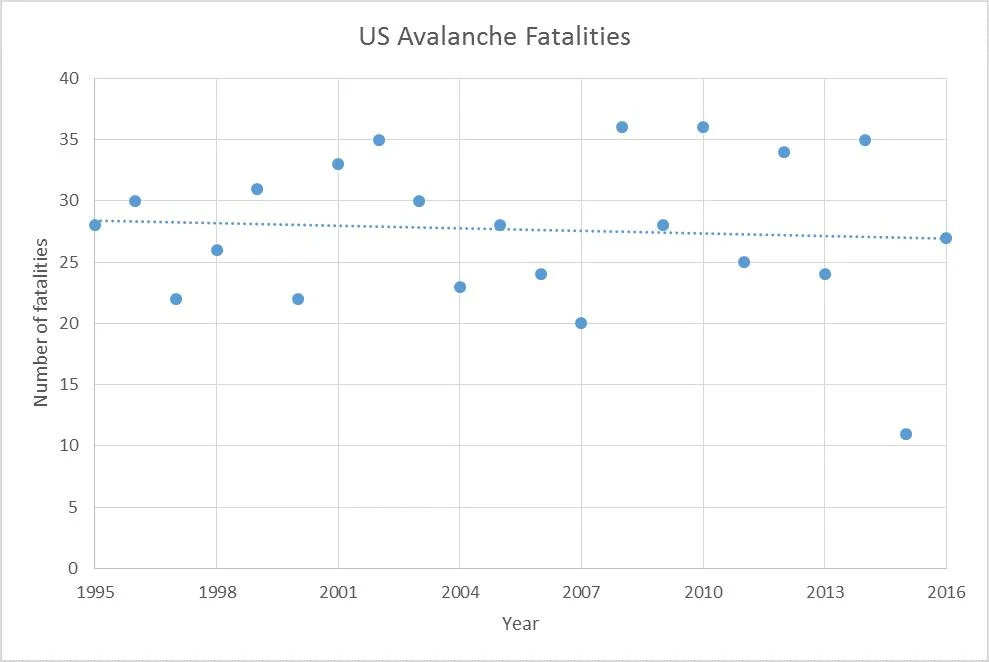
Data compiled from the 1994/95 winter through the 2015/16 winter illustrates a flat trend line for overall avalanche fatalities in the United States. According to the CAIC data, while the year-to-year numbers fluctuate due to varying snowpack stability and weather patterns, the long-term "least squares trend line" shows no statistically significant increase. With a p-value of 0.7, statisticians indicate there is no evidence of a change in the total number of annual deaths over this 22-year period.
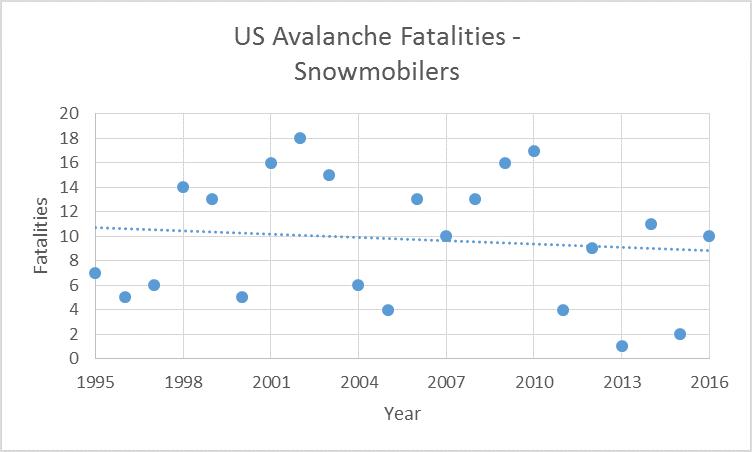
When the data is disaggregated by user group, the results remain largely consistent, though with subtle nuances. Snowmobile-related fatalities have remained flat, showing a slightly decreasing trend line that is also statistically insignificant (p = 0.6). In contrast, the data for backcountry skiers and snowboarders suggests a potential, albeit slight, upward trend. With a p-value of 0.07, there is some marginal statistical evidence of an increase in fatalities for this specific demographic, though it remains remarkably low given the sheer volume of new participants in the sport.
The significance of these flat lines cannot be overstated when compared against the estimated growth of the user base. While precise numbers for dispersed winter recreation are notoriously difficult to track, experts use avalanche advisory usage as a reliable proxy for participation. The growth in this metric is staggering. Over the 22-season study period, the Utah Avalanche Center reported a 12-fold increase in advisory usage. The Colorado Avalanche Information Center saw a 17-fold increase, while the Gallatin National Forest Avalanche Center and the Northwest Avalanche Center experienced 36-fold and 60-fold increases, respectively.
The Declining Fatality Rate: A Factor of Eight
By combining conservative estimates of backcountry use—suggesting at least an eight-fold increase in participation—with the flat fatality trend, analysts have concluded that the individual fatality rate (deaths per backcountry user day) has plummeted. If the fatality rate had remained constant as participation grew, the United States could have reasonably expected upwards of 200 avalanche fatalities per winter by 2016. Instead, the annual average has hovered consistently in the range of 25 to 30. This suggests that the risk profile for the average backcountry traveler has decreased by at least a factor of eight over the last two decades.
This reduction in risk is viewed as a monumental success for the North American avalanche safety community. It represents a collective victory for several sectors, including public education, professional guiding, government forecasting, and equipment manufacturing.
The Role of Technological Innovation
The evolution of safety equipment has played a pivotal role in keeping fatality numbers low. In the mid-1990s, avalanche transceivers were largely analog and required significant practice to master. Modern digital transceivers with three antennas and sophisticated marking functions have drastically reduced the time required to locate a buried victim.
Furthermore, the introduction and refinement of "active" safety gear have fundamentally changed the odds of survival during an incident. The development of the Avalung, which allows a buried victim to breathe longer under the snow by diverting carbon dioxide, and the widespread adoption of avalanche airbag packs, which use the principle of inverse segregation to keep the wearer on the surface of the slide, have provided a critical secondary layer of defense. Lightweight helmets and improved armor have also reduced the trauma-related fatalities that account for approximately one-quarter of all avalanche deaths.
The transformation of snowmobiles has also impacted the statistics. While more powerful machines allow users to reach more dangerous terrain, they also allow for faster movement out of harm’s way. More importantly, the snowmobile community has seen a cultural shift toward carrying proper rescue gear and seeking formal education, a trend that was less prevalent in the 1990s.
Expansion of Educational and Forecasting Infrastructure
The stabilization of fatality rates is also deeply linked to the professionalization and expansion of avalanche forecasting. The regional avalanche center network has grown from a handful of outposts into a robust, interconnected system. These centers now provide daily, high-resolution advisories that are easily accessible via smartphones, allowing recreators to make informed decisions before they ever leave their homes.
Education has moved from informal mentorship to standardized, tiered curricula. Organizations like the American Institute for Avalanche Research and Education (AIARE) and the American Avalanche Association (A3) have developed rigorous training programs for both professionals and recreationists. Public awareness campaigns, most notably the "Know Before You Go" (KBYG) program, have been instrumental in reaching younger and less experienced demographics. By focusing on five simple pillars—Get the Gear, Get the Training, Get the Forecast, Get the Picture, and Get Out of Harm’s Way—these programs have streamlined complex safety information for the general public.
The Professional Influence and Industry Responsibility
The "sidecountry" and "slackcountry" phenomenon, where skiers exit resort boundaries to access unmanaged terrain, initially posed a significant threat to safety statistics. However, ski area operations and professional guiding services have responded by increasing their role in public education. Many resorts now feature "avalanche gear check" stations at gates and provide prominent signage with current danger ratings.
Guiding services have also seen a surge in demand, as more users recognize the value of professional risk management. This shift toward "pro-led" experiences has likely mitigated the risks for a significant portion of the new user base. Additionally, the role of social media, while often criticized for encouraging "peak bagging" and risky behavior, has also served as a platform for real-time observation sharing. Platforms like the CAIC’s observation portal allow the public to contribute to a collective understanding of snowpack conditions, creating a "crowdsourced" safety net.
Implications and Future Challenges
While the flat trend in fatalities is a cause for celebration within the industry, experts remain cautious. The goal of the avalanche safety community continues to be the reduction of fatalities toward zero. As climate change continues to alter mountain snowpacks—leading to more frequent "rain-on-snow" events and deeper, more persistent weak layers—the challenges facing forecasters are evolving.
The potential for a "mass casualty" event remains a concern as more people congregate in popular backcountry corridors. Furthermore, the slight upward trend in skier and snowboarder fatalities (p = 0.07) suggests that this specific group may be pushing into increasingly complex terrain or that the sheer volume of users is beginning to strain the limits of current educational efforts.
The analysis of the past 22 seasons provides a clear mandate: the current strategies are working. The combination of accessible, high-quality forecasting and a culture that prioritizes education has successfully decoupled the growth of the sport from the growth of its inherent dangers. For the professionals and volunteers who document accidents, compile data, and issue daily warnings, these statistics are a testament to the efficacy of their work.
Ultimately, the story of U.S. avalanche safety over the last two decades is one of human adaptation. As technology has made the mountains more accessible, the community has responded with an equally sophisticated framework for safety. The "flat line" of fatalities is not a sign of stagnation, but rather a remarkable achievement of resilience and collective effort in the face of unprecedented growth.
