

North Dakota, a state not typically recognized for its mountainous terrain or extensive ski resorts, actually boasts four distinct areas catering to winter enthusiasts. While these resorts may not rival the sprawling landscapes of New England or the towering peaks of the Rockies, they serve as vital hubs for local skiers and snowboarders. Among these are Bottineau Winter Park and Frost Fire Park, situated a stone’s throw from the Canadian border near Winnipeg; Thrill Hills, located directly south of Bottineau; and Huff Hills, found in the south-central region of the state. Given the considerable distances involved in traversing between these locations, the decision was made to focus on Huff Hills, a choice further bolstered by a positive recommendation from individuals associated with Terry Peak, a South Dakota ski area, underscoring the inter-state appeal of regional winter recreation. This phenomenon is akin to Vermonters occasionally venturing into New Hampshire or New York for skiing, highlighting a common pattern of seeking out nearby, accessible winter sports opportunities.

Proximity and Perseverance: The Foundation of Huff Hills
Arriving at Huff Hills in the mid-afternoon, the ski area was found to be approximately 20 miles south of Mandan, a city adjacent to the more prominent Bismark, North Dakota. This strategic location, nestled within a metropolitan area of about 135,000 residents, has been instrumental in the sustained operation of Huff Hills since its inception in 1993. Parking was readily available, a testament to the modest crowd on this particular weekday. An initial attempt to park in a lower lot was met with the telltale signs of "mud season," a familiar challenge for winter sports aficionados, prompting a relocation to a more convenient spot closer to the base lodge.
Built by Hand: A Legacy of Local Initiative
Upon entering the base lodge, an introduction was made to John Thorenson, the base manager at Huff Hills. Thorenson, who had previously spent time in the Rocky Mountains, returned to the region and found a fulfilling career at Huff Hills, where he has remained ever since. Soon after, Andrew Beck, the current owner, made an appearance. Andrew, along with his father, Jim Beck, was the driving force behind the establishment of Huff Hills in 1993. Their endeavor was a true labor of love, with a young Andrew frequently enlisted to assist in the development of the ski area.

The history of skiing in this specific locale dates back to the 1960s, with a smaller ski area known as Thrill Hill operating briefly before its closure. Recognizing the demand for local winter recreation, particularly among residents accustomed to long drives to more distant mountain ranges, Jim Beck, with the support of a few investors who shared his vision, embarked on the project to create a well-managed, community-focused ski area. This initiative aimed to provide a convenient and accessible alternative for skiing and snowboarding enthusiasts in the region.
Recycled Lifts and Mid-Continent Vertical: Ingenuity in Development
The transformation of the leased farmland into a functional ski area was remarkably swift, with Huff Hills coming to fruition in approximately five months. Trails were meticulously carved through the dense hardwood forests. The initial ascent was facilitated by a chairlift, affectionately named the "Blue Chair," which was acquired from Holimont Ski Area in upstate New York. This was later complemented by a T-bar lift. The local community responded positively, and Huff Hills began to gain traction. A few years later, a second chairlift, the "Green Chair," was added, sourced from Brianhead Resort in Utah. This practice of repurposing and relocating ski lift infrastructure is a common theme in the development of smaller ski areas, embodying a spirit of resourcefulness.

Jim Beck, a skilled builder by trade, along with Andrew and a dedicated team of individuals, was instrumental in constructing the base lodge, equipment storage facilities, and other essential infrastructure required to operate the ski area. The interior of the base lodge, though simple in its design, reflects a high standard of craftsmanship. Today, Huff Hills is equipped with a robust snowmaking system, modern grooming equipment, and the necessary infrastructure to maintain operations for an average of four to five months annually, contingent on weather conditions.
With a vertical drop of approximately 450 feet, Huff Hills stands as the largest ski area in North Dakota. It features two chairlifts and two surface lifts, servicing a network of around twenty trails, offering a diverse range of terrain for skiers and snowboarders of all skill levels.

The Soul of the Patrol: A Volunteer Force
On the day of the visit, lift lines were virtually non-existent, with only a handful of skiers and snowboarders present. During a ride up the lift, a conversation was struck with Scott, a long-serving member of Huff Hills’ entirely volunteer ski patrol. He shared insights into the dedication and camaraderie that define the patrol.
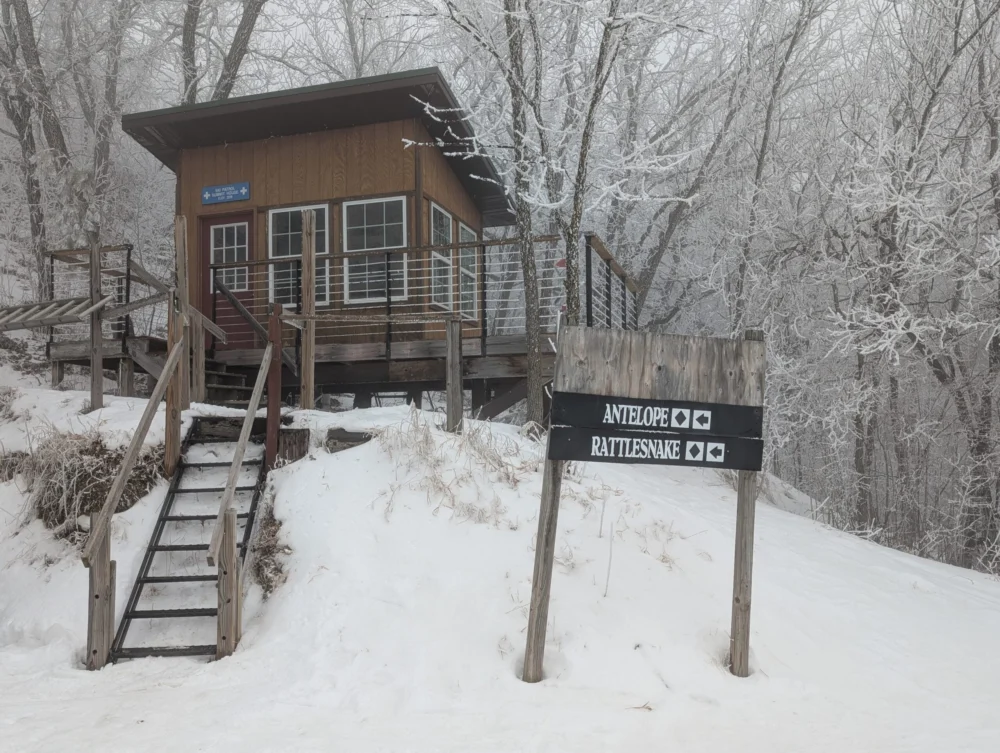
The patrol building itself, situated at the summit, was constructed by the patrollers, providing a warm and essential facility for their operations. This self-sufficiency underscores the deep commitment of the volunteer staff to the success of Huff Hills.

While the snow conditions on this particular day were not optimal, perhaps contributing to the sparse crowds, the skiing itself was described as decent. The prevailing grey, foggy weather, however, may have detracted from the visual appeal of the landscape. Despite the less-than-ideal conditions, the Scribe managed several laps, joined by a small group of snowboarders who were actively finding opportunities to catch air off natural features.
The Green Chair and the T-bar were not operational on this weekday. However, on weekends, Huff Hills experiences a significant influx of visitors. The area attracts school groups and families, and hosts an active alpine racing program and freeride initiatives. The beginner slopes, served by a handle tow, are a focal point of activity, bustling with young skiers learning the sport. This observation reinforces a recurring theme encountered throughout the Scribe’s tour: the vital role of accessible and affordable ski areas in fostering a new generation of winter sports enthusiasts, with parents actively involved in their children’s introduction to skiing and snowboarding.

The Legend of the Rabote: A Tale of Camaraderie
As the Scribe prepared for another run, a ski patroller approached. Despite a rope line indicating the closure of the Blue Chairlift line, the terrain appeared skiable. However, a sense of respect for the resort’s hospitality prevailed. The patroller introduced himself as Kurt Weiberg, a fellow enthusiast from near Syracuse, New York, who had been a member of the Huff Hills patrol for nearly as long as the resort had been in operation. Weiberg shared that the patrol operates entirely on a volunteer basis and has twice been recognized by the National Ski Patrol Association as the "Small Patrol of the Year."
Kurt recounted a humorous anecdote that led to the unique designation of a patrol team. During an inter-mountain ski patrol gathering, members of "Team 3" engaged in a spirited debate over the identification of a roadkill specimen – a coyote or a large jackrabbit. The matter was eventually resolved, and from that point forward, Team 3 became known as the "Rabote" team, adopting a mascot that symbolized their distinctive character. Kurt presented the Scribe with a pin featuring the Rabote mascot, a small token of the deep bonds forged within the volunteer community.

The Ultimate Hospitality: A Gracious Farewell
Kurt departed to attend to his duties, and the Scribe returned to the chairlift for a final descent. The lift operator, noticing the dwindling number of skiers, inquired if anyone else intended to continue skiing. With the closing hour approaching, the considerate lift operator offered to keep the chair turning if the Scribe wished for another run. Such an offer speaks volumes about the genuine hospitality extended at Huff Hills. A final run down the firm but enjoyable snow was taken, with the three persistent snowboarders still carving turns. It was then time to head in, express gratitude to John and Andy, pack up, and commence the journey to the next destination on the tour: Minnesota, a state renowned for its "Land of 10,000 Lakes" and, more pertinent to this journey, the Anders Tower Hill Ski Resort.
The experience at Huff Hills underscored the enduring appeal of smaller, community-focused ski areas. These resorts, often built and sustained by the passion and dedication of local individuals and volunteers, provide invaluable opportunities for people of all ages to engage with winter sports. The combination of accessible terrain, reasonable pricing, and a welcoming atmosphere creates a foundation for sustained success, ensuring that these hidden gems continue to thrive and contribute to the fabric of their local communities. The spirit of perseverance, exemplified by the founders and the dedicated volunteer patrol, serves as a testament to the enduring power of community and shared passion in the world of skiing.
