

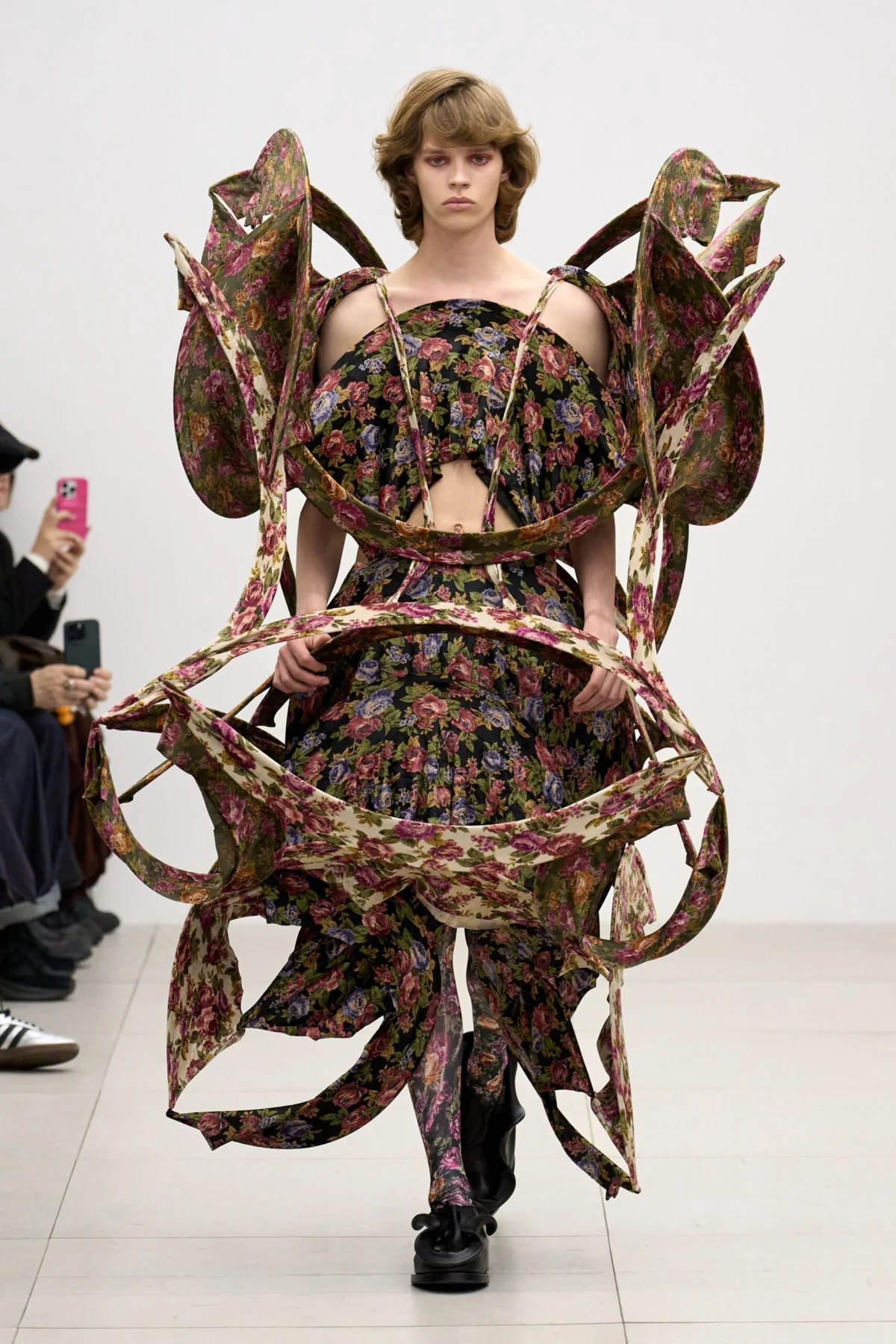
Fresh off an exhibition dedicated to his work at London’s V&A, Ryunosuke Okazaki is back on the runway, presenting a collection that marks a significant evolution in his artistic journey. The presentation, witnessed live rather than through static lookbooks and embodied by human form rather than inert mannequins, underscored the visceral, androgynous grandeur of Okazaki’s extraordinary exoskeletons. These creations, characterized by sweeping curves and sharp spikes, evoke the protective strength of armor while simultaneously conveying a profound tenderness. The alien articulation of the joints, often jutting across bare skin, serves to expose the inherent softness and fragility of the human body beneath, creating a compelling dialogue between the artificial and the organic. The interaction between the garments and the models’ limbs, which curve and wrap to become integral components of the sculpted forms, feels genuinely new, pushing the boundaries of what constitutes "wearable."
A Transition from Collector’s Item to Ready-to-Wear
For an artist whose business model has historically relied on the discerning patronage of art collectors, Okazaki has been demonstrably shifting towards more realistically wearable pieces in recent months. This season’s runway show represented a pivotal moment in this transition, signaling his first significant foray into ready-to-wear. Building upon the foundational success of his bags and shoes, which made appearances in previous collections, this latest offering introduced garments designed for broader accessibility. Notable among these were a striking green turtleneck sweater featuring removable boning at the shoulders, allowing for adjustable sculptural elements, and a daring tube dress characterized by a dramatic, scythe-like silhouette across the torso. These pieces retain Okazaki’s signature avant-garde aesthetic while incorporating elements that suggest a greater integration into daily wardrobes.
A New Language of Prints: Nature, Heritage, and Personal Transformation
The collection also unveiled a novel approach to textile prints, weaving together disparate influences to create a rich visual narrative. The introduction of python and leopard prints directly references the animal kingdom, a conscious nod to the animism and reverence for nature that permeates Okazaki’s artistic philosophy. This engagement with the primal forces of nature stands in stark contrast to, yet harmoniously complements, the heritage patterns of tweed and pinstripes that also graced the runway. These traditional fabrics, evocative of established sartorial traditions, represent a universe seemingly distant from Okazaki’s typically boundary-pushing creations.
The most profound narrative within the print repertoire, however, emerged from a floral pattern featured in the penultimate look. Okazaki revealed that this pattern was initially met with personal resistance, perceived as old-fashioned and unappealing. He described the initial feeling as "somewhat nostalgic, like the pattern on my grandmother’s futon." This sentiment, however, was not one of dismissal but rather a catalyst for deeper reflection. "There’s something very human about [florals]," he explained, "like a person trying to print nature onto something." This initial feeling of rejection, he shared, was something he consciously chose to "cherish." The transformative power of this emotional process became evident as he elaborated, "When I actually made it, it became one of my favorite pieces from this collection, and I felt that hatred could transform into life and then into love." This personal journey with the floral print mirrors the collection’s broader theme of evolving expression and the potential for profound beauty to emerge from unexpected sources.
Hiroshima’s Legacy: A Prayer for Peace Woven into the Fabric of Existence
Okazaki, who grew up in Hiroshima, imbues his work with a profound sense of purpose, often describing his creations as a prayer for peace. This season, by focusing more intently on the interplay between his designs and the human body, he has unlocked a new dimension of depth in articulating this central theme. "It’s like I moved from a transcendent, conceptual idea of prayer to something more personal; a prayer inherent in everyday life, as a way of getting closer to people," he articulated. This shift suggests a move from abstract ideals towards a tangible, embodied spirituality, where the act of creation and the experience of wearing become acts of personal devotion and connection.
The Sonic Landscape: Embodying the Spectrum of Human Emotion
The accompanying musical score for the presentation further amplified the collection’s emotional resonance, oscillating between dark, foreboding tones and moments of serene meditation. This sonic journey was directly inspired by the Japanese concept of "kidoairaku," an idiom that encapsulates the four fundamental aspects of human emotion: joy, anger, sadness, and pleasure. This deliberate choice to explore the full spectrum of human feeling underscores Okazaki’s commitment to honesty and authenticity in his artistic output. "I want to be honest about what I create," he stated. "And my expression, stemming from a prayer for peace, remains constant whether in fashion or art."
Broader Implications: Art, Fashion, and the Pursuit of Universal Understanding
The evolution of Ryunosuke Okazaki’s work from avant-garde sculptural pieces to more accessible ready-to-wear, while retaining its profound conceptual underpinnings, carries significant implications for the fashion industry and the broader art world. It demonstrates a growing trend where designers are increasingly blurring the lines between traditional artistic disciplines and commercial fashion, challenging conventional notions of what constitutes art and how it should be consumed. Okazaki’s ability to translate complex philosophical and emotional themes, such as his prayer for peace and the exploration of human emotion, into tangible garments that resonate on both an aesthetic and an intellectual level, positions him as a significant voice in contemporary design.
The V&A exhibition, dedicated to his work, served as a critical platform, solidifying his reputation within the international art community and undoubtedly paving the way for broader appreciation of his fashion endeavors. By engaging with themes of animism, nature, heritage, and personal transformation, Okazaki is not merely creating clothing; he is crafting wearable narratives that invite introspection and dialogue. His commitment to using his platform to advocate for peace, rooted in his personal history and expressed through the universal language of art and design, offers a powerful counterpoint to the often superficial concerns of the fashion cycle.
Furthermore, his personal journey of transforming "hatred" into "love" through the creative process, as exemplified by the floral print, offers a potent metaphor for overcoming adversity and finding beauty in unexpected places. This narrative of personal and artistic growth is not only inspiring but also speaks to the resilience of the human spirit, a message that resonates deeply in a world often grappling with conflict and division. In dark times, Okazaki’s cosmic talent taps into something that the four pillars of kidoairaku might not fully account for: hope. This collection, therefore, stands as a testament to the enduring power of art to transcend boundaries, foster understanding, and inspire a more peaceful and compassionate existence. The successful integration of his signature sculptural elements with more wearable silhouettes suggests a promising future where his unique vision can reach a wider audience, enriching the landscape of contemporary fashion with its depth, intention, and profound artistic integrity. The industry will be watching closely as Okazaki continues to navigate this exciting new phase, further cementing his legacy as an artist who uses fashion as a medium for profound expression and a force for positive change.
