

The winter of 1994/95 marked a distinct era in North American avalanche safety. For context, the landscape of avalanche forecasting and backcountry access was vastly different from today. At the forefront of avalanche awareness were key figures like Knox Williams, who led the Denver avalanche center, Bruce Tremper in Utah, and Mark Moore in Seattle. In Jackson Hole, Jim Kanzler directed operations, while Brad Ray managed the center at Mount Washington. The author, Karl Birkeland, was in his fifth year of operating a nascent avalanche center in Bozeman. Notably, significant backcountry regions such as the Chugach Mountains in Alaska, the Lake Tahoe area, and Mount Shasta lacked dedicated avalanche centers.
The gear and technology of the time further underscore this generational shift. The vast majority of backcountry skiers relied on telemark equipment, often with the distinctive sound of leather boots crunching on snow. Snowmobiles, while present, were significantly less powerful, agile, and lighter than their modern counterparts. Ski resorts largely maintained strict in-bounds policies, with the concept of "sidecountry"—the often-accessed terrain just beyond resort boundaries—yet to gain widespread recognition or terminology, a concept that would take another decade to become commonplace. Connectivity was also in its infancy; the internet was just beginning to permeate public consciousness, and the first rudimentary avalanche advisories were only beginning to appear online at the close of that very winter season. This provides a critical baseline against which to evaluate current trends in avalanche safety and backcountry participation.
In light of this historical context, a surprising revelation emerges: the annual number of avalanche fatalities in the United States has remained remarkably consistent since that 1994/95 winter. Over the subsequent 22 seasons, a period characterized by the ubiquitous adoption of smartphones, the pervasive influence of social media, the advent of lightweight touring (AT) gear, the dramatic increase in snowmobile capabilities, and an explosive surge in backcountry recreational use, the total number of avalanche fatalities per season has not seen a statistically significant rise. This stability is particularly noteworthy when contrasted with the exponential growth in human activity in avalanche terrain.
Further analysis reveals nuanced trends within this overall equilibrium. While overall avalanche fatalities have remained flat, the number of snowmobile-related avalanche fatalities has also shown a stable pattern over the same 22-year period. This suggests that the advancements in snowmobile technology, while increasing their reach and capability, have not translated into a proportional increase in fatalities within avalanche environments. Conversely, there is some indication that the number of fatalities among backcountry skiers and snowboarders may be experiencing a slight, albeit statistically marginal, upward trend.
Data Analysis: A Stable Fatality Landscape
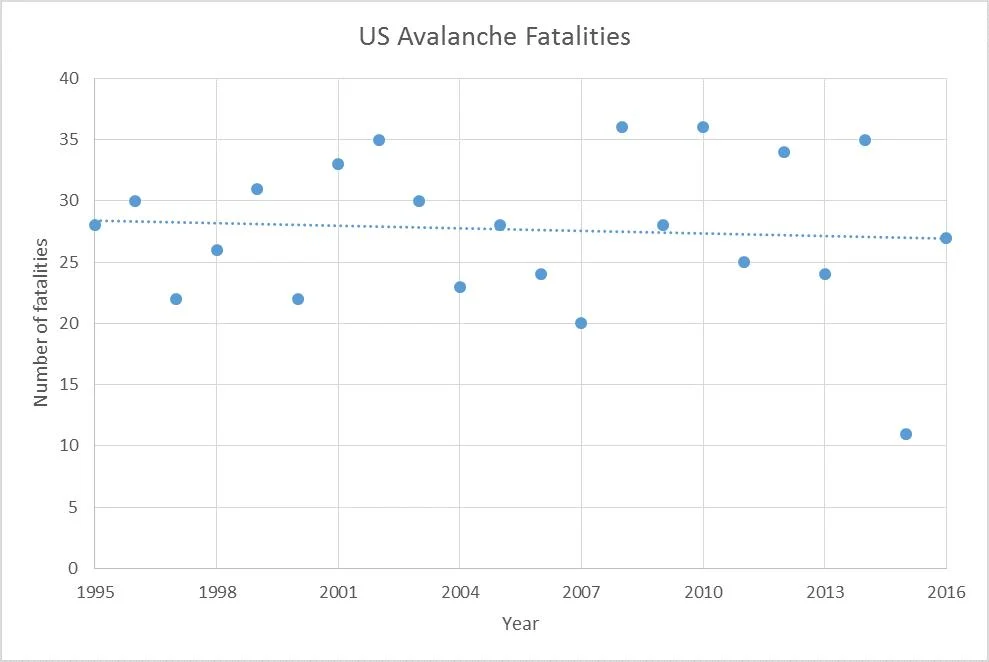
Statistical data compiled from the 1994/95 winter through the 2015/16 winter (Figure 1) demonstrates this crucial finding. A trend line fitted to the annual U.S. avalanche fatalities shows a very slight decrease, but this trend is not statistically significant (p = 0.7). This p-value indicates that the observed variation is well within the bounds of random chance, meaning there is no compelling statistical evidence to suggest a change in the overall number of avalanche fatalities over this 22-year span.
Figure 1: U.S. Avalanche Fatalities (1994/95 – 2015/16)
[Image Description: A graph depicting annual U.S. avalanche fatalities. A trend line shows a slight downward slope. The accompanying text states the trend is not statistically significant.]
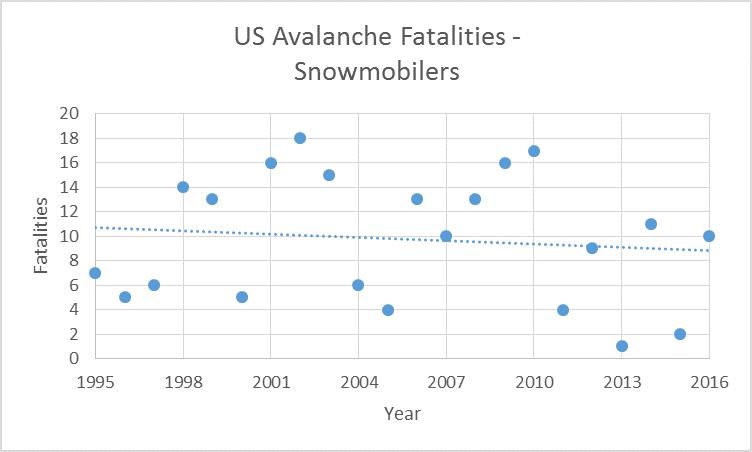
The data for snowmobile avalanche fatalities presents a similar picture of stability (Figure 2). Over the same 22-season period, the number of individuals losing their lives in snowmobile-related avalanches has also remained relatively constant. The trend line for this category also indicates a slight decrease, with a non-significant p-value (p = 0.6), reinforcing the observation that snowmobile use in avalanche terrain has not led to a commensurate rise in fatalities.
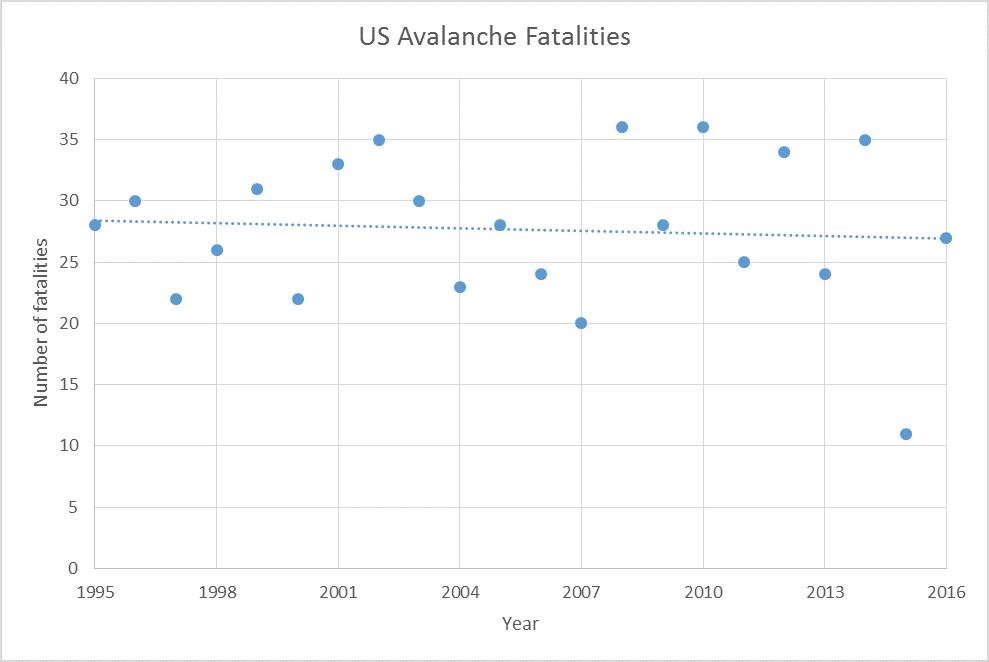
Figure 2: Snowmobile Avalanche Fatalities (1994/95 – 2015/16)
[Image Description: A graph illustrating annual snowmobile avalanche fatalities. A trend line shows a slight downward slope. The accompanying text confirms the trend is not statistically significant.]
In contrast, Figure 3, which specifically examines backcountry skier and snowboarder avalanche fatalities, shows a slightly different dynamic. While this category also appears relatively flat, there is some statistical evidence (p = 0.07) suggesting a potential for a slight increase in fatalities over the examined period. While this p-value is on the borderline of statistical significance, it warrants continued monitoring and analysis as backcountry skiing and snowboarding continue to grow in popularity.
Figure 3: Backcountry Skier and Snowboarder Avalanche Fatalities (1994/95 – 2015/16)
[Image Description: A graph illustrating annual backcountry skier and snowboarder avalanche fatalities. The trend line is largely flat with a slight upward tendency. The accompanying text notes some statistical evidence of a slight increase.]
The Unprecedented Growth of Backcountry Engagement
The constancy of avalanche fatalities becomes truly remarkable when juxtaposed with the dramatic and undeniable surge in backcountry use. While precise, quantifiable data on dispersed winter recreation is inherently challenging to obtain, proxy indicators provide compelling evidence of this growth. Avalanche advisory usage, a key metric for gauging public engagement with avalanche safety information, reveals astonishing increases across various regions.
For instance, the Utah Avalanche Center has reported a twelve-fold increase in advisory usage over the past 22 seasons. The Colorado Avalanche Information Center (CAIC) has experienced a seventeen-fold increase. The Gallatin National Forest Avalanche Center has seen an even more dramatic thirty-six-fold surge in usage, and the Northwest Avalanche Center has recorded an astounding sixty-fold increase. While these figures are undoubtedly influenced by the increased accessibility and ease of obtaining avalanche information through digital platforms, they unequivocally indicate a substantial influx of individuals venturing into avalanche-prone terrain. This surge in participation is not limited to a few isolated areas; it represents a nationwide phenomenon.
A Dramatic Decline in Fatality Rate
The implications of this growth, when considered alongside the flat fatality trend, are profound. Assuming a conservative estimate that backcountry use has increased by a factor of eight over the past 22 years, and combining this with the stable annual fatality numbers, the overall fatality rate (defined as avalanche fatalities per backcountry user day) has plummeted dramatically. This suggests that, on a per-user basis, the risk of dying in an avalanche has decreased by at least a factor of eight, and likely more.
To illustrate the significance of this decline, consider the alternative scenario: if the fatality rate had remained constant while backcountry use increased eightfold, the United States could have experienced well over 200 avalanche fatalities per winter. The fact that this grim projection has been averted is a testament to a multifaceted effort within the avalanche community.
A Collective Success Story
The sustained equilibrium in U.S. avalanche fatalities, especially against the backdrop of burgeoning backcountry participation, represents a significant achievement for the entire avalanche safety community. This success is not attributable to a single factor but rather to a confluence of dedicated efforts and advancements across various domains.
Avalanche Education: The tireless work of avalanche educators at all levels has been instrumental. This includes professionals delivering comprehensive avalanche courses, instructors providing essential "Know Before You Go" awareness presentations to a broad audience, and the continuous dissemination of vital safety information. These educational initiatives equip individuals with the knowledge and skills necessary to make informed decisions in the backcountry.
Industry Innovation: Equipment manufacturers have played a crucial role through the development of innovative and improved safety gear. This includes advancements in avalanche transceivers, the integration of technologies like the Avalung, the widespread adoption of lightweight and protective helmets, and the increasing popularity of airbag packs, which can significantly increase a buried victim’s chances of survival.
Guiding and Resort Operations: Backcountry guiding services and ski area operations that extend their services beyond resort boundaries have also contributed significantly. Their commitment to client safety, thorough risk management, and the provision of expert guidance in potentially hazardous terrain have undoubtedly saved lives.
Regional Avalanche Center Network: The network of regional avalanche centers across the United States has been a cornerstone of this success. These centers provide critical, up-to-date avalanche advisories and forecasts, enabling backcountry users to assess the prevailing avalanche conditions. Furthermore, their educational outreach programs and the dissemination of safety information empower individuals to make responsible choices. The data presented in this analysis, notably the proxy data on advisory usage, highlights the increasing reliance on and reach of these vital institutions.
The author, Karl Birkeland, emphasizes that while the goal remains to drive fatalities toward zero, acknowledging this stable trend is crucial. It signifies that the collective efforts within the avalanche community are yielding tangible results. This ongoing success story should instill a sense of pride and encourage continued dedication to enhancing avalanche safety practices and outreach.
Acknowledgements and Future Directions
The data presented in this analysis was primarily provided by the Colorado Avalanche Information Center (CAIC). The broader avalanche community owes a profound debt of gratitude to the CAIC, its dedicated personnel responsible for compiling this invaluable data, and all individuals who diligently report and document avalanche accidents. These reports are essential for learning from past events and refining safety strategies for the future. Constructive reviews and feedback from esteemed professionals such as Simon Trautman, Doug Chabot, and Spencer Logan have also been invaluable in shaping this analysis.
Looking ahead, continued research and data collection will be essential. While the overall trend is encouraging, the slight upward indication in skier and snowboarder fatalities warrants further investigation. Understanding the specific factors contributing to this potential trend, such as changes in user demographics, risk-taking behaviors, or the increasing popularity of specific types of terrain, will be critical for targeted interventions. The ongoing evolution of technology, from advanced forecasting models to improved rescue equipment, alongside sustained educational efforts, will continue to shape the future of avalanche safety. The remarkable equilibrium achieved over the past two decades serves as a powerful motivator, demonstrating that with collective commitment and innovation, significant reductions in avalanche-related harm are indeed achievable, even in the face of unprecedented growth in backcountry recreation. The continued collaboration between researchers, forecasters, educators, manufacturers, and recreationalists will be paramount in building upon this success and striving for a future with zero avalanche fatalities.
