

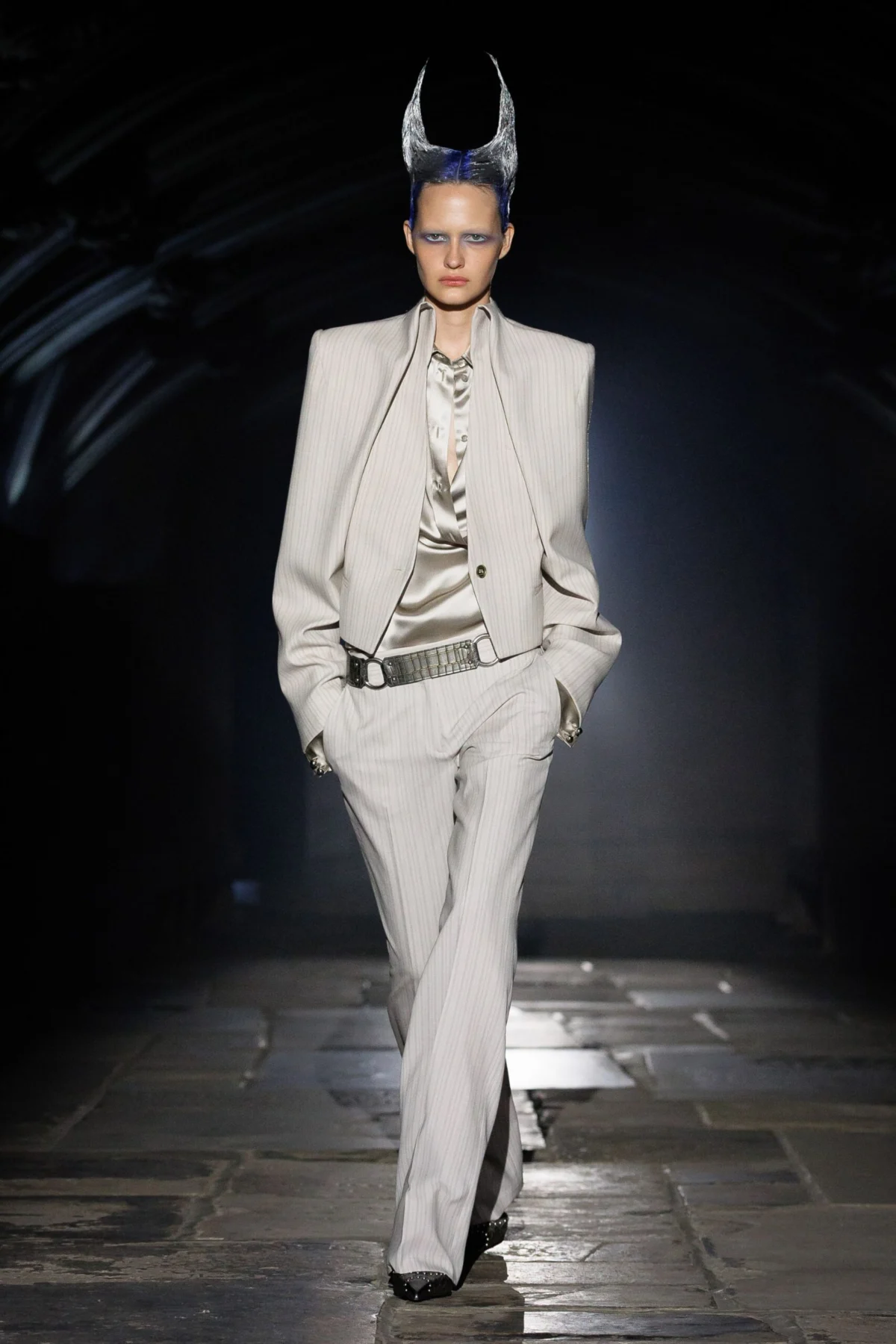
The strategic decision by Kering Group CEO Luca de Meo to orchestrate the return of the iconic Alexander McQueen brand to its foundational city, London, marks a pivotal moment in the house’s storied history. This homecoming, eschewing the established Parisian fashion calendar for the raw, vibrant energy of the British capital, underscores a deliberate embrace of the brand’s inherent identity – a fusion of exquisite craftsmanship and a beautifully chaotic spirit that is intrinsically linked to its origins. The recent runway presentation, held within the hallowed, yet evocative, Undercroft of Lincoln’s Inn Chapel, served not merely as a fashion show but as a profound reaffirmation of McQueen’s London roots, showcasing Creative Director Seán McGirr’s inaugural collection for the house in this significant setting.
A Sacred and Profane Synthesis: McGirr’s Inaugural London Statement
The choice of venue, a 17th-century chamber with a flagstone floor inscribed with the names of historical figures and a ceiling adorned with star-pattern lierne vaulting, provided a dramatic juxtaposition for McGirr’s vision. This Gothic grandeur served as a powerful backdrop for a collection that, as McGirr himself articulated, was deeply engaged with "the clashing of things." His creative impetus, he explained, revolved around articulating McQueen’s essence as a dialogue between the "neoclassically sacred and the chemically profane." This duality was powerfully evoked, drawing inspiration from the profound serenity of Piero della Francesca’s "The Baptism of Christ," a work that resonated deeply with McGirr during his early student days in London, and the electrifying, uninhibited energy of the city’s enduring rave culture.
The collection’s opening looks immediately established this thematic tension. House suiting, meticulously constructed with shoulders designed to mimic furled angel wings, were presented alongside hairstyles that deliberately evoked the iconic, dual-peaked silhouette reminiscent of Keith Flint, the late frontman of The Prodigy, a figure synonymous with the rebellious spirit of British rave culture. The tailoring itself was a testament to the enduring legacy of Huntsman, a Savile Row institution and a long-time collaborator with both the McQueen house and the late Lee McQueen himself. McGirr’s interpretation of these Huntsman creations paid homage to Tommy Nutter, a tailor celebrated as "the first rebel of Savile Row," whose radically disruptive silhouettes redefined menswear in the 20th century. This precisely fitted tailoring was further imbued with a sense of raw discipline through the incorporation of thick leather collars, a detail that served as a potent visual bridge between Nutter’s sartorial innovation and the uninhibited "off your nut" ethos – a quintessentially British idiom for a state of heightened euphoria often experienced in clubbing environments.
Juxtaposing Grandeur and Anarchy: The Fabric of the Collection
Beyond the sharp tailoring, McGirr demonstrated a masterful ability to infuse classically grand gowns with elements of stimulating anarchy. These were not merely dresses; they were statements of controlled chaos. Stimulatingly anarchic enhancements were woven into the fabric of the collection, featuring harnesses by Shaun Leane, a foundational collaborator with the house, whose work with Lee McQueen was instrumental in defining the brand’s avant-garde aesthetic. Warped shapes, rendered in stretched fabric, were strategically placed across the bodices of lacquered satin gowns, creating a visual tension that disrupted their inherent elegance. Open-backed corsets that soared above the shoulder line added another layer of dramatic flair.
The palette of the collection itself contributed to this sense of controlled disruption. Collisions of diffuse color, described as recalling "the seared-retina glitching of a night in the lights," evoked the sensory overload of urban nightlife. A particularly striking gown, meticulously crafted from interlinked, hand-embroidered metal skulls, each rendered with unique detail, served as a poignant memento mori, a visceral reminder of mortality juxtaposed against the ephemeral nature of fashion and life itself. The individuality of each skull mirrored the unique existence of every human body, a profound philosophical statement woven into textile.
Materiality and Metamorphosis: A Tactile Exploration
The materiality of McGirr’s designs further amplified the collection’s thematic explorations. Metallic leaves were artfully embellished onto garments, appearing as if randomly caught in a gust of wind, adding a touch of ethereal, yet grounded, beauty to both tailoring and dresses. The strategic use of mesh, perforated leather, and color-piped sporty knitted shorts and skirts subtly edged the collection towards the realm of authentic ravewear, acknowledging the genre’s influence on contemporary fashion aesthetics. Jacquards, a fabric often associated with opulence and tradition, were subjected to a process of deliberate deconstruction. Shadowed, overlaid, and interfered with, their decorative integrity was pushed to the brink of collapse, mirroring the collection’s overarching theme of controlled fragmentation and reassembly.
A Creative Alchemy: Embracing the Darkness, Celebrating Life
McGirr’s approach to the McQueen ethos appears to be one of profound understanding, acknowledging that "darkness has often proved creatively generative" within the house. His personal philosophy, as he articulated, is one of embracing the "dark stuff" and allowing it to inform one’s work, while simultaneously advocating for a life lived with joy: "You can talk about the dark stuff. You can let it into your work, but you shouldn’t let it into your life: you should have a good time." This sentiment perfectly encapsulates the spirit of the collection, which, despite its exploration of darker themes and rebellious aesthetics, ultimately "danced in the shadows in search of euphoria."
Historical Context and Strategic Significance
The decision to return the Alexander McQueen runway show to London represents a significant strategic move for Kering, the luxury conglomerate that owns the brand. Following the passing of Lee McQueen in 2010 and subsequent creative directors, the brand has maintained its global presence, but this homecoming signals a deliberate reconnection with its core identity. London, as a global hub for fashion innovation and a city known for its edgy, diverse, and often avant-garde creative scene, offers a fertile ground for the brand’s continued evolution. Historically, London has been the crucible for McQueen’s most groundbreaking and boundary-pushing work, from the early days of the London Fashion Week shows that defined the 1990s to the theatrical presentations that became his signature.
The choice of Lincoln’s Inn Chapel Undercroft, a venue steeped in history and intellectual gravitas, further amplifies this narrative. It grounds the brand’s future in its past, connecting the raw, rebellious spirit of McQueen with the enduring traditions of British institutions. This juxtaposition speaks to the brand’s ability to transcend time and context, to be both revolutionary and deeply rooted.
Data and Industry Reaction (Inferred and Contextual)
While specific immediate data on sales projections or immediate market reactions to this particular show are proprietary, the broader context of the luxury fashion industry provides valuable insights. The return of a heritage brand to its origin city often resonates positively with both established clientele and a new generation of consumers seeking authenticity and narrative depth. Kering’s portfolio, which includes other major luxury houses like Gucci and Saint Laurent, relies on such strategic brand storytelling to maintain market share and consumer engagement.
Industry analysts have consistently noted the growing importance of brand heritage and authentic storytelling in the current luxury market. Consumers, particularly younger demographics, are increasingly drawn to brands that can articulate a clear, compelling narrative rooted in their history and values. The McQueen homecoming, therefore, is not just a stylistic choice but a sound business strategy aimed at reinforcing brand equity and emotional connection.
Furthermore, the London fashion scene itself has been experiencing a resurgence, with a renewed focus on creativity, craftsmanship, and independent designers. The presence of a major house like Alexander McQueen, under the leadership of a new creative director, is likely to inject further energy and international attention into the city’s fashion ecosystem. This can, in turn, stimulate local talent, supply chains, and the broader creative industries.
The McGirr Era: A New Chapter
Seán McGirr’s appointment as Creative Director in October 2023 marked the beginning of a new chapter for Alexander McQueen. His previous work at JW Anderson and Loewe demonstrated a keen understanding of contemporary silhouettes and a daring approach to materials. His inaugural collection for McQueen, presented in London, has been widely interpreted as a successful interpretation of the house’s core tenets while also laying the groundwork for his individual creative voice.
The "clashing of things," as McGirr described, is a fitting metaphor for the brand itself. Alexander McQueen has always been about the beautiful tension between the sublime and the grotesque, the romantic and the rebellious, the classical and the contemporary. McGirr’s ability to synthesize these elements, drawing inspiration from both high art and subcultures, suggests a promising future for the house, one that honors its legacy while boldly forging new creative paths. The return to London is not just a geographical shift but a symbolic reassertion of the brand’s identity, a powerful statement of intent for the years to come.
