

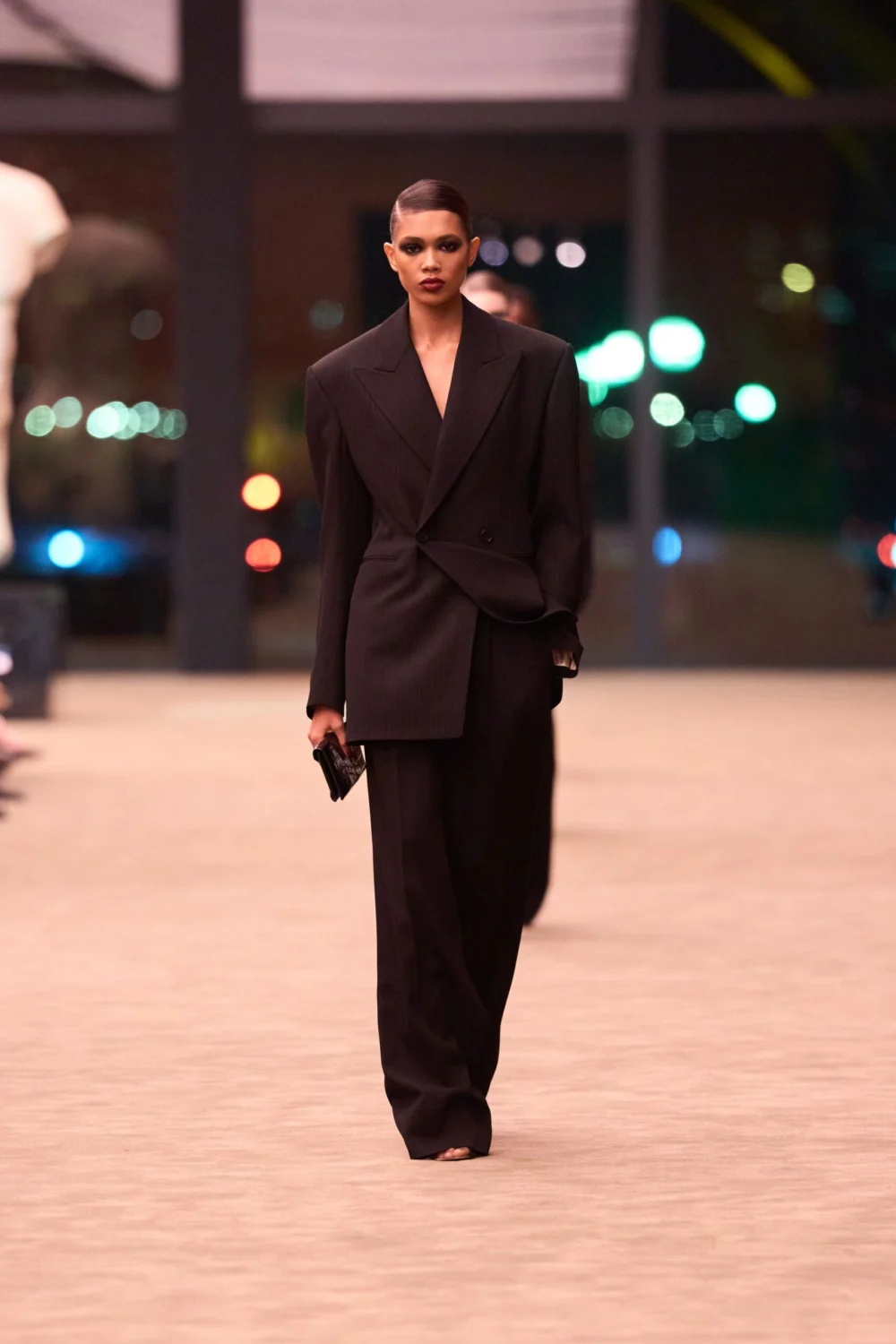
The year 2026 marks a significant milestone: the 60th anniversary of Yves Saint Laurent’s groundbreaking creation, the "Le Smoking." While the term itself might require a contemporary translation – essentially, a women’s tailored black tuxedo suit – its historical impact remains undeniable. In 1966, this garment was not merely a fashion statement; it was a catalyst for social revolution, empowering women in their pursuit of equality and challenging traditional gender norms. Anthony Vaccarello, the current creative director of Saint Laurent, paid a profound homage to this iconic silhouette at his Fall 2026 Ready-to-Wear presentation, reaffirming the brand’s rightful claim as the spiritual home of the tuxedo.
The collection, unveiled with a stark yet powerful aesthetic, underscored Vaccarello’s unwavering commitment to rigor and focus. Following a season that explored voluminous evening gowns, the designer immediately set a new tone by opening the show with eight impeccably tailored dark trouser suits. These ensembles, worn with nothing beneath, were a direct and unapologetic reference to the original Le Smoking. By the conclusion of the presentation, a total of fourteen such looks had graced the runway, solidifying the tuxedo’s central role in the collection’s narrative.
Vaccarello’s approach to the modern tuxedo was characterized by a masterful understanding of fluidity and form. He revealed backstage that he had drawn inspiration from the sloping shoulder lines of his recent men’s tailoring, adapting them to create garments that were both structured and sensually unlined for the female form. This meticulous attention to detail extended beyond the garments themselves, influencing the entire presentation. The models’ hair was uniformly styled with a severe side part, slicked back into a tight bun, a look that perfectly complemented the makeup artistry by Pat McGrath. McGrath’s interpretation featured a signature smoky eyeshadow, sharp cheekbone contouring, and a deep, glossy dark red lip, an accurate evocation of the iconic Saint Laurent makeup as immortalized in Helmut Newton’s photography and the brand’s advertising campaigns of the 1970s and 1980s. This cohesive vision created a powerful, almost historical, resonance, transporting the audience back to an era of daring self-expression and undeniable allure.
Beyond the celebrated tuxedo, Vaccarello presented a compelling counterpoint to the Le Smoking’s sartorial elegance: a series of fetish-inspired, decadent creations that pushed the boundaries of contemporary sensuality. This included an extended sequence of silicone-covered lingerie lace body-dresses, offering a provocative and daring interpretation of feminine form. Interspersed with these were two high-shine rubber raincoats, adding a dystopian yet undeniably chic element to the collection. This bold juxtaposition of materials and silhouettes resonated with a broader fashion discourse, echoing sentiments expressed by designers like Demna at Gucci in Milan, suggesting a significant return of overt sexuality to the fashion agenda. Furthermore, it implicitly championed a singular, powerful body type, a theme that is increasingly being explored and debated within the industry.
The Enduring Legacy of Le Smoking
The introduction of Le Smoking in 1966 was a pivotal moment in fashion history. Prior to its arrival, women’s formalwear was largely confined to dresses and skirts. Yves Saint Laurent, a visionary designer who consistently challenged societal expectations, recognized the growing desire among women for clothing that mirrored the power and authority traditionally associated with menswear. Le Smoking, a direct adaptation of the men’s tuxedo, offered a radical alternative. It was not merely a garment; it was a symbol of liberation, a declaration of independence, and a powerful tool for women to assert their presence in spaces previously dominated by men. The initial reception was mixed, with some viewing it as scandalous, while others recognized its revolutionary potential. However, over time, Le Smoking became an indispensable part of the modern woman’s wardrobe, a testament to its timeless design and enduring cultural significance.

Anthony Vaccarello’s Interpretation: A Modern Homage
Anthony Vaccarello, known for his signature blend of sharp tailoring, dark sensuality, and rock-and-roll edge, has consistently demonstrated a deep understanding of the Saint Laurent heritage. In his Fall 2026 collection, he delved into the brand’s archives, not to replicate the past, but to reinterpret its most iconic elements for a contemporary audience. The extensive use of the tuxedo silhouette was a clear and deliberate tribute to Yves Saint Laurent’s pioneering spirit. Vaccarello’s genius lies in his ability to infuse these classic designs with a modern sensibility. By focusing on the fluidity of the fabric, the precision of the cut, and the subtle yet impactful details of the styling, he created a collection that felt both historically relevant and undeniably of the moment.
The decision to pair the tuxedo suits with nothing underneath was a bold statement, amplifying the inherent sensuality and confidence associated with the garment. This choice speaks to a contemporary understanding of female empowerment, where embracing one’s sexuality is not seen as a compromise of power, but rather an integral part of it. The collection’s limited color palette, dominated by black and punctuated by the starkness of the silicone and rubber elements, further emphasized Vaccarello’s minimalist yet impactful aesthetic.
Supporting Data and Industry Context
The fashion industry has witnessed a significant resurgence in tailoring and power dressing in recent seasons. Data from fashion analytics firms indicates a growing consumer demand for well-constructed, versatile pieces that can transition from professional settings to evening wear. The "quiet luxury" trend, while evolving, has paved the way for a renewed appreciation for craftsmanship and timeless silhouettes. Furthermore, the increasing visibility of female leaders and entrepreneurs in various fields has naturally translated into a demand for fashion that reflects this authority and confidence. Vaccarello’s collection directly taps into this trend, offering a sophisticated yet provocative interpretation of power dressing.
The emphasis on a singular body type, as observed in the collection’s presentation, also reflects a broader conversation within the fashion world. While inclusivity remains a paramount concern, designers are increasingly exploring how to present a strong, unified vision that speaks to a particular aesthetic ideal. Vaccarello’s approach, while potentially divisive, is undeniably in line with the brand’s historical association with a certain kind of aspirational glamour.
Chronology of Influence
- 1966: Yves Saint Laurent introduces "Le Smoking," a women’s tuxedo suit, revolutionizing womenswear.
- 1970s-1980s: Le Smoking becomes a symbol of female empowerment and is frequently featured in iconic photography by Helmut Newton and in brand advertising.
- Late 20th Century – Early 21st Century: Numerous designers incorporate elements of the tuxedo into their collections, but Saint Laurent remains its definitive home.
- 2010s: A renewed interest in minimalist and androgynous fashion leads to a resurgence of tailored silhouettes.
- 2020s: Anthony Vaccarello at Saint Laurent consistently explores the brand’s heritage, with a particular focus on iconic pieces like Le Smoking, reinterpreting them for a modern era.
- Fall 2026: Vaccarello’s collection explicitly celebrates the 60th anniversary of Le Smoking, showcasing its enduring power and relevance.
Broader Impact and Implications
Anthony Vaccarello’s Fall 2026 collection for Saint Laurent is more than just a series of beautifully crafted garments; it is a cultural statement. By revisiting and reinterpreting Le Smoking, Vaccarello not only pays homage to Yves Saint Laurent’s revolutionary vision but also reaffirms the enduring power of fashion as a tool for self-expression and social change. The collection’s bold aesthetic, its embrace of sensuality, and its confident assertion of a singular vision are likely to influence trends in tailoring, evening wear, and the broader conversation around body image and female empowerment in fashion.
The collection’s success will likely be measured not only in sales figures but also in its ability to spark dialogue and inspire a new generation of women to embrace the power and confidence embodied by the timeless Le Smoking. It serves as a potent reminder that true style transcends fleeting trends, rooted in heritage, innovation, and an unwavering understanding of the modern woman’s aspirations. The legacy of Yves Saint Laurent, as reinterpreted by Anthony Vaccarello, continues to define the essence of Parisian chic and unapologetic self-assuredness.
