

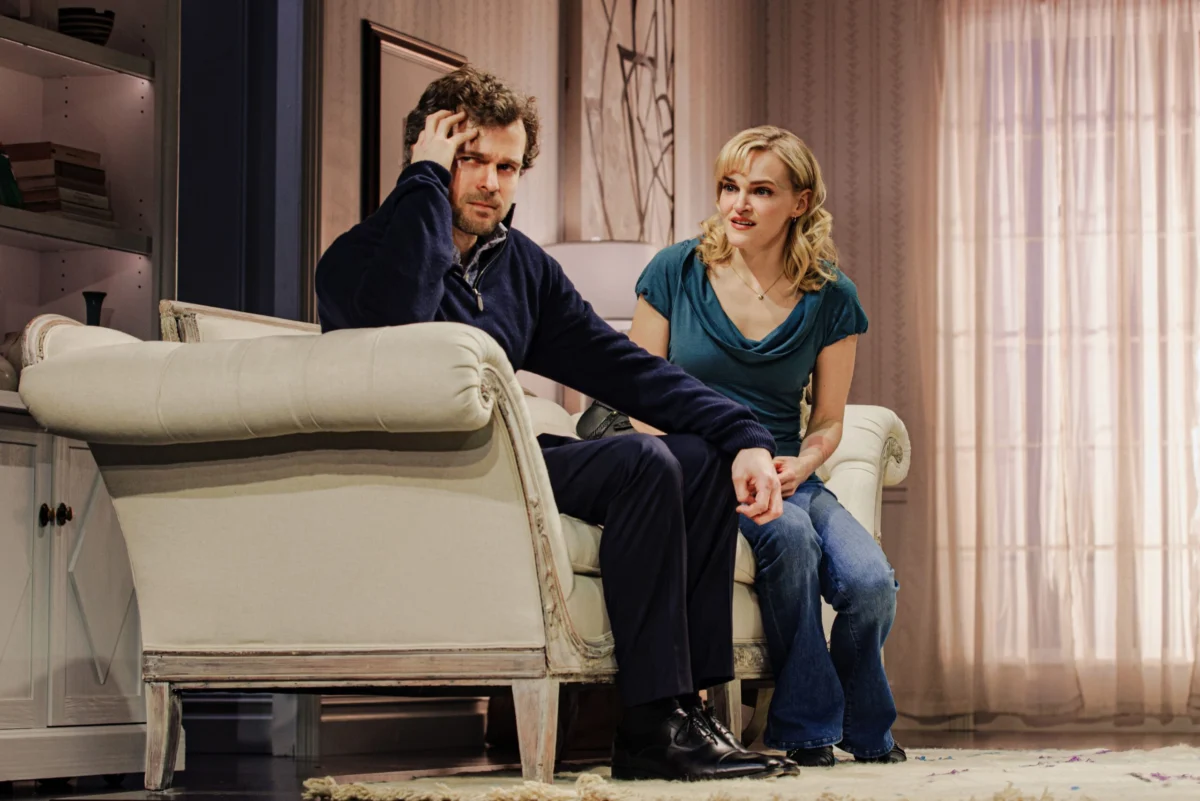
“I’m terrible,” playwright Gina Gionfriddo admits, a wry smile playing on her lips as she reflects on her often-provocative sense of humor. “I made a joke [to my daughter] once about leaving the door open and letting the murderers come in and kill us all. I have to watch it.” While her domestic audience may occasionally flinch, this sharp, unflinching wit is the very engine that drives Gionfriddo’s celebrated play, Becky Shaw. This acid-tongued comedy, a finalist for the 2009 Pulitzer Prize for Drama, has returned to the Broadway stage eighteen years after its premiere at the Humana Festival of New American Plays. Now captivating audiences at Second Stage’s Helen Hayes Theatre, the limited-run revival, masterfully directed by Trip Cullman, opened to widespread critical acclaim on April 6th, reaffirming its status as a potent and prescient exploration of contemporary relationships and ethics.
The narrative centers on the titular Becky Shaw, portrayed with a compelling blend of desperation and shrewdness by Madeline Brewer. At 35, Becky finds her life unraveling under the weight of a series of disastrous romantic entanglements. Her pragmatic, albeit morally flexible, solution? To "marry up." In her quest to course-correct, she sets her sights on the snarky, financially adept Max, a blind date disastrously orchestrated by her well-meaning but misguided coworker, Andrew (played by Patrick Ball). The ripple effects of Becky’s ambitious pursuit are far-reaching, ensnaring everyone in her immediate orbit – including Andrew’s wife, Suzanna (Lauren Patten), and Suzanna’s mother, Susan (Linda Edmond) – in a whirlwind of escalating pandemonium.
Gionfriddo has openly acknowledged that aspects of Becky Shaw were loosely inspired by William Makepeace Thackeray’s classic novel, Vanity Fair. The titular character in Thackeray’s work, Becky Sharp, is depicted as unapologetically and “super, super out there and blunt about trying to marry into a higher class.” Gionfriddo was particularly drawn to the contemporary relevance of exploring what such mercenary aspirations might look like for a 21st-century woman navigating a complex social and economic landscape. The play, in its incisive examination of hypergamy, delves into themes that resonate deeply with modern audiences: the societal pressures to achieve upward mobility, the often-unseen costs of personal ambition, and the blurred lines of responsibility in an increasingly interconnected yet seemingly isolating world.
A Tapestry of Modern Anxieties
Beyond its central premise of romantic ambition, Becky Shaw weaves a complex tapestry of modern anxieties. The play fearlessly tackles subjects ranging from the audacity of ex-baristas harboring savior complexes to the insidious nature of narcissistic mothers, the practicalities of mail fraud, the unsettling implications of coitus between quasi-siblings, and the stark reality of robbery at gunpoint. Through this confluence of dramatic and darkly comedic elements, Gionfriddo poses profound and often arduous questions that lie at the heart of the human experience: What does it truly mean to lead a virtuous life? Can we ever fully comprehend the motivations and inner lives of those we love? And what obligations, if any, do we owe to strangers? These are not abstract philosophical debates; they are the very questions that inform the characters’ actions and the audience’s contemplation long after the curtain falls.

From Crime Dramas to the Stage: Gionfriddo’s Journey
Gina Gionfriddo’s career has often found her immersed in the gritty realities of crime-related television series. Her impressive writing credits include extensive work on the Law & Order universe, FBI: Most Wanted, and House of Cards, showcasing her adeptness at crafting compelling narratives within complex, often morally compromised, worlds. This background undoubtedly informs the sharp dialogue and the nuanced exploration of human fallibility present in her theatrical work.
Coincidentally, Gionfriddo was in her Upper West Side home when Becky Shaw began its production process, a fortunate alignment that allowed her to be “very, very involved” in the creative endeavor. She attended the majority of the three weeks of rehearsals and was instrumental in approving casting decisions. This intimate involvement provided her with a unique vantage point on the production’s evolution and the actors’ engagement with the material.
Navigating the Unlikable: Casting and Audience Reception
The casting process, as Gionfriddo notes, presented a particular challenge. “Actors doing this play really have to be okay not being liked,” she muses. “And there certainly were actors who read the script who were not okay with that.” The play’s characters, particularly Becky, are not designed for easy audience identification or immediate affection. They are flawed, often self-serving, and their actions frequently push ethical boundaries. This deliberate choice forces audiences to confront uncomfortable truths about human nature and societal pressures.
A palpable concern during rehearsals was how theatergoers would respond to some of the show’s more audacious and “nasty” jokes. “I think we were all a bit worried about audiences maybe recoiling from the nastiness of some of the humor,” Gionfriddo admits. “And that hasn’t proven to be the case, which is a great relief.” This reception, she posits, could be attributed to the current global climate, where the sheer volume of societal challenges might render a dose of theatrical coarseness less jarring. Alternatively, it might simply be a testament to the play’s undeniable comedic power. As Gionfriddo wryly observes, “That, or Becky Shaw is just really fucking funny.”
The Evolution of a Humorist: Pain and Resilience
While Gionfriddo’s most celebrated plays, including After Ashley and Rapture, Blister, Burn, have consistently been lauded as dark comedies, she did not always identify as a humorist. “I don’t think I would ever have said I was a comic writer, that I was funny, until college, which is when things sort of got hard for me,” she reveals. Her artistic journey has been profoundly influenced by the work of gay playwrights who navigated the AIDS crisis. “I just love that their humor was so dark… I think there is a certain kind of humorist I respond to who is sort of cracking jokes to keep despair at bay.” This perspective sheds light on the cathartic function of humor in her writing, a tool used not to trivialize suffering, but to confront it with a bracing honesty.

Pain, indeed, is a recurring and central theme in Becky Shaw. A pivotal scene features Suzanna confronting Max about his tendency to tune out the suffering of others when it becomes inconvenient. Max’s defense is a stark articulation of personal responsibility: “Unless you’re Gandhi or Jesus, you have a limited sphere of responsibility,” he retorts. “You have a plot of land and the definition of a moral life is tending that plot of land.”
Gionfriddo readily identifies the inhabitants of her own “plot of land”: “obviously first my child, then my brother, my close friends.” However, the question of her broader obligations to the world at large continues to weigh on her. When Becky Shaw first premiered in 2008, the Iraq War served as a prominent backdrop for moral debates. Today, the world faces a multitude of equally pressing global crises, from environmental concerns to geopolitical instability. “There’s a lot of dialogue [asking] how are we all going about our lives when we’re threatening to decimate Iran?” Gionfriddo reflects. “And there is a part of me that, like Max, is sort of like, I have a kid to raise. I need to pay my mortgage… And what would I do anyway? But the other side of that is nothing changes if we all take that attitude.” This internal conflict, mirroring the characters’ own moral quandaries, underscores the play’s enduring relevance.
Ambiguity as the Unvarnished Truth
Ultimately, Becky Shaw resists providing easy answers. The play resides in a murky, often slightly uncomfortable, zone of moral ambiguity. A neat, didactic ending would feel disingenuous to the complexities it explores. Instead, the characters take the stage, pose their questions, articulate their contradictory viewpoints, make their choices, and engage in further argument before the lights dim. The scripted drama may conclude, but the implications linger. It is highly probable that Becky, Max, Suzanna, Andrew, and Susan are still out there, making questionable decisions, navigating the treacherous currents of love, inadvertently inflicting damage, and continuing their individual journeys. This open-endedness is not a failure of narrative resolution but a deliberate artistic choice, reflecting the messy, ongoing nature of human experience. The revival’s success on Broadway, nearly two decades after its initial debut, serves as a powerful testament to Gina Gionfriddo’s enduring insight into the human condition and her remarkable ability to translate its complexities into compelling, unforgettable theater.
