

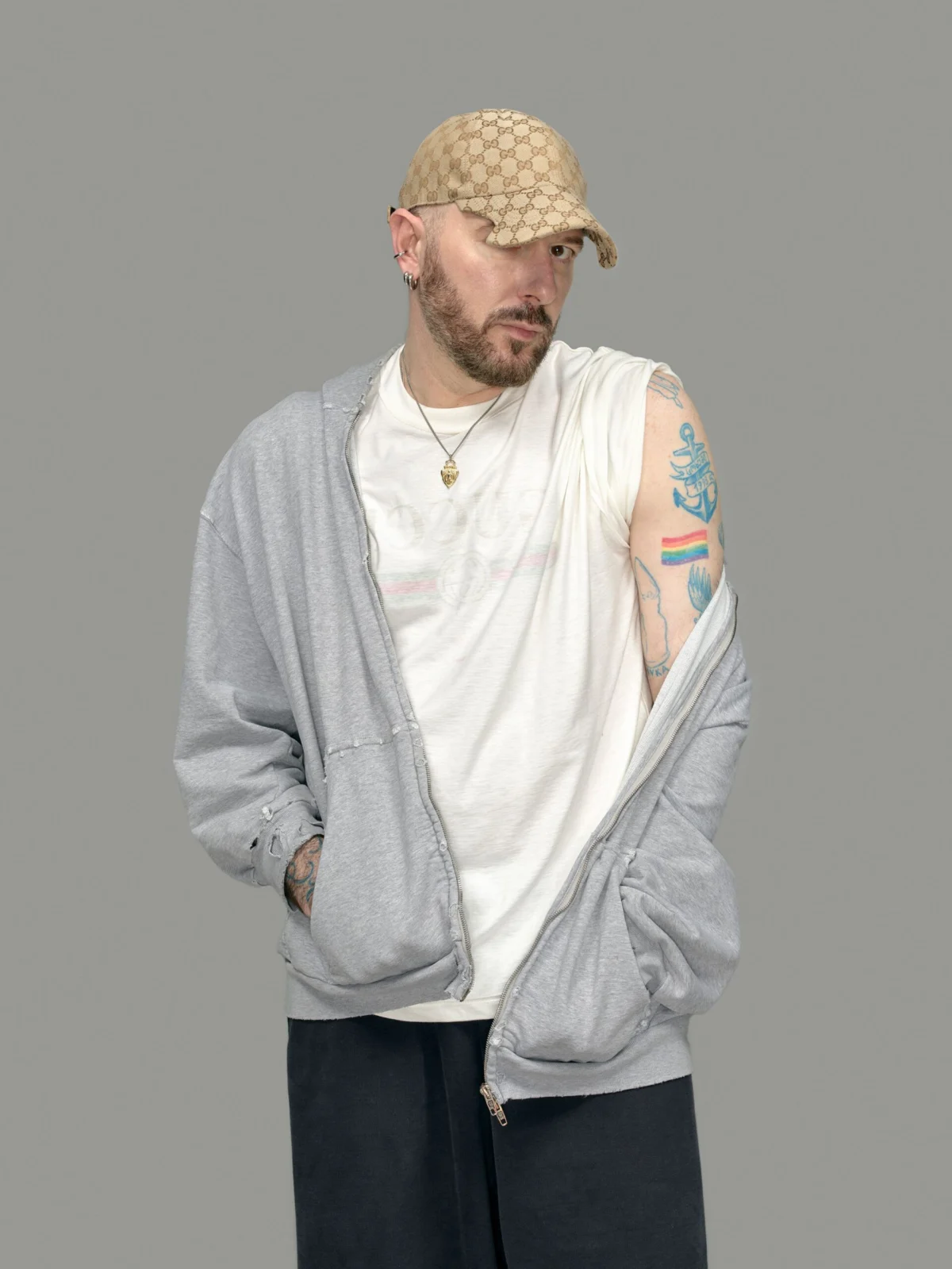
On a crisp February morning in Milan, just a day before a pivotal show, Demna, the artistic director of Gucci, navigated his offices with an almost unnerving calm. The man who once redefined French fashion as a leading iconoclast now helms one of the world’s most storied luxury houses. "Obviously, I’m a bit stressed—but I feel good," he remarked, his gaze sweeping across a studio adorned with his signature aesthetic. Leather sofas nestled against expansive windows, and vibrant patchwork curtains by artist Pia Camil adorned the walls. It was a scene that echoed the transformation Gucci had undergone since its relocation to these industrial buildings on Via Mecenate a decade prior. Under its previous leadership, the brand had successfully reasserted its image as the "Italian sports car of fashion"—a streamlined, powerful vehicle with an audacious spirit, an image that had deeply embedded itself in popular culture. Demna shared an anecdote that highlighted this cultural resonance: "My cousin, who is 16 and spends her life on Roblox, heard that I was going to Gucci and was like, ‘Do you know Gucci is a word we use a lot to describe a certain state of mind? If you feel Gucci, it means you want to be crazy and meet people and be out there.’" He smiled, articulating his immediate ambition: "I want to make people feel Gucci tomorrow."
Demna Gvasalia, born in Georgia and known professionally by his first name since his ascendant years at Balenciaga, is now 45. This is an age where many designers find their mature creative voice. However, Demna’s distinct perspective had been fully formed much earlier, in 2014, when he co-founded Vetements. Mere months later, his appointment as artistic director of Balenciaga catapulted him to a new level of influence. "It made him the most influential designer of the decade," states Alexandre Samson, a fashion historian and curator at the Palais Galliera in Paris. "He created characters that were very clear and reflective of an Eastern, post-USSR youth culture with no money, which looked to, admired, and despised the Western world." Demna astutely recognized that this complex ambivalence, a blend of desire and criticism, could resonate deeply within the social-media-dominated landscapes of the West. Samson further elaborated, "It was a very strong take, mixing logo mania with deconstructive patternmaking skills and sportswear." This approach, intensely personal, has remained a consistent thread throughout his subsequent reinterpretations of established brands.
In his Milan studio, Demna’s personal style was on full display: loose black Adidas trousers, a black T-shirt emblazoned with the logo of the heavy metal band Slipknot, and black Gucci mules. This ensemble exemplified the voluminous, relaxed silhouette he championed. In his youth, within the context of bourgeois Europe, his distinctive style was often perceived as a provocation, leading to instances of being chased from establishments and having food thrown at him. Today, that very aesthetic has become a foundational element of mainstream luxury fashion.
A Legacy of Disruption and Redefinition
Demna’s arrival at Gucci in the summer, following a decade at the helm of Balenciaga, was met with a palpable sense of anticipation, akin to a seasoned captain taking the reins of a grand vessel. The brand had experienced a period of flux, and Demna’s appointment signaled a potential resurgence. "He has this complete I-don’t-give-a-fuck-ness about what he does, and he knows how to garner attention, how to make a moment," comments model and influencer Vivian Wilson. "He has a very good tap on the cultural conscience." Kim Kardashian, a long-time friend and muse of Demna’s, echoed this sentiment: "He designs what he wants. He’s just so unapologetically himself."

The primary question lingered: could Demna’s distinctive approach to garnering attention translate effectively to a brand of Gucci’s scale and mainstream appeal? As the flagship of the Kering luxury conglomerate, Gucci had become a critical indicator of the industry’s health, especially amidst a year marked by economic downturns. The brand’s financial performance was so intrinsically linked to Kering’s success that its CEO confessed to limiting her daily perusal of global sales figures. Luca de Meo, Kering’s CEO, acknowledged the significant responsibility: "The team has a big responsibility, because they are handling a mega brand. Handle with care!" Demna, a graduate of the Antwerp fashion school’s conceptualist tradition, was known for his sharp irony and penchant for provocation. His early Vetements collections, for instance, featured items like yellow dishwashing gloves. The inherent risk was that this restless, avant-garde style might buckle under the weight of Gucci’s global success.
However, in a surprising revelation during our studio visit, Demna stated that since his arrival, he had consciously moved away from pure conceptualism towards a more immediate and sensual design philosophy. "Gucci is a very pragmatic brand, and it’s about product. It’s liberating not to have to conceptualize a dress just to make a dress that you love," he explained. "This is how fashion should be: more intuitive and emotional—either ‘I hate it’ or ‘I love it.’" His inaugural collection for Gucci, "La Famiglia," was presented as a film, exploring the brand’s core archetypes through the lens of its 1970s aesthetic. His subsequent pre-fall collection paid homage to the alluring and sophisticated styles that defined the house in the 1990s under Tom Ford.
A New Sensuality for a Heritage House
The collection Demna was preparing to unveil was envisioned as a reflection of Gucci in the present day. It represented his personal vision, aligning him with a new generation of Belgian conceptualists, including Matthieu Blazy and Pieter Mulier, who have found a fresh sensuality within established heritage brands. Early indicators suggested a positive reception, with store traffic reportedly increasing following the release of his initial capsule collection. Demna showcased an example from the rack destined for the runway: coats that mimicked the appearance of fur but were crafted from shearling, a common agricultural byproduct. These were expertly trimmed on the bias and stitched with muslin, resulting in a garment that felt as light as a windbreaker.
Demna now places paramount importance on lightness and speed. Upon joining Gucci, he discovered that all prototypes were being produced off-site. One of his immediate priorities was to establish an on-site Gucci atelier, facilitating quicker, more industrialized garment creation and allowing for immediate, hands-on design adjustments rather than relying solely on paper drafts.
He also demonstrated how classic Gucci handbags had been rendered lighter and more supple. Two exquisite dresses on mannequins—one featuring the classic Gucci pattern in purple, the other in shimmering gold sequins—were also highlighted. Beyond these curated displays, the studio itself presented a striking sense of spaciousness, as if it too had undergone a regimen of de-cluttering. Demna seemed to acknowledge this perceived emptiness with a playful smile, stating, "I don’t want to show you too many things. I want the show to be a surprise."

Many observers trace Demna’s unique design sensibility, if not his exact stylistic approach, to his four-year tenure at Maison Martin Margiela early in his career, where he oversaw the women’s ready-to-wear collections. "He absolutely understood the process and the way of thinking behind the whole brand: the idea of repurposing," notes Samson, referencing Margiela’s renowned practice of using vintage pieces as a foundation, a technique mirrored by Demna. "And the idea, also, of playing with society." At Vetements, Demna applied these principles to his own distinctive style, creating hoodies with exaggerated shoulders and oversized jackets. As a self-conscious young man, he had initially adopted oversized clothing as a form of self-concealment. Later, he began to reshape the conventional human form into new and striking silhouettes, achieving remarkable effects. "At the time, there was really nothing else happening in Paris," recalls Julien Charrier, who began as an intern at Vetements in 2016 and now serves as Demna’s chief of staff. "He was bringing something that was completely out of the box, very fresh, very young, very street-culture." Within a year, his designs were being worn—or emulated—by prominent figures like Jared Leto and Ye (formerly Kanye West). "He was always just so cool," says Kardashian, who met Demna shortly after Vetements launched, even before a physical store existed, and spent hours trying on pieces in a Paris warehouse late at night.
Navigating Controversy and Crafting Identity
Demna’s inaugural show at Balenciaga in 2016 marked a significant turning point. While continuing to design for both brands for several years, he introduced hits like the chunky Triple S sneaker and the wide-collar Swing shirt. His collections also began to engage with geopolitical themes. In March 2022, in response to the outbreak of the Russia-Ukraine war, his Balenciaga show featured models walking through a simulated snowstorm, with the color palette of yellow and blue prominently displayed. Within three years of his appointment, Balenciaga’s revenue had doubled, surpassing the billion-dollar mark. In 2019, The Washington Post recognized Demna for "changing what we consider fashion."
During an earlier meeting in late 2022, Demna described his life in Switzerland, seeking refuge from the perceived distractions and claustrophobia of Paris. He lived remotely, immersing himself in nature, an experience that fueled his plans to relaunch Balenciaga’s couture operations and explore the human body in new, poetic ways. "I’m no longer on the dark side of the world," he had stated at the time.
However, the tranquility was short-lived. The COVID-19 pandemic brought the world to a standstill, and Demna’s couture debut was postponed. Simultaneously, Balenciaga faced increasing scrutiny for its provocative imagery. In 2022, the brand severed ties with Ye after his widely criticized antisemitic social media posts. Shortly thereafter, Balenciaga and Demna found themselves at the center of a public outcry following an advertising campaign that featured children holding teddy bear bags, which many interpreted as suggestive of BDSM themes. Further examination of another campaign for a spring 2023 collection, which depicted a desk cluttered with papers, revealed what appeared to be a page from a Supreme Court case concerning child pornography.
The repercussions were substantial. Close celebrity associates, including Kim Kardashian, re-evaluated their relationships with the brand. Kardashian clarified, "That was never an issue with him. Once we did an investigation and we saw where things happened, we were comfortable moving forward." Demna issued a public apology, stating, "It was inappropriate to have kids promote objects that had nothing to do with them. As much as I would sometimes like to provoke a thought through my work, I would NEVER have an intention to do that with such an awful subject as child abuse that I condemn."

Addressing the role of provocation in his work, Demna stated, "Provocation is like humor, and humor cannot be stupid. It involves a kind of nuance. Provocation is stupid when you’re the only person laughing."
Demna eventually decided to leave his secluded life in Switzerland. "After a while, I got so bored there," he admitted. "Boredom is such a scary and tricky thing for a creative person—I always want to discover new things." He and his husband, Loïk Gomez, relocated to Geneva, and later found themselves drawn back to Paris, though still feeling a sense of restlessness. "I love Paris, but it only works as a long-distance relationship for me," Demna explained. "I lived there for 15 years, which is the longest I’ve been in one place in my life. But I didn’t like what fashion started to become while I was living in Paris full-time: safe, boring, beige, wannabe bourgeois, flat, superficial—all the things fashion shouldn’t be." This led them to seek a secondary residence in Los Angeles, a city where Demna had proposed to Gomez and long dreamed of living. They purchased a 1950s bungalow, integrating into the local scene and finding that Demna maintained a more active social life in California than in Europe.
"It’s radically different, culturally speaking," he observed. "Modernity is there. It’s not for no reason that Silicon Valley happened in California: There’s something about feeling more free in your head about how we do stuff, how we dress, how we express ourselves. In Europe it’s much more conservative."
Upon accepting the role at Gucci, Demna moved from Paris to Milan, noting its distinct industrial approach to fashion, which he admired. He maintained Los Angeles as his secondary base. "People always say, ‘Oh, I get why you’re there—you want to be far from fashion,’" he remarked. "I’m like, ‘Actually, no—there I’m really in the epicenter of thinking behind how we use fashion.’ Whereas in Italy, what I have is the product, the heritage, the history, the manufacturing—all those things that don’t exist in LA." He concluded, "It’s a pretty good balance. Gucci needs both."
The Gucci Renaissance: From History to "GucciCore"
Demna’s journey into the heart of Gucci began with an intensive period of research. "I didn’t know so much about Gucci—I knew the movie, you know?" he confessed. "I knew Alessandro, and I knew—Tom Ford from fashion TV when I was, like, 13… but to understand the brand, I had to know what Gucci stood for outside of those three things." His clandestine visits to the Gucci archive in Florence proved transformative. "I saw the whole world," he recalled. "Homeware. Chairs. Umbrellas. A roulette wheel. And on top of that, the most incredible collections. I was seduced."

He proposed to Kering’s president and CEO, Francesca Bellettini, that he compile a presentation to articulate his vision. "I need to convince you and myself that we can do this," he told her. During the holidays in Los Angeles, he finalized his proposal. "On the day I finished, I showed it to my husband," he recounted, referring to Gomez as his "fashion therapist."
Gomez’s reaction was pivotal: "’It gives me a FOMO feeling—I want to be that or I want to have it.’" This resonated deeply with Demna. "I was like, that’s what my vision of Gucci is—creating this FOMO," he explained. "The chic, the elegance, the Italian-ness of it. The dolce vita, but in a nonchalant way. There’s a bit of humor to it, but it’s not sarcastic. It’s a fun thing, quite punk, in a way—like, ‘I like myself, and I don’t care what other people think.’ There’s something daring about it—it’s flamboyant. It’s confident. You know who you are."
This vision was solidified just as the Los Angeles fires began. Demna evacuated with only his passport and laptop, his presentation lost. He sent his proposal to Kering, stating, "This is my vision… And if they don’t like it, I might as well know that now." Bellettini understood his perspective, recognizing the unique liberation that came from a brand not historically rooted in a singular couture maison, unlike competitors who are perpetually compared to their founders. François-Henri Pinault, Kering’s chairman, subjected Demna to rigorous questioning, but Demna’s precise answers ultimately secured his appointment.
The Show Must Go On: Times Square and the "GucciCore" Aesthetic
Demna’s creative process often begins with a disciplined, unhurried morning routine, a practice he attributes to his time working with Marc Jacobs at Louis Vuitton over a decade prior. In Milan, his mornings are dedicated to personal rituals: coffee and a smoothie with Gomez, meditation, and walks with their two Chihuahuas. "We talk about stuff that isn’t fashion," he noted. "I want to have this moment which is about my family, my husband, and me. And us as a couple. And our life."
By noon, he transitions to his office, typically working through to 8 p.m. with minimal breaks. "It’s intense, but I love it, because when I’m in the flow of working, I’m quite fast in making decisions," he said. "We manage a lot for a brand this size in one day." Evenings are spent cooking with Gomez, navigating their respective dietary preferences (gluten-free for Gomez, vegan for Demna). While they dine out frequently in Los Angeles, their Milan evenings are structured around this "ritual." "We cook, we watch stand-up comedy on YouTube, listen to music," he described. Their social life in Milan is intentionally limited, with dinners out occurring at most once a week, often after a leisurely walk through the city. "I don’t really have a lot of social life in Milan," he admitted. "I’m always going to be this rebellious person, but now I live this Gucci life professionally." His rebellion, he acknowledged, had taken on a more sophisticated, bourgeois dimension.

During a two-week stay in New York City, preparing for the Gucci cruise collection show in Times Square, Demna elaborated on his creative research. "I’ll go to vintage stores, bookstores. See some art, get some cultural impact," he stated. This process involves gathering visual references for his collections and acquiring vintage pieces that serve as physical canvases, providing "raw material" for his design manipulations. "It’s very hard sometimes to start making a jacket from scratch, especially when it comes to tailoring and shapes," he explained. "I need to have material that has good details and good proportions that I can cut and Frankenstein into the shapes I want to get to."
Shape has been a central focus for his September collection. After meticulously understanding Gucci’s heritage through its various eras, from "La Famiglia" to the sensual, Tom Ford-inspired club styles of his first Milan show, Demna felt prepared to present a vision that honored the house’s history while distinctly bearing his signature. This translates into the creation of new silhouettes—specific configurations of form, proportion, and mood that will be instantly recognizable as his interpretation of the brand, much like the iconic Chanel jacket or the Dior hourglass dress.
"Personally, I’m in need of a defined Gucci silhouette, and in September I will dare myself to show it," he declared, signaling for another kombucha. "It’s about centimeters, it really is. It’s about proportion. And I want to do something that also I haven’t done before, which… limits the possibilities."
He began by defining the desired mood: "What is the feeling I want to give so a person can be like, ‘I feel Gucci’?" In collaboration with Gomez, he enumerated the qualities he wanted his new Gucci silhouette to project: "Sharp, Confident, Chic, Bold, Rich, Eccentric, Hot, Sexy, Cool." He elaborated on these terms: "’Sharp’ as in not wobbly, not round: There is no cocoon shape at Gucci. ‘Sexy’ and ‘hot’: They’re not the same. You can be completely covered and feel hot, but you can’t be sexy. For sexy, you need to show some body. Gucci needs to have both."
He meticulously refined these definitions, using them to shape the silhouette’s parameters. In the spring, he visited a favored vintage men’s tailoring shop in Rome, acquiring a substantial collection of Italian men’s tailoring pieces. "We’re using those pieces when I work the silhouette, in defining the shoulder line and the sleeve shape," he noted.

GucciCore: Staples Reimagined for a New Generation
At a fitting session in a New York City studio, Demna introduced the concept of "GucciCore," a term he coined to describe the foundational aesthetic of his collection. "Like hard-core, but also the essence, the base, of the aesthetic"—in essence, reliable "staples" that customers could consistently find at Gucci. A key example was his reimagining of the classic red double-breasted peacoat. "I was afraid to work on it, because I don’t like peacoats: How could I make one that I really liked?" he mused. His successful creation of a peacoat he genuinely admired became a blueprint for extending his perspective across various product categories.
Perhaps his most significant, albeit understated, innovation at Gucci has been the development of a novel sizing system. Traditionally, garments are designed for tall runway models and then graded, often compromising proportional integrity. "It doesn’t consider the body type," Demna explained. "If someone is shorter and more muscled, he’s going to look like a dork." At Gucci, the aim is to ensure that the fundamental design integrity of a garment remains consistent across diverse body types, from the tall and lean to the shorter and more robust. The cruise collection featured pieces in three distinct fits: standard small and medium, and a "Demna fit"—his signature baggy proportions.
During fittings, Demna meticulously assessed each piece. When a jacket worn by a tall male model didn’t quite meet his approval, he sought alternatives, ultimately selecting a long coat. "That’s my big thing—to find the authenticity," he emphasized.
The night of the cruise collection show in Times Square was clear and cool. The iconic canyons of Midtown were imbued with an eerie atmosphere, enhanced by smoke machines. Guests arrived on a cordoned-off gray carpet, with celebrities like Mariah Carey, Lindsay Lohan, Playboi Carti, and EsDeeKid drawing enthusiastic cheers. Kim Kardashian observed, "Being at Gucci, he can dream as big as he wants, right? He can say ‘I want a show in Times Square’ and pull it off."
Backstage, in a commandeered sushi restaurant, Demna and Gomez monitored street footage from cameras and drones. The show opened with Charlie Jones in a deceptively simple black suit, a stark contrast to the elaborate visuals playing across nearly 50 massive billboards. The collection showcased a range of power-hued suits, the red peacoat, leather biker jackets, and shearling ensembles. Tom Brady made an appearance in an asymmetric black leather jacket and trousers, highlighting the collection’s continued focus on slender or athletic physiques. Paris Hilton’s entrance in a sunflower yellow Gucci-patterned summer dress, draped with a black fur-like coat, elicited a wave of phone cameras.

Unlike his previous, often crescendoing presentations at Balenciaga, the Gucci show built to a more poetic conclusion. The sequence culminated with a poised Cindy Crawford, in a striking shoulder-less black feathered gown, executing a slow, grand final walk, reminiscent of a traditional Italian passeggiata. For a profound moment, Times Square fell into a hushed silence.
The after-party, held at the "Gucci Mansion" on Madison Avenue, transformed the space into a vibrant hub of Gucci’s multifaceted identity. A jazz quartet serenaded guests on the first floor, while a private karaoke room hosted enthusiastic renditions of hip-hop classics. The basement offered a billiards lounge and a fortune teller. Demna, arriving after midnight, expressed his relief and satisfaction. "I’m relieved that this is done, because it was very complex," he stated, holding a Starbucks cup. "But a lot of people told me that it was 12 minutes of forgetting about whatever they were thinking before. I love that."
