

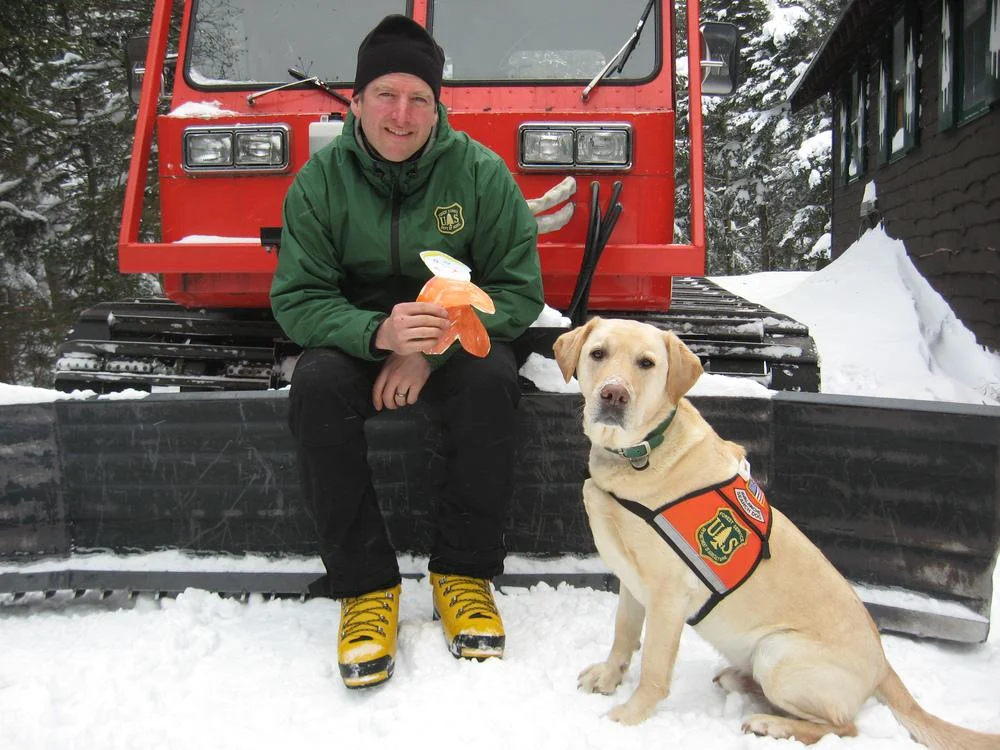
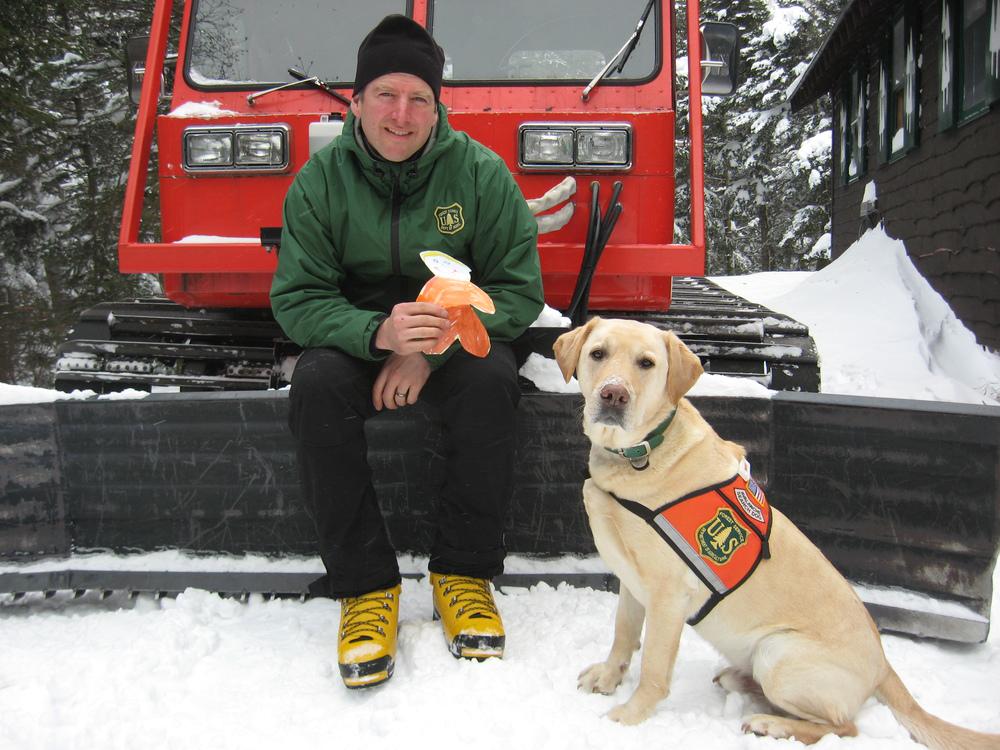
The Mount Washington Avalanche Center (MWAC) and the broader mountaineering community of the White Mountains are mourning the loss of a foundational figure in regional search and rescue operations. Cutler, a highly decorated avalanche rescue dog who served the White Mountain National Forest for over a decade, has passed away at the age of 14. With 11 years of active service, Cutler spent nearly 80% of his life dedicated to the safety of winter recreationists in some of the most dangerous terrain in the United States. His career was marked not only by his technical proficiency in scent detection and mountain navigation but also by his extraordinary role as a public ambassador for avalanche awareness.
As a central figure in the Mount Washington Snow Ranger program, Cutler worked alongside Director Chris Joosen, forming a partnership that became synonymous with the safety protocols of Tuckerman Ravine and Huntington Ravine. His passing marks the end of an era for the MWAC, an organization that has provided critical safety information and rescue services to the public since its formal inception under the United States Forest Service.
The Critical Role of the Mount Washington Avalanche Center
To understand the magnitude of Cutler’s service, one must consider the environment in which he operated. Mount Washington, the highest peak in the Northeastern United States at 6,288 feet, is world-renowned for its "worst weather in the world." The convergence of several major storm tracks, combined with the funneling effect of the surrounding topography, results in hurricane-force winds and extreme snowfall.
The Mount Washington Avalanche Center is the only Type 1 avalanche center in the U.S. Forest Service located east of the Mississippi River. Its primary mission is to issue daily avalanche bulletins and provide search and rescue (SAR) capabilities for the thousands of skiers, climbers, and hikers who visit the Presidential Range each winter. The steep, glacial cirques of Tuckerman Ravine are particularly high-traffic areas, often seeing hundreds of visitors on a single spring Saturday. In this high-consequence environment, the presence of a trained avalanche dog like Cutler is not a luxury but a vital component of the emergency response infrastructure.
The Science and Training of an Avalanche Rescue K9
Cutler’s 11-year career was built upon a foundation of rigorous training and biological capability. Avalanche rescue dogs are considered the most effective tools for locating buried subjects when traditional electronic beacons are not present or are malfunctioning. While human rescuers use collapsible probes to physically search through debris—a process that can take hours—a trained K9 can cover the same area in minutes.
The training process for a dog like Cutler involves scent-specific conditioning. Dogs are taught to distinguish the scent of human "pools" rising through the snowpack. This requires the animal to have immense physical stamina to navigate deep, unstable snow and the mental acuity to remain focused despite the distractions of high winds, machinery, and large crowds of onlookers. Throughout his career, Cutler maintained a level of proficiency that met the high standards of the Forest Service, ensuring that he was always mission-ready during the peak winter months.
A Chronology of Service: 2001–2015
Cutler’s life was defined by a steady progression from a trainee to a seasoned veteran of the White Mountains. While his specific rescue deployments are often kept confidential out of respect for the families involved, his presence was a constant at the Hermit Lake Courtyard and the base of the ravines.
- Early Years and Certification: Cutler began his training as a young dog, demonstrating the temperament and drive necessary for mountain work. His partnership with Chris Joosen was established early, ensuring a seamless bond between handler and K9.
- The Active Service Years: For 11 years, Cutler was a fixture of the winter season. His "commute" often involved traveling via snowcat or snowmobile into the heart of the White Mountain National Forest. He worked through some of the most severe winters on record, providing a layer of security for the Snow Rangers as they conducted snowpack analysis and triggered controlled avalanches.
- The Public Relations Era: As Cutler aged and became a familiar face to regular visitors, his role expanded. He became a bridge between the authoritative figure of the Snow Ranger and the general public. This "soft" power allowed the MWAC to disseminate safety information more effectively to a diverse audience.
- Retirement and Passing: After over a decade of service, Cutler transitioned into a well-earned retirement. His passing at age 14 reflects a long and full life for a working dog, especially one subjected to the physical rigors of alpine environments.
Public Education and the "Cutler Effect"
Beyond the technical aspects of search and rescue, Cutler’s greatest contribution may have been in the realm of public relations and education. Mount Washington attracts a wide range of visitors, from professional alpinists to ill-prepared tourists. Approaching visitors to discuss safety protocols, gear requirements, and avalanche forecasts can sometimes be met with resistance.
However, Cutler served as a natural icebreaker. Mount Washington Avalanche Center Director Chris Joosen noted that Cutler’s presence allowed the Snow Rangers to reach and educate many more people than they would have through traditional signage or verbal warnings alone. This "Cutler Effect" facilitated thousands of interactions where rangers could check if a hiker had a beacon, shovel, and probe, or explain the current avalanche rating (Low, Moderate, Considerable, High, or Extreme). By making the rangers more approachable, Cutler indirectly saved lives by preventing accidents before they occurred.
Data and Analysis: The Impact of Avalanche K9s
The importance of dogs like Cutler is underscored by national avalanche statistics. According to data from the American Avalanche Association and the Colorado Avalanche Information Center (CAIC), the "golden hour" for avalanche survival is incredibly short. A person buried in an avalanche has a 93% chance of survival if recovered within 15 minutes. That percentage drops to roughly 37% after 35 minutes.
In the rugged terrain of the White Mountains, where professional rescue teams may take time to mobilize and reach remote ravines, having a dog on-site or nearby is a critical factor in the speed of recovery. While modern technology like the RECCO system and digital transceivers have improved search times, the K9 remains the only "biological sensor" capable of finding individuals who are not wearing any electronic equipment.
During Cutler’s tenure, the MWAC saw a significant increase in winter usage. The rise of "backcountry" skiing as a mainstream sport has put more pressure on rescue resources. The longevity of Cutler’s service provided a level of institutional stability during a period of rapid growth in outdoor recreation.
Official Responses and Community Legacy
The announcement of Cutler’s passing was met with a significant outpouring of support from the local and national mountaineering communities. Chris Joosen, who shared both his professional and personal life with Cutler, released a tribute highlighting the dog’s work ethic and companionship. In a blog post and photo album dedicated to Cutler, Joosen described him as a partner who was always ready to go to work, regardless of the conditions in Tuckerman Ravine.
The Mount Washington Volunteer Ski Patrol and various search and rescue organizations across New England have also acknowledged the loss. Statements from the community emphasize that Cutler was more than just a working animal; he was a symbol of the dedication required to manage the risks of the White Mountains. For many regulars at "Tucks," seeing Cutler was a sign that the Snow Rangers were on duty and that the mountain was being watched over.
Broader Implications for the K9 Program
The legacy of Cutler also raises questions about the future of K9 programs within the U.S. Forest Service and other avalanche centers. The cost and time required to train a replacement for a dog of Cutler’s caliber are substantial. It takes years of daily training and thousands of dollars in certifications and veterinary care to produce a certified avalanche dog.
Cutler’s success has served as a proof-of-concept for the continued integration of K9s into the MWAC’s operations. His 11 years of service demonstrate that with proper handling and care, a rescue dog can provide a decade of high-level utility. The MWAC is expected to continue its K9 program, building on the protocols and public engagement strategies that were perfected during Cutler’s career.
Conclusion: A Lifetime of Service
Cutler’s passing marks the conclusion of a remarkable chapter in the history of the Mount Washington Avalanche Center. From the perspective of a journalistic analysis, his career represents a perfect intersection of technical rescue capability and effective public policy. By performing his duties with consistency and grace, he helped humanize the life-saving work of the U.S. Forest Service.
As the winter seasons continue to bring snow and wind to the Presidential Range, the impact of Cutler’s work will remain. The thousands of people he "educated" on the slopes of Mount Washington carry with them a greater understanding of mountain safety, a legacy that is difficult to quantify but impossible to ignore. Cutler was not just a dog; he was a dedicated public servant who spent his life ensuring that those who sought adventure in the White Mountains could return home safely.
